
Skopelos (town)
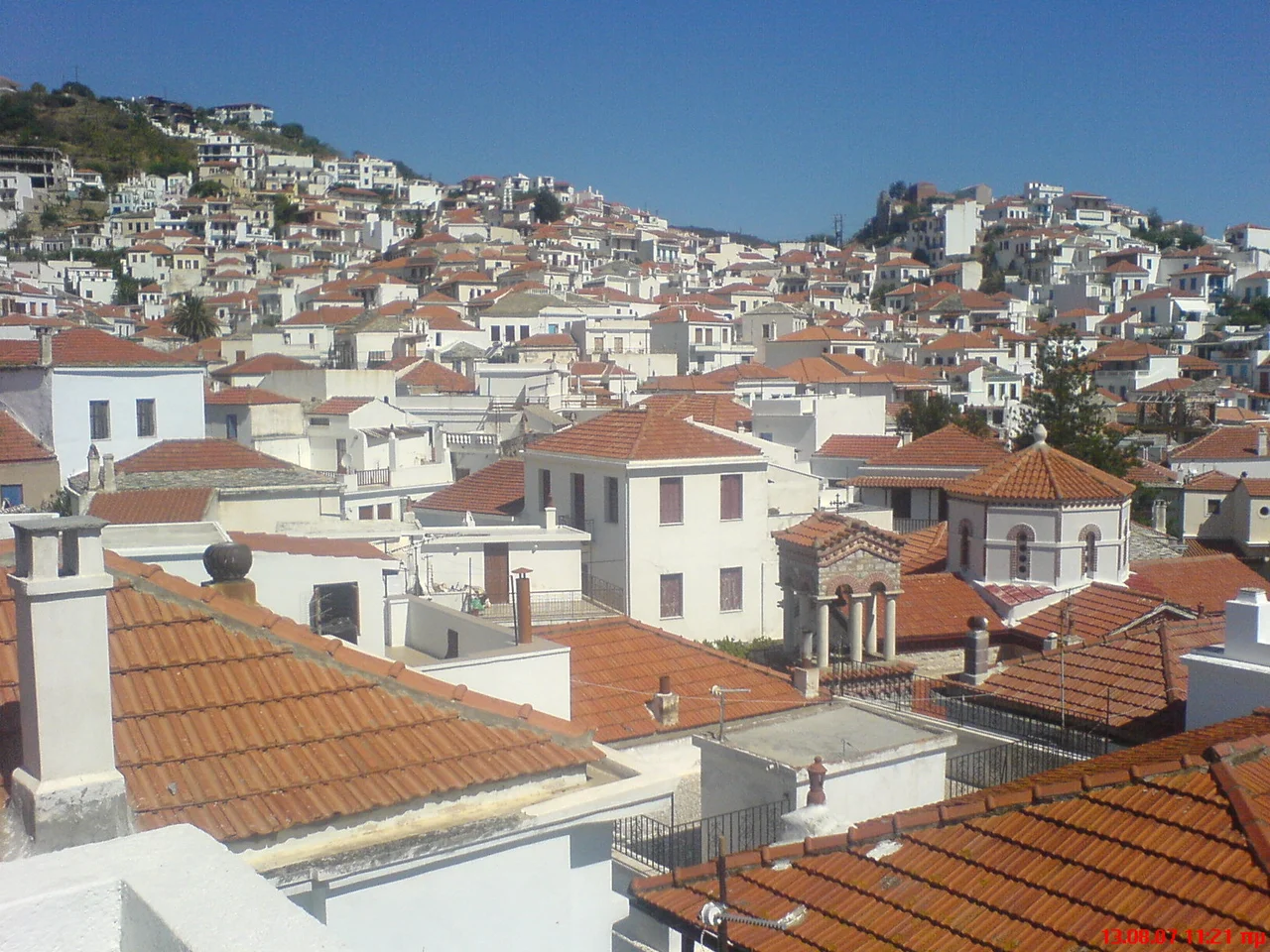
Skopelos town does not sit beside its harbor so much as rise out of it. The houses climb the slope above the bay in tier upon tier, an amphitheatre of white walls and gray slate roofs that bends around the water and pulls the eye upward, from the quay to the ruined Kastro at the summit. Sail in at dusk and the whole hillside seems to glow, a single curved wall of light. This is the Chora, the capital of the island, and beneath its lanes lies a city that was already ancient when Rome was young.
Peparethus, Member of the League
Long before it was Skopelos, this was Peparethus, an ancient city standing on the very ground the town occupies today. It was a member of the Delian League, the alliance Athens led across the Aegean in the fifth century BCE, and it appears in the Athenian tribute lists alongside the great names of the classical world. War found it more than once. An earthquake struck the city during the Peloponnesian War in 426 BCE. In 207 BCE, Philip V of Macedon installed a garrison to hold Peparethus against the advancing Romans, then deliberately destroyed it in 200 BCE rather than let it fall into their hands intact. The town that stands here now is built on those layers.
More Than Three Hundred Churches
Skopelos is studded with churches, more than 360 chapels and basilicas scattered across the island and packed into the town's twisting lanes. Most stay locked all year, opening only for the single feast day of whatever saint they honor, and the great majority were built privately, by families fulfilling vows or marking their dead. The oldest survivor is the basilica of Agios Athanasios, raised in the eleventh century within the Kastro, the castle quarter at the town's crown. The island's Christian story runs deeper still. It was formalized in the fourth century by Bishop Riginos, who was martyred under the emperor Julian the Apostate in 362 AD. His feast day on 25 February is a holiday across the island, the town pausing for the saint who first carried the faith here.
The Castle and the Climb
The Kastro crowns the town, the highest and oldest quarter, where the medieval castle once guarded the bay and where Agios Athanasios still stands. From there the settlement cascades down through a maze of stepped alleys too narrow for cars, past blue-painted doors and overflowing courtyards, to the waterfront below. The arrangement is not accidental but defensive, a town designed so that every level watched the sea. Walking it means climbing, and climbing slowly, because the lanes were laid for donkeys and feet, not engines.
A Town Worth Protecting
In 1978, Greece recognized what visitors had long felt. By presidential decree, signed by President Konstantinos Tsatsos, the town was declared a Traditional Settlement of Outstanding Beauty, the Greek equivalent of a protected site of architectural heritage. The rules that followed are strict and deliberate: no new building may rise above two stories, every roof must be sloped and laid in traditional ceramic or stone, and doors, windows and balconies must be made of wood. The decree is the reason Skopelos still looks like Skopelos, the reason the amphitheatre of white houses survived the tourism boom that reshaped so many Aegean ports.
Two Towns, One Island
The Chora is not the island's only face. Across the slopes, on the northwestern tip, sits Glossa, a quieter village of traditional houses perched above Loutraki harbor, more than 25 kilometers away by the island's single main road. Where the Chora is a theatre of stacked stone, Glossa is a tranquil balcony over the water. Both swell each summer. In winter the town holds a few thousand souls, many of them Northern Europeans who have retired to its slow pace, but in the high season the island's population can climb from around 5,000 to four times that, the asphalt parking lot built along the waterfront in the 1990s never quite enough. The crowds come, and then they leave, and the amphitheatre stays, climbing its hill above the bay as it has for three thousand years.
From the Air
Skopelos town (the Chora) sits on the northern coast of Skopelos island at roughly 39.12°N, 23.73°E, on a bay backed by a steep amphitheatrical hillside crowned by the Kastro. From the air, look for the dense white settlement curving around a north-facing harbor, distinct against the island's dark pine forest. There is no airport, only a small heliport; the nearest airport is Skiathos (LGSK), a short hop west across the Sporades. The exposed northern harbor can close during summer meltemi gales.
Nearby Stories
- Paleo Trikeri 12 km away
- John the Russian 24 km away
- Atalanti 28 km away
- Skyros 35 km away
- Tempi Train Crash 79 km away
- Great Sand Beach 91 km away
- Battle of Athos 96 km away
- Battle of Potidaea 98 km away