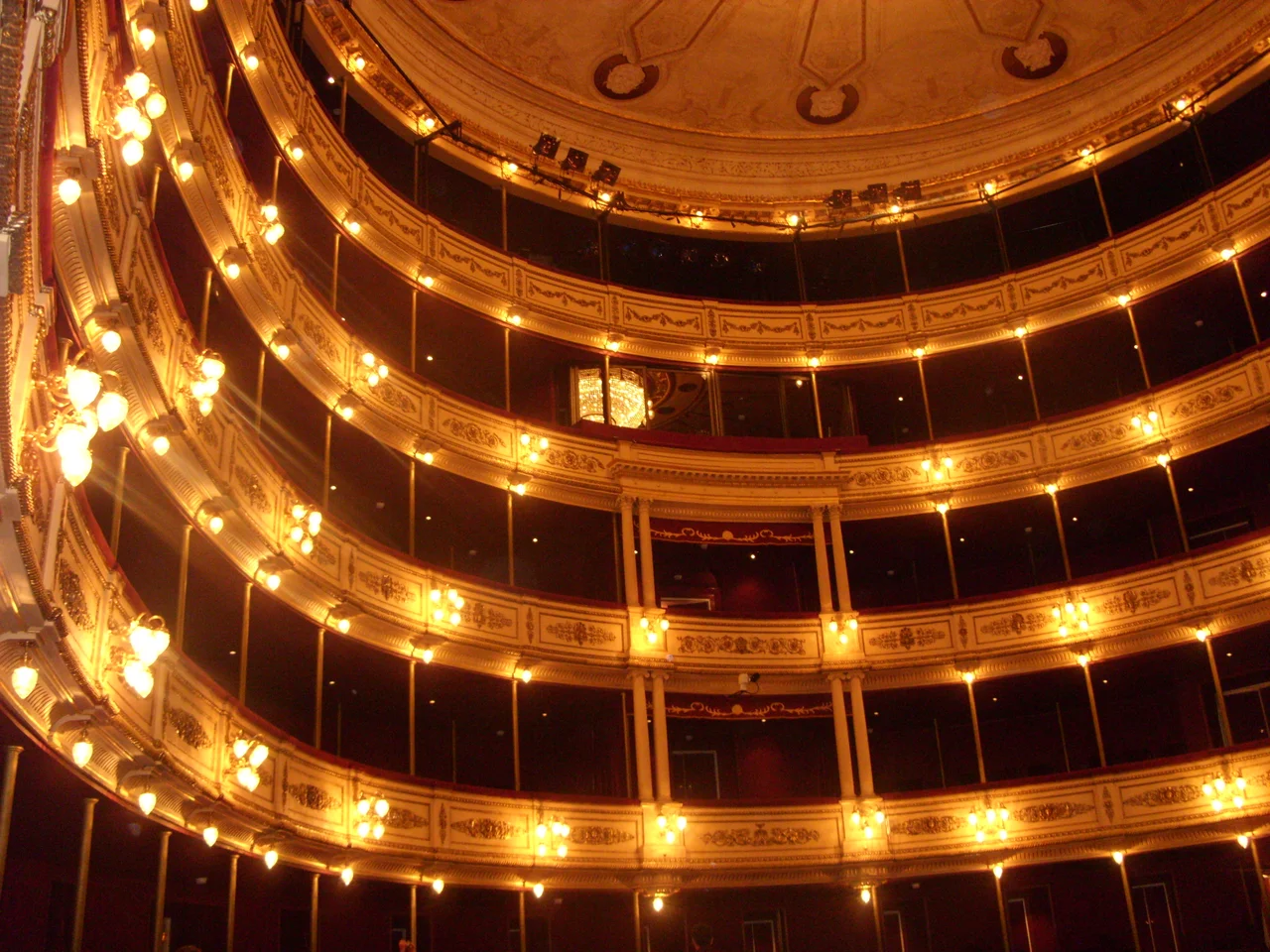

Solís Theatre
When the Solís Theatre opened its doors in 1856, Montevideo was barely more than a fortified town, and the land where the building rose had been city outskirts ringed by ravines, ditches, and sand dunes. The men who willed it into existence wanted something audacious: a grand opera house for a young nation, a place where the elite of the Eastern State of Uruguay could gather to see and be seen. Nearly 170 years later, the Solís still stands beside the Plaza Independencia, its Corinthian portico facing the heart of the capital - Uruguay's oldest major theater and the cultural soul of the city.
A Theater Born of Ambition
The idea took root in 1833, when a circle of influential citizens formed a committee to build Montevideo a proper theater. Their motives were not purely artistic. In the language of the era, a theater offered a worthy place to socialize, to flaunt social and political influence, to elevate one's standing through the kind of civic association that signaled wealth and refinement. By 1840 the government had granted approval, and a board of distinguished names took charge of construction. The theater they envisioned would be more than entertainment - it would be a statement that a small, struggling republic intended to take its place among cultured nations.
An Italian Dream in Stone
For the design, the project turned to the Italian architect Carlo Zucchi, who presented his plans in August 1840. The result is a study in European borrowing made distinctly Uruguayan. The facade echoes the Teatro Carlo Felice in Genoa. The auditorium, shaped in a slight ellipse and ringed with tiers of balconies, recalls the legendary La Scala in Milan, while the interior draws on the Teatro Metastasio near Florence. The theater was named for Juan Díaz de Solís, the explorer who sailed into the Río de la Plata in 1516. From its corner at Buenos Aires and Bartolomé Mitre streets, the building announces itself with a grand columned portico - confident, ornate, unmistakably operatic.
The First Uruguayan Opera
A theater earns its place through the work performed inside it, and the Solís holds a foundational moment in the nation's culture. On 14 September 1878, the stage premiered Tomás Giribaldi's La Parisina, regarded as the first Uruguayan national opera - the moment the country's own composers stepped onto the grand stage rather than merely importing the works of Europe. In the generations since, the Solís has launched the careers of Uruguayan actors, singers, and musicians, and drawn celebrated performers from around the world to its boards. It became the place where Uruguay measured itself against the great cultural capitals, and found it could hold its own.
Outskirts Turned Center
It is worth pausing on where the Solís was built, because the choice reveals an act of faith. When Carlo Zucchi laid out his plans, the chosen ground sat on the edge of the city - a parcel measured in blocks and bordered by ravines, ditches, sand dunes, and rough roads. To raise an opulent opera house there, on the literal margins of town, was a bet that the city would grow to embrace it. The bet paid off spectacularly. Montevideo expanded outward and folded the theater into its very heart, until the Solís came to stand beside the Plaza Independencia, the symbolic center of the nation. The outskirts became the core, and the gamble of 1856 looks today like foresight.
Saved and Reborn
By the late twentieth century, age had caught up with the old house. In 1998 the government of Montevideo launched a sweeping reconstruction, modernizing the building while preserving its historic character; even the acoustic studies were entrusted to specialists from the French firm Avel Acoustique. The work was completed in 2004, and that August the Solís reopened to a city that had missed it. The restoration secured the theater's future without erasing its past - the same elliptical hall, the same gilded balconies, now wrapped in twenty-first-century engineering. Today the Solís remains exactly what its founders intended in 1856: the proudest stage in Uruguay, anchoring the cultural life of the capital it has served for generations.
From the Air
The Solís Theatre stands at 34.908°S, 56.201°W, in Montevideo's Ciudad Vieja (Old Town), at the corner of Buenos Aires and Bartolomé Mitre streets, immediately beside the Plaza Independencia. From the air, look for the open square of the Plaza Independencia - one of the largest in the old city - with the theater on its western flank and the Río de la Plata waterfront a few blocks south. The dense historic grid of Ciudad Vieja and the nearby Port of Montevideo aid navigation. The nearest major airport is Carrasco International (ICAO: SUMU), about 19 km to the east along the coast; Ángel Adami Airport (SUAA) lies inland to the northwest. Best viewed at low altitude over the old city in clear daylight.
Nearby Stories
- Piriápolis 24 km away
- Minas 40 km away
- Tronador (rocket) 67 km away
- Nueva Helvecia 69 km away
- La Plata Museum 122 km away
- Battle of Sarandí 126 km away
- Mundo Marino 145 km away
- South Georgia Island 2584 km away