.jpg)
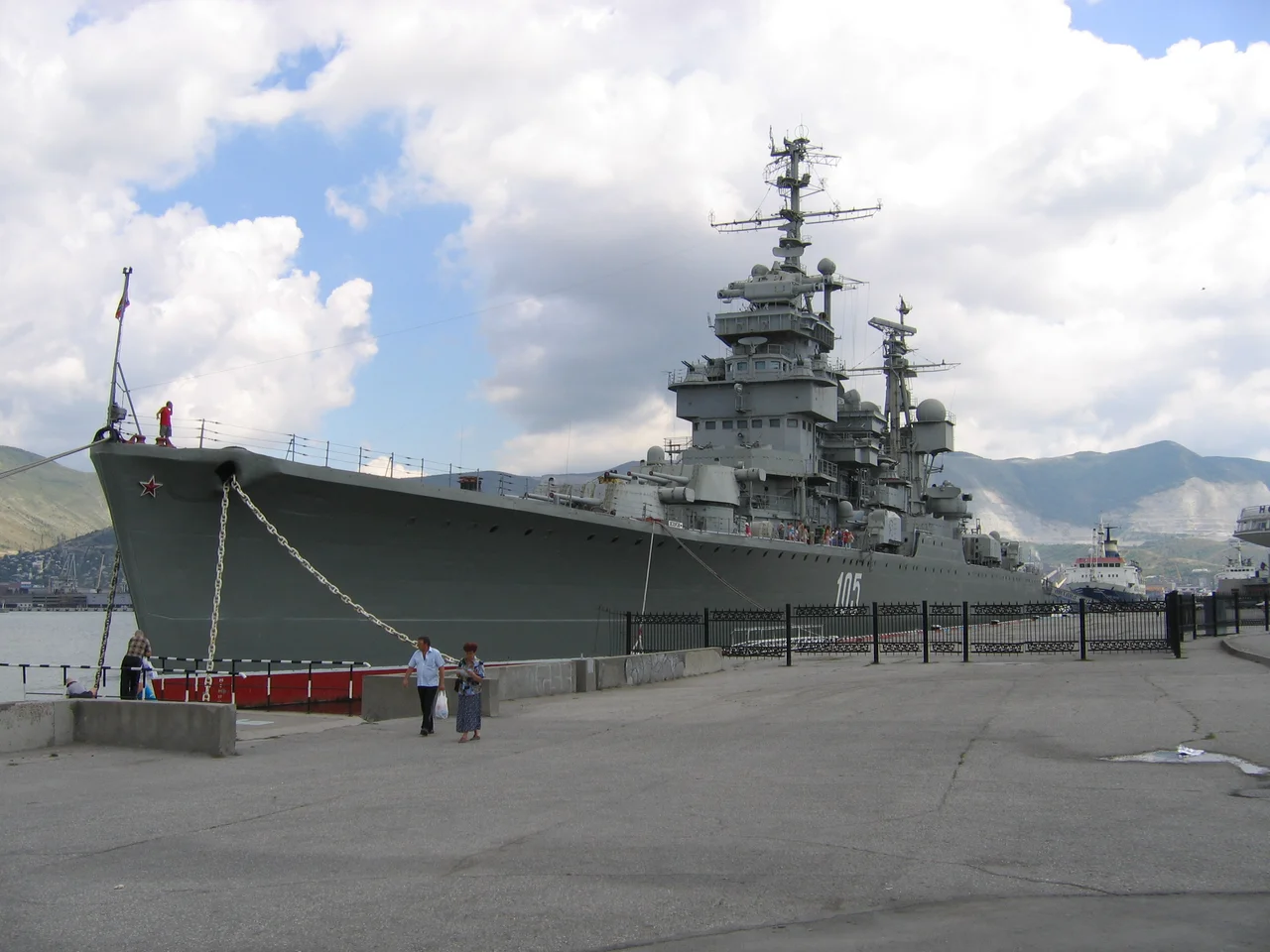
Soviet Cruiser Mikhail Kutuzov
The guns are the first thing you notice - twelve of them, in four great triple turrets, the last generation of an idea that was already dying when this ship was built. Mikhail Kutuzov was a Project 68bis cruiser, one of the final conventional gun cruisers the Soviet Navy ever laid down, born in the 1950s just as missiles were about to make her kind obsolete. Today she is moored in Novorossiysk on Russia's Black Sea coast, no longer a warship but a museum you can board and explore. To walk her decks is to step into the Cold War at sea, into a moment when a superpower still believed the future belonged to steel and shellfire.
The Last of a Breed
The Sverdlov-class cruisers - Project 68bis in Soviet designation - were the last conventional gun cruisers the Soviet Navy would ever build, and Mikhail Kutuzov was one of them. Their design reached back before the Second World War, blending Soviet, German, and Italian ideas, then refined them for the punishing swells of the North Atlantic where the Soviets meant these ships to fight at speed. The hull was more modern and better armored than most comparable cruisers other navies were fielding after the war, bristling with up-to-date radar and anti-aircraft artillery. The ambition was staggering: the Soviets initially planned to build forty of them, a whole fleet of gun cruisers. History had other plans - the missile age arrived, and the class was cut far short of that number. Mikhail Kutuzov became a survivor of a naval vision that the future overtook.
A Fortress That Floats
The numbers convey the sheer heft of her. She stretched 210 meters overall and displaced over 16,000 tons at full load, driven by six boilers and two shafts to a brisk 32.5 knots, with the range to cross 9,000 nautical miles. Her welded hull carried a double bottom along most of its length and twenty-three watertight bulkheads - a ship built to take punishment and keep floating. Roughly 1,250 sailors crewed her. Her main battery of twelve 152mm guns was backed by a dozen 100mm weapons and thirty-two 37mm anti-aircraft guns, with torpedo tubes besides. In 1986 she became the fourth and last of her class modernized to a newer standard, trading torpedo tubes and some of the old anti-aircraft mounts for rapid-fire AK-230 close-in weapon systems - a mid-life update for a Cold War veteran.
The General She Carries
The ship bears the name of Mikhail Kutuzov, the Russian field marshal who outlasted Napoleon in the campaign of 1812, wearing down the French invasion until it broke on the Russian winter. It is a fitting namesake for a warship built for a long standoff rather than a quick victory - Kutuzov was famous not for dramatic charges but for patience, endurance, and the willingness to trade ground for time. For nearly half a century the cruiser named for him served the Black Sea Fleet, a piece of national memory afloat, linking the naval Cold War to the older Russian story of survival against a mightier enemy. Some ships are named for places; this one was named for a way of winning.
From Warship to Museum
Retired from active duty, Mikhail Kutuzov found a second life at the quayside. On 28 July 2002 she opened to the public as a museum ship in Novorossiysk, and in 2012 she became a branch of the Central Naval Museum, formally enshrined as a piece of naval heritage. Visitors now climb where sailors once stood watch, peering into turrets and passageways, running their hands along a hull that was engineered for the North Atlantic and ended its days on the calm of Tsemes Bay. Few of the great gun cruisers of her era survive anywhere in the world. That this one endures - polished, preserved, and open - lets a whole vanished chapter of naval history be walked, touched, and understood by anyone who steps aboard.
From the Air
Mikhail Kutuzov is moored as a museum ship at Novorossiysk near 44.72°N, 37.78°E, on Tsemes Bay on the Black Sea. From altitude the enclosed bay, its mountain amphitheater, and the port waterfront where the long grey cruiser lies alongside make the spot easy to find. Nearest airports are Anapa (Vityazevo) Airport (ICAO URKA) to the northwest and Gelendzhik (URKG) to the southeast.
Nearby Stories
- Taman Peninsula 23 km away
- Battle of Kerch Strait (1790) 28 km away
- Temryuk 44 km away
- Soviet Hospital Ship Armenia 238 km away
- Battle of the Tanais River 241 km away
- Abkhazia 269 km away
- Beriev 277 km away
- Livadia Palace 290 km away