
Sphinx of Naxos
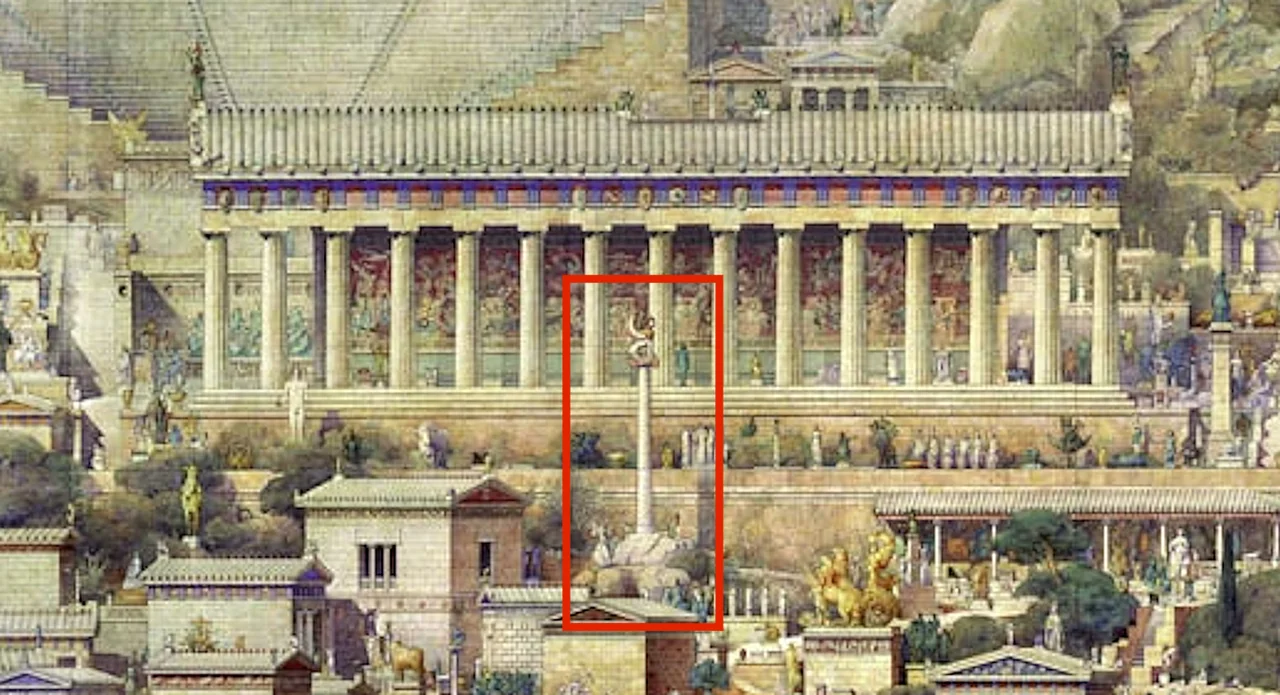
In 560 BC, the island of Naxos was rich — the richest of the Cyclades, in fact — and it wanted Delphi to know it. The Naxians commissioned a sphinx from their own marble: a figure with a woman's face wearing an enigmatic smile, the broad wings of a bird of prey turned upward, and the body of a lioness. They set this creature not on a plinth at ground level, where it might be overlooked among the treasury buildings and votive statues crowding the sanctuary, but on top of a soaring column — 10 metres of Ionic stonework, one of the earliest Ionic capitals ever erected at Delphi. The sphinx herself stood 2.22 metres tall. The whole assembly reached 12.45 metres into the Delphic sky, visible from almost anywhere in the sanctuary. It was placed close to the Halos, the most sacred spot of all, where Apollo was said to have killed the python. The message was not subtle: Naxos mattered. Naxos had Apollo's ear.
The Island's Gift
Naxian marble was famous throughout the ancient Greek world for its quality and whiteness, and the island's sculptors had developed a distinctive style in the 6th century BC — powerful, detailed, carved fully in the round rather than in relief. The Sphinx of Naxos is a prime example of this tradition at its peak. The statue is carved from a single large block of Naxian marble, and the craftsmanship is unusual for its time: the hair, the feathers of the wings, the musculature of the lioness body are all rendered with attention to surface texture and the illusion of life. Early Greek sculpture was moving away from flat, frontal forms toward figures that existed fully in three dimensions, and this sphinx embodies that transition.
The column beneath her was also innovative. Ionic capitals — the scrolled volutes that distinguish the Ionic order from the simpler Doric — were relatively new in the mid-6th century BC, and the Naxian column at Delphi may have been the oldest Ionic construction at the oracle site. The island was not just making an offering; it was demonstrating architectural ambition.
Guardians at the Gate
The Greeks understood the sphinx as a guardian — a creature of ferocious strength stationed at entrances and sacred thresholds to ward off the unworthy or the malevolent. A lion's body gave it power; a woman's face gave it enigma. The combination was read as dangerous intelligence, the kind that could pose a riddle and devour anyone who failed to answer it. Sphinxes appeared at temple entrances, at royal tombs, atop funerary steles. They marked the boundary between the profane world and something more demanding.
At Delphi, the boundary was especially charged. The sanctuary of Apollo was the navel of the world — the Greeks called it the omphalos — and the oracle within it could speak the future. Pilgrims came from across the Mediterranean to ask questions that kept them awake at night: will I win this war? Will my city survive? Should I found a colony here? Placing a sphinx above the Halos, beside the temple itself, was to put a guardian at the mouth of the most consequential place in the Greek world.
An Inscription Two Centuries Later
The Sphinx of Naxos was not a gift easily forgotten. Carved into its base is an inscription dated to 328–327 BC — more than two centuries after the statue was erected. The inscription renews the promanteia of the Naxians: their right to consult the oracle ahead of all other petitioners. Priority access to Apollo's oracle was among the most coveted privileges a city-state could hold, and the Naxians had apparently maintained theirs for generations. The inscription is a kind of receipt, confirming the deal: the sphinx was offered; the privilege was granted; here is the renewal.
By 328 BC, Naxos was no longer the dominant power it had been in 560 BC. Persian invasion, Athenian dominance, and the pressures of the 5th century had diminished it. But the privilege endured, renewed in stone beside the statue the island had given when it was still confident of its own greatness.
From Sacred Ground to Museum
The sphinx stood at Delphi for centuries until the sanctuary fell into disuse and its monuments were buried under centuries of debris and landslide. The first fragments were excavated in 1860; the rest came to light in 1893. Reassembled and placed in the Archaeological Museum of Delphi, where it is now one of the collection's most striking objects, the sphinx has lost the height that made it extraordinary — separated from its column, it is simply a fine marble sculpture. The original effect, a winged creature perched 12 metres above the sanctuary floor looking over the entire sacred precinct with that enigmatic smile, can only be imagined.
Similar columns topped with sphinxes existed elsewhere in ancient Greece — in Sparta, Athens, and Spata among others — but the Naxian example at Delphi, given the site and the scale and the ambition behind it, remains the most celebrated. It stands in the museum now, eye level, approachable. At Delphi in 560 BC, it was anything but.
From the Air
The Sphinx of Naxos originally stood at the sanctuary of Apollo at Delphi, at approximately 38.48°N, 22.50°E on the lower slopes of Mount Parnassus in Phocis. The sanctuary is now visible from altitude as a terrace complex on the steep south-facing flank of the mountain, with the Pleistos valley and the Gulf of Corinth spread out to the south. The Archaeological Museum of Delphi, where the sphinx is now housed, is immediately adjacent to the archaeological site. Recommended approach altitude: 3,000–5,000 ft to see the full sanctuary and valley context. Nearest major airports: LGRX (Araxos, ~80 km south across the Corinthian Gulf) and LGAV (Athens Eleftherios Venizelos, ~150 km east). Excellent visibility typical in summer months; the pale limestone of the Phaedriades cliffs above Delphi is a distinctive navigation marker.
Nearby Stories
- Battle of Leontion 2.8 km away
- Siege of Livadeia 3.1 km away
- Pyre of Heracles 8.2 km away
- Corinth Rail Disaster 8.8 km away
- Rio–Antirrio Bridge 9.9 km away
- Heraion of Perachora 13 km away
- Prousou Monastery 15 km away
- Free and Real 30 km away