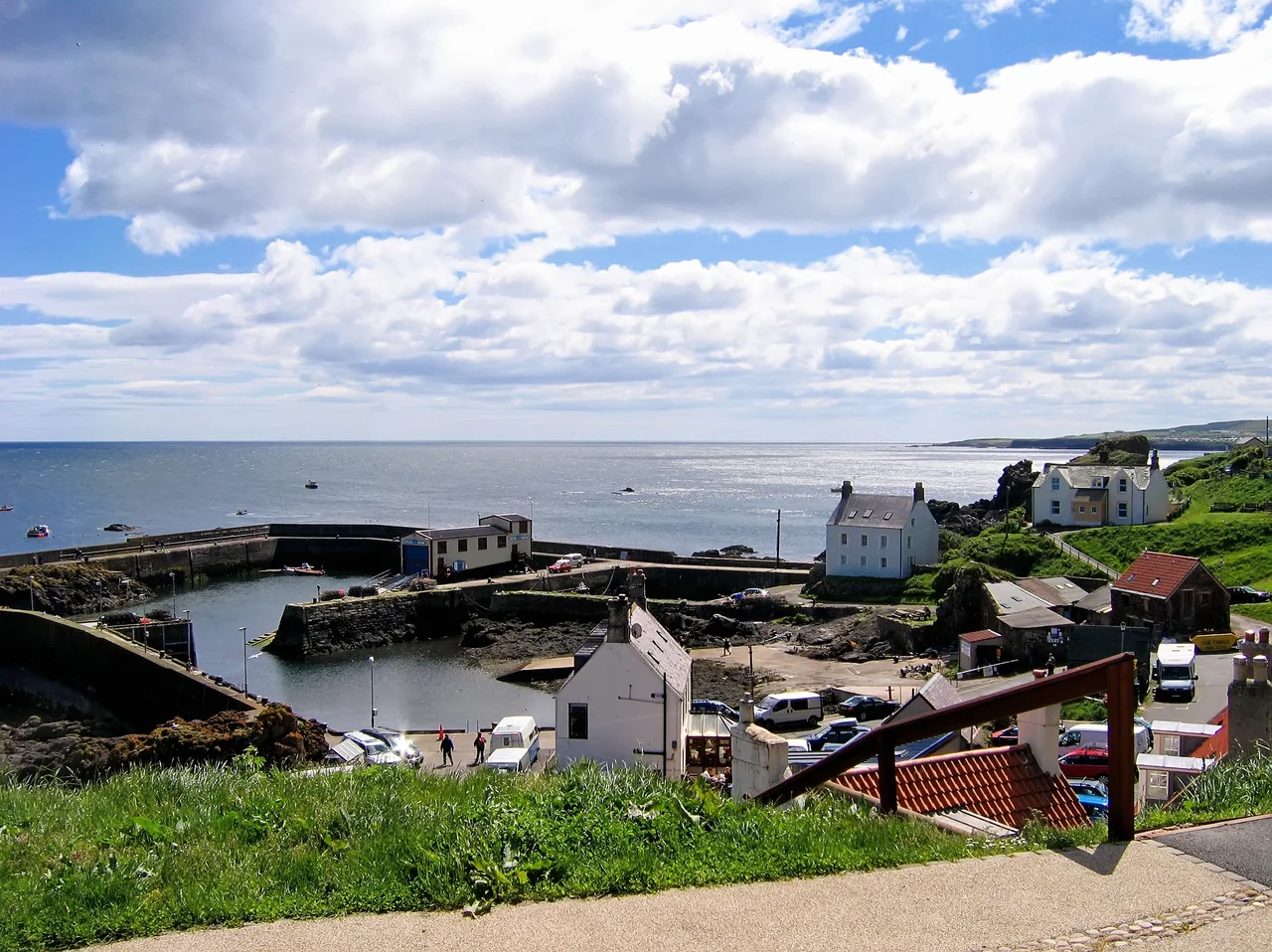

St Abbs
Signs around the village declare it twinned with New Asgard. Another set claim a partnership with Eroda, a fictional island that exists only in a Harry Styles music video. Both are jokes that the village leans into, but they say something true about St Abbs: this fishing village on the Berwickshire coast, only a few rows of cottages wrapped around a small harbour, somehow keeps attracting outsized attention. The clear water draws scuba divers from across Britain. The dramatic cliffs drew filmmakers looking for somewhere that could pass for a Norse god's seaside retreat. And one September morning in 1914, the headland overlooking the village watched the German U-21 sink HMS Pathfinder offshore in the first sinking of a warship by a self-propelled torpedo fired from an enemy submarine.
From Coldingham Shore to St Abbs
Until the 1890s the place was called Coldingham Shore. The fishermen who worked the small beach below the cliffs lived a mile and a half up the path in the inland village of Coldingham, carrying their nets and creels down to the boats each day on what the locals still call the Creel Path. A creel, in this corner of Scotland, is a lobster pot. The first cottage went up in the middle of the 18th century, then a row of five more built in the traditional Scottish style with central fires and chimneys wide enough to wash the smoke up through walls of clat and clay, a framework of wood interlaced with straw and daubed with moist clay. By 1832, sixteen families lived on the Shore and made their living from the sea. Fourteen boats sailed each year for the herring grounds north of here. Then in the 1890s came Andrew Usher, the Edinburgh whisky tycoon who bought the Northfield estate above the village, renamed the place, and began the modernisation that would give it harbour improvements, a village hall in 1897, and eventually a lifeboat.
The Saint on the Headland
The new name came from the high rocky promontory just north of the village. St Abb's Head was itself named after Aebbe of Coldingham, a 7th-century Northumbrian princess who founded a double monastery for monks and nuns nearby and was honoured as a saint after her death. The headland that bears her name is now a national nature reserve, its sea cliffs noisy with thousands of breeding seabirds each summer: guillemots, razorbills, kittiwakes, fulmars, shags. From the village you can walk the coast path out to the headland in less than an hour. The path climbs through gorse and thrift and ends at a lighthouse perched above some of the highest sea cliffs on the east coast of Scotland.
Beneath the Surface
The sea around St Abbs is unusually clear. Cold North Sea water meets a coastline largely free of the silt-laden estuaries that cloud the water further north and south, and the result is visibility good enough that Britain's first Voluntary Marine Reserve was established here on 18 August 1984 by the broadcaster David Bellamy. Divers can shore-enter from the rocks outside the harbour wall and reach about 15 metres of depth, making it a common training site for first sea dives. Cathedral Rock, with its dramatic double archway, sits just 50 metres from the shore. Small rocky islets like Big Green Carr, Broad Craig, and Little Carr lie close enough to circumnavigate underwater on a single tank. For a working village of fewer than a hundred residents, the marine traffic on a summer weekend can be remarkable.
Lifeboat and Tunnock
The lifeboat station was first established in 1911, after the wreck of the SS Alfred Erlandsen made the case impossible to ignore. For more than a century the RNLI ran it, until the institution withdrew its lifeboat in 2015. The village refused to let the station close. A local fundraising campaign rallied public donations and won a substantial gift from Tunnock's, the Lanarkshire bakery famous for its caramel wafers and teacakes. On 17 September 2016 the new lifeboat slid down the slipway to be christened Thomas Tunnock, and the station was operational again. The visitor centre that opened in 2011 is housed in Usher's original village hall. There is something fitting about a building paid for by a whisky tycoon now being run by volunteers who fundraised a lifeboat with the help of a biscuit maker.
New Asgard
In 2018, Marvel Studios brought film crews to St Abbs to shoot scenes for Avengers: Endgame. In the film, the village stands in for New Asgard, the refuge where the surviving Asgardian refugees, led by Thor, settle on Earth after the destruction of their world. The crew filmed on the harbour wall and along the coast path. The village, which has weathered the herring trade, the U-boat war, the slow decline of fishing, and the loss and recovery of its lifeboat, took the Marvel attention with characteristic deadpan. Soon after the film's release, signs appeared declaring the official twinning with New Asgard. A second set followed for Eroda, the fictional island Harry Styles invented for his Adore You music video, also filmed nearby. The signs are not entirely a joke. For a village whose original name change was driven by a Victorian businessman's branding instinct, embracing twentieth-century fame from a Norse-god superhero movie is just the latest chapter in St Abbs' long history of being more interesting than its size suggests.
From the Air
St Abbs sits at 55.90 N, 2.13 W on the Berwickshire coast, with St Abb's Head rising as a prominent rocky headland just to the north. The lighthouse at the head is visible for many miles offshore. Edinburgh (EGPH) lies about 35 nm to the west-northwest; Newcastle (EGNT) about 55 nm south-southeast. The Bass Rock, Berwick-upon-Tweed, and the Cheviot Hills are all visible on a clear day. Sea cliffs of around 90 metres provide a stark visual marker. Local fog from the haar is common in summer.
Nearby Stories
- Battle of Philiphaugh 4.7 km away
- College Valley 6.7 km away
- HMS Pathfinder (1904) 8.8 km away
- Embleton, Northumberland 9.6 km away
- Crichton Castle 12 km away
- Longstone Lighthouse 21 km away
- Ravenscraig Castle 21 km away
- German submarine U-58 (1938) 240 km away