,_Cymru_(Wales)_03.jpg)
St Cadwaladr's Church
Around AD 615 the kings of Gwynedd established a royal monastery on a slight rise above the south coast of Anglesey. The man whose name the church carries was not yet born. Cadwaladr ap Cadwallon - 'Cadwaladr the Blessed' - was the grandson of Cadfan ap Iago, the king buried beneath one of the oldest inscribed stones in Wales. Cadwaladr would in time become a king himself, retreat to this monastery as a monk, and die in Rome of plague in 664. His body, by tradition, was brought back to Anglesey and laid to rest at the foundation his grandfather had patronised. The church was renamed in his honour. Welsh tradition, more romantically, remembered him as the last king of all the Britons - the final ruler before Saxon dominance reshaped the island for good.
The Catamanus Stone
What survives most powerfully from the earliest church is a stone. Cadfan ap Iago - Cadwaladr's grandfather - died around 625 and was buried here. His tombstone, inscribed in Latin, calls him CATAMANUS REX SAPIENTISIMUS OPINATISIMUS OMNIUM REGUM, 'Cadfan the king, wisest and most renowned of all kings'. The stone is still in the present church, easily one of the most extraordinary Welsh inscriptions to survive from the 7th century. It is the kind of monument that demands you stand still in front of it. Welsh kingship in the period after Rome left Britain is mostly a matter of names and fragments and contested chronologies. This stone is one of the few moments where the documentary record stands up and looks back at you.
Building Over the Centuries
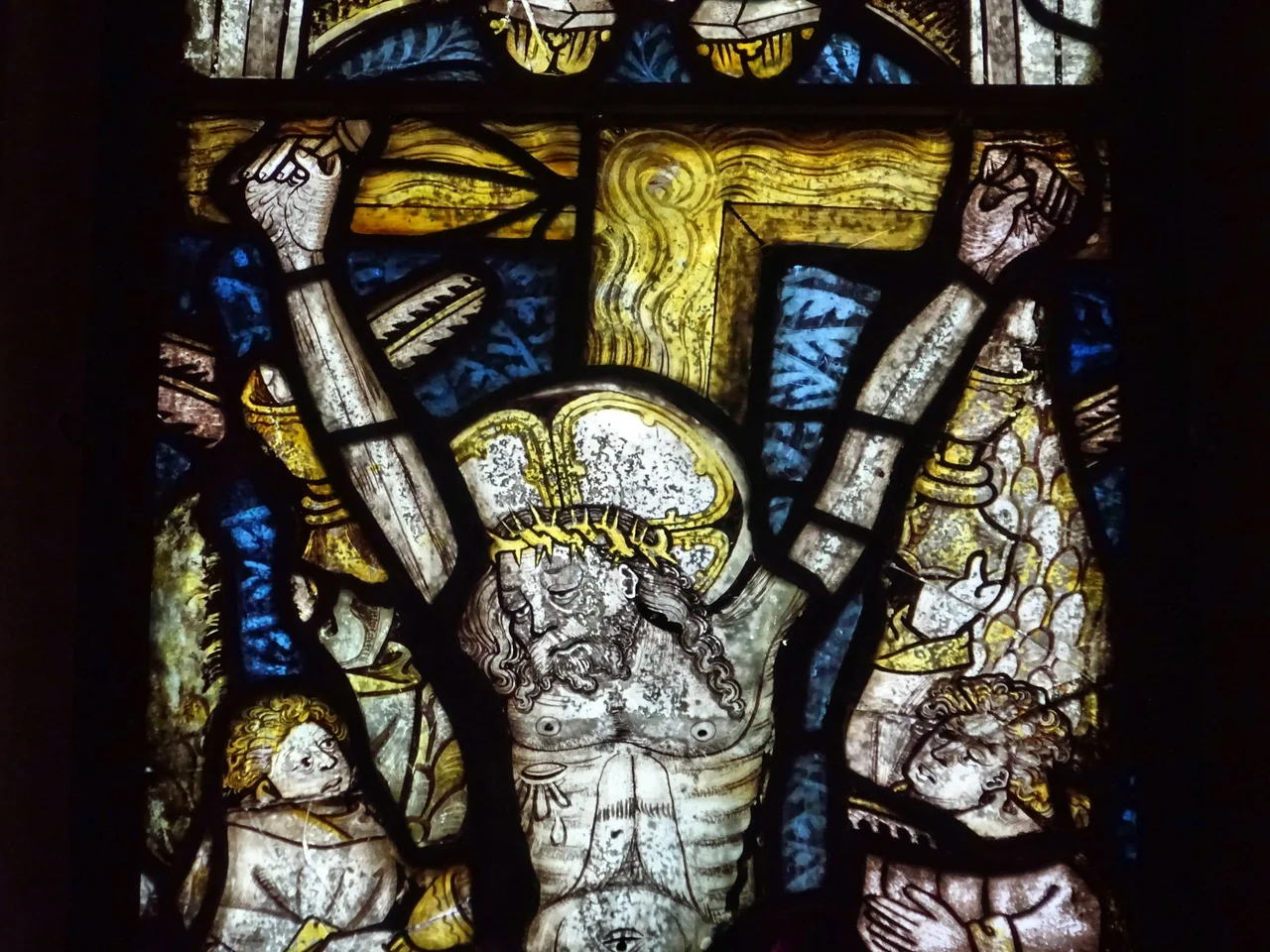
The current structure tells the standard story of a Welsh parish church that mattered to wealthy patrons. The nave is 12th- or early 13th-century work. The chancel was added in the 14th. A stained glass window installed in 1485, restored in 1850, still glows in the chancel east window with the Crucifixion - one of the finest pieces of Tudor-period glass surviving in any Anglesey church. The window shows Owen ap Meurig praying with his wife Ellen, accompanied by a man in armour carrying the crest of Llywarch ap Bran. The north chapel - the Meyrick chapel - was developed in 1640 by Richard Owen Meyrick and rebuilt in 1801 by Owen Putland Meyrick. The south chapel, the Bodowen Chapel of the Owen family, was built in 1661. The south porch followed in 1856. By that date the church had reached the shape it holds today: T-shaped, perpendicular, accreted from a millennium of patrons who wanted to be buried close to the king-saint they had inherited.
Meyricks and Memorials
The Meyrick family of Bodorgan Hall - the same estate that would host the wartime RAF Bodorgan airfield nearly three centuries later - are written into the fabric of this church. Their chapel records their construction in plaques. A vault beneath one plaque holds Richard's great-grandson Owen Meyrick, who died in 1730. Owen Putland Meyrick (d. 1825) is recorded as the rebuilder of the chapel in 1801. The south chapel commemorates the Owen family of Bodowen. A marble memorial in the Meyrick chapel remembers the children of Augustus Elliot Fuller - the F and M monograms in the window stand for Fuller and Meyrick, the two families that joined when an heiress married out. These are the slow accumulations of a parish church functioning across centuries as the place a family came to mark its dead.
Bro Cadwaladr
The church is Grade I listed and remains in active use today as part of the Bro Cadwaladr benefice, sharing a priest with seven other churches in the local area. It still works as a place of worship - which is, in some ways, the most remarkable thing about it. A foundation made in the 7th century, holding a 7th-century inscribed tombstone of a Welsh king, a 15th-century stained glass window of national importance, 17th-century private chapels of major Welsh families, and a congregation that still gathers under all of it on Sundays. There are older churches in Britain. There are not many that have stayed so continuously embedded in the same landscape, with the same purpose, attended by the descendants of the same families.
From the Air
St Cadwaladr's Church lies at 53.196N, 4.421W in the village of Llangadwaladr on south-central Anglesey, about 1.5 nm north of the coast at Aberffraw Bay. The site is 4 nm southwest of RAF Mona (EGOQ) and 6 nm southeast of RAF Valley (EGOV). From the air, look for the small village clustered around the modest church with its T-shaped plan, set in farmland between Bodorgan and Aberffraw. The wartime RAF Bodorgan site is 1 nm to the southwest. Caernarfon Airport (EGCK) is 11 nm to the southeast across Caernarfon Bay.
Nearby Stories
- Wakestock 1.7 km away
- Trefriw 3.8 km away
- Irish Sea 8.7 km away
- Irish Sea Bridge 20 km away
- East–West Interconnector 30 km away
- Machynlleth 36 km away
- HMS Tyler 41 km away
- New Brighton Lifeboat Station 54 km away