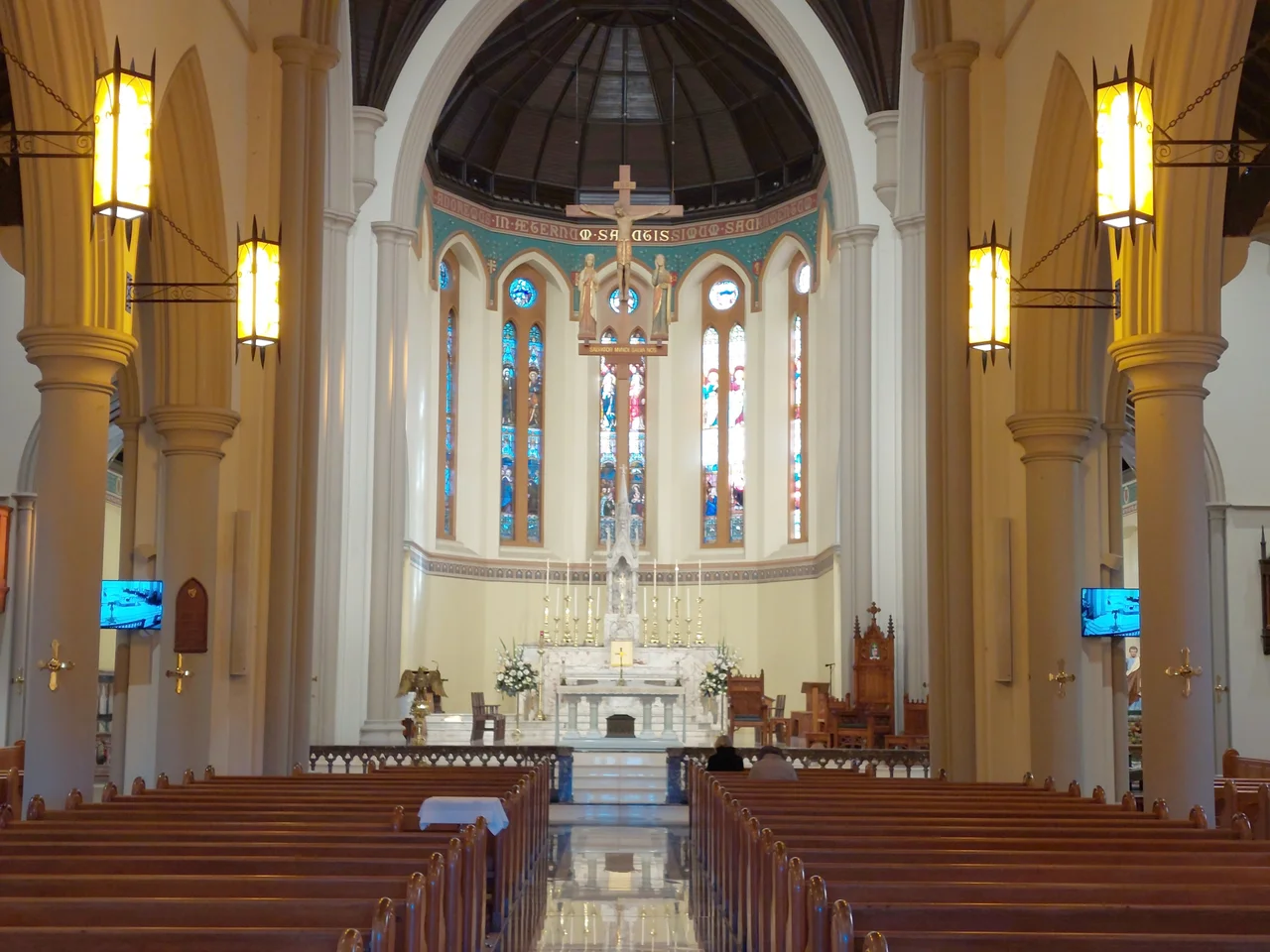

St Carthage's Cathedral
When Jeremiah Doyle was made bishop of a brand-new diocese in 1887, he chose to live in Lismore - then a small, insignificant outpost that not even the diocese was named after. Most men in his position would have stayed put in the established town of Grafton. Doyle instead set out to build a cathedral in the mud-and-cedar river settlement he had picked, and to bend Rome itself to his choice. The Gothic Revival landmark that now rises on a Lismore hill, St Carthage's Cathedral, is the monument to that stubbornness - a building raised quite literally one brick at a time, as fast as one man could collect the money to pay for them.
A Bishop's Obsession
Doyle laid the foundation stone in 1892 and needed forty thousand pounds to finish the job - a fortune for a frontier diocese. Then the times turned against him. The economic depression of the 1890s and the Australian banking crisis of 1893 shuttered banks and froze the project for years. Work resumed in 1904, only for a fire in 1905 to destroy the neighbouring convent and school and set everything back again. Doyle simply refused to stop. He borrowed money, with the Presentation Sisters standing as his guarantors, and travelled his diocese five days a week, collecting donations and selling whatever he could to feed the building fund. The cathedral went up as the cash trickled in, course by course, until it was largely complete and dedicated in 1907 by Cardinal Francis Moran.
The Wardell Lineage
To design his cathedral, Doyle commissioned Herbert Wardell, son of William Wilkinson Wardell, one of the great architects of Catholic Australia. The elder Wardell had shaped St Patrick's Cathedral in Melbourne and the rebuilt St Mary's in Sydney, and the son carried that Gothic Revival vocabulary north to Lismore. The result is a pointed-arch, soaring-clerestory church that would not look out of place in a European cathedral city, transplanted to a subtropical river town. The original drawings included a great spire that was never built - the tower rises only to its base - so the cathedral wears a kind of dignified incompleteness, a reminder that ambition and budget rarely finish in step.
Bells from the Old Country
In 1908 Doyle sailed to his native Ireland and ordered twelve bells from a Dublin foundry, a personal gift to the diocese. He never heard them ring. After returning to Australia he died suddenly of a brain haemorrhage at his Lismore home in June 1909, and was buried in the cathedral he had willed into being. The bells arrived after his death to find no tower to hang in, and sat waiting on the docks. Over the next two years the bell tower was finished and the bells installed by public subscription, consecrated in 1911 - the largest of them weighing more than two tonnes. A successor noted that the community had raised slightly more than the work cost, leaving a small surplus to beautify the grounds. Doyle's bells finally rang out over the city he had chosen against all advice.
A Name from Two Lismores
The cathedral's name carries a small geographical riddle. St Carthage's was named after the cathedral of the same name in Lismore, County Waterford, in Ireland - yet the Australian Lismore was not named after that Irish city at all. The town took its name instead from the tiny island of Lismore in the Inner Hebrides of Scotland. So the building honours an Irish saint and an Irish cathedral while standing in a city named for a Scottish island, a tidy knot of the migrant geography that settled this corner of New South Wales. Later bishops added their own touches: a pipe organ in 1912, an Australian-marble altar in 1919, and a mosaic shrine to St Patrick in 1937.
Above the Flood
St Carthage's sits on a hill, which is usually what saves a building in Lismore. In the catastrophic flood of February 2022, when the Wilsons River reached its highest level on record, even the hill was not enough. Water entered the cathedral, lifting and shifting its heavy timber pews, though the sanctuary itself was spared. A second major flood weeks later, and the slow grind of cleanup that followed, kept the cathedral closed for months. It is a fitting modern chapter for a building defined by perseverance. The bishop who raised it brick by brick through depression, fire and his own death would likely have recognised the response of the parish that scrubbed out the mud and reopened the doors - the same refusal to be beaten that put the stones there in the first place.
From the Air
St Carthage's Cathedral stands at roughly 28.80 degrees south, 153.28 degrees east, on a rise on the northern edge of central Lismore in the Northern Rivers region of New South Wales. From the air, its Gothic Revival form and square bell tower (built only to the base of an unrealised spire) mark it out against the surrounding floodplain and the brown thread of the Wilsons River winding through the city. The nearest airfield is Lismore Airport (YLIS), about 4 km to the south; the nearest commercial airport is Ballina Byron Gateway Airport (YBNA), roughly 45 minutes by road to the southeast, with Gold Coast Airport (YBCG) about 90 minutes north. Best viewed in clear conditions; river fog is common over the floodplain after rain.
Nearby Stories
- Uki, New South Wales 14 km away
- History of New Italy, New South Wales 23 km away
- Spicers Gap Road 67 km away
- Washpool National Park 70 km away
- Bald Rock National Park 87 km away
- HMS Porpoise (1799) 712 km away
- Wreck Reefs 742 km away
- SS Elingamite: Gold, Fog, and a Captain Wrongly Blamed 1801 km away