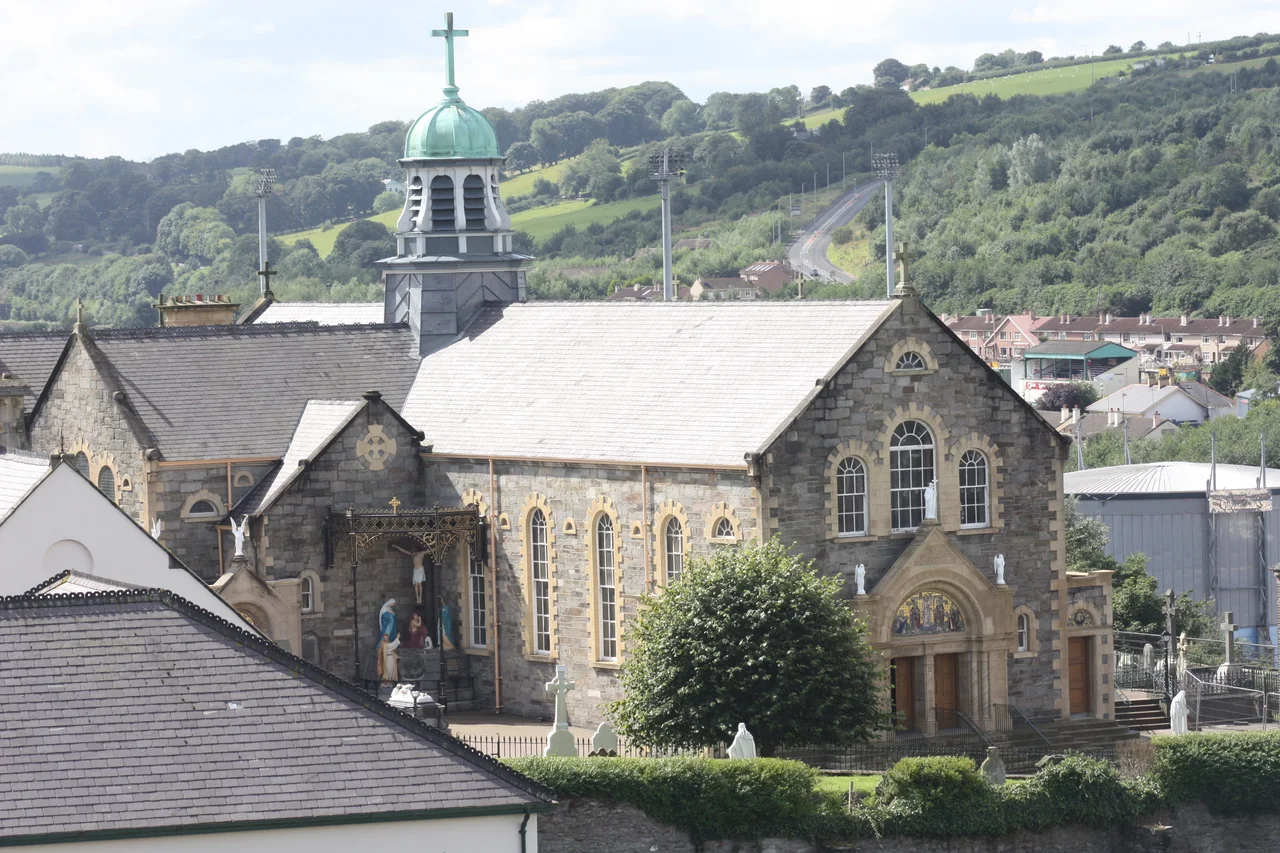

St Columba's Church, Long Tower
Father John Lynch needed money to build a Catholic church in Derry. It was the 1780s, the Penal Laws restricting Catholic worship were finally being eased, and the city had not had a serious Catholic place of worship since the Reformation more than two centuries earlier. So Lynch went door to door. The interesting part is who answered. He raised the funds for the Long Tower Church partly from Derry's Catholics, but also - in significant amounts - from the city's Protestants. The church opened in 1788, an unusually ecumenical birth for a building that would later host the funeral of one of Ireland's most controversial republican leaders.
On Older Ground
The site itself is older than the modern church. Catholic worship is recorded here as far back as the twelfth century, on land associated with St Columba - the sixth-century Irish saint who founded the monastery from which Derry takes its name. The 1788 building was much smaller than the church visitors see today. The major expansion came in 1810: gallery seating, a proper nave, and a marble High Altar repositioned to the northern side of the church. The Altar was first supported by wooden pillars, which proved too weak to hold the marble; the pillars themselves had to be remade in marble. From 1810 the basic layout has barely changed, even through the major refurbishment of 1908-1909 that added stained glass windows, statues, a baptismal font, and a new sacristy. When Vatican II in the 1960s prompted many Catholic churches to strip out their altar rails, High Altars, and confessional boxes, the Long Tower parishioners simply declined. They installed a modest temporary wooden altar in 1964 to allow Mass facing the people, replaced it with a more permanent marble one in 1979, and kept everything else.
The Cemetery on the Slope
On the morning of 8 January 1934 the perimeter wall of the Long Tower cemetery, the one facing Lecky Road, gave way. A section of the graveyard slid down the hill. No passers-by were hurt - and the timing, in a busy commercial street, was extraordinarily lucky - but graves were dislodged and bodies were strewn among the debris. The collapse made local newspapers across Ireland. Lecky Road has been remodelled since, with a flyover added decades later, but from the flyover the section where the graveyard came down is still visible. The Long Tower sits on a slope above the Bogside, the same slope on which Free Derry stood thirty-five years later, and the geography that gave the church its dramatic site also gave it that one terrible morning in 1934.
Opus Sectile
Behind the High Altar are three grand panels installed in 1909 - the Ascension of Christ flanked by St Peter and St Paul. They are made of opus sectile, a technique with a Latin name dating to ancient Rome: opalescent painted glass tiles, originally used on luxury floors. Most opus sectile is set in grout, and the inner walls of the Long Tower carry many such pieces. But the three panels behind the altar are set in lead, which experts say is extremely rare. By 2008 the lead frames had become dangerous; the panels were taken down on 17 November and transported to Belfast for restoration at a cost of about £20,000. They were re-installed in February 2009 and unveiled at a special mass on 9 March 2009, just in time for the church's centenary on St Columba's Day, 9 June 2009 - one hundred years from the original consecration after the 1908-09 work. The Long Tower marked its centenary by setting aside the 9th of every month for renovations to other parts of the building, including the repair of a memorial to Bishop Raymond O'Gallagher, who was martyred in Claudy, County Londonderry, in 1601.
The Funeral of Martin McGuinness
On 23 March 2017, the Long Tower hosted the Requiem Mass for Martin McGuinness. He had died two days earlier, aged 66, of a rare heart condition. He had been Deputy First Minister of Northern Ireland for ten years - the Provisional IRA commander turned Sinn Fein deputy leader who shared power with Ian Paisley's unionists and shook hands with Queen Elizabeth II. His political life had been more contradictory than most. The Long Tower was his parish church. The Mass was celebrated by Father Michael Canny, with the Bishop of Derry Donal McKeown in attendance. In the pews were former US President Bill Clinton, who had brokered key moments of the Northern Ireland peace process; Irish President Michael D. Higgins; the Irish Taoiseach Enda Kenny; Northern Ireland's First Minister Arlene Foster, whose Democratic Unionist Party had been McGuinness's coalition partner; Mary McAleese; representatives of the Catholic, Presbyterian, and Methodist churches; and members of every Irish and Northern Irish political party. McGuinness was buried that afternoon in the republican plot of Derry's City Cemetery. The church that had begun with Protestant donations in 1788 had become the place where a former IRA commander was farewelled by the British and Irish establishment together.
From the Air
St Columba's Church, Long Tower, stands on Long Tower Street in the Bogside area of Derry at 54.993 N, 7.328 W, just outside the western city walls. The nearest airport is City of Derry Airport (EGAE), six miles north on Lough Foyle; Belfast International (EGAA) is sixty miles east-southeast. From altitude, look for the church spire immediately west of the walled city, set in the dense Victorian housing of the Bogside neighbourhood.
Nearby Stories
- Portrush Lifeboat Station 1.9 km away
- Main Street, Letterkenny 2.1 km away
- Inishowen 6 km away
- Rosguill 6.3 km away
- County Tyrone 7.1 km away
- St Patrick's College, Maghera 9.6 km away
- St Patrick's Purgatory 11 km away
- Coalisland Canal 17 km away