
St Conan's Kirk
Walter Douglas Campbell was not a trained architect. He was a wealthy younger brother, an aesthete with time on his hands and a mother who needed somewhere convenient to attend church. So he designed a kirk himself. He started in 1881 and could not stop. For more than thirty years he kept adding cloisters, chapels, carved owls and dolphin chairs, hare-shaped downspouts, and an arch carried on unsmoothed granite boulders he had hauled down from Ben Cruachan. By the time he died in 1914 the building was still unfinished. His sister Helen carried on. The kirk above Loch Awe was finally consecrated in 1930, sixteen years after its dreamer was gone.
An Amateur's Cathedral
St Conan's Kirk is built of the place itself. The piers carrying the chancel arch are raw boulders of Ben Cruachan granite, dragged down from the mountain that rises behind the loch and left unsmoothed so that the geology shows through. The heavy oak beams in the cloister are said to have been salvaged from broken-up Royal Navy wooden battleships, including HMS Caledonia. Inside, the chancel-stalls are canopied; outside, the roofline carries a tower and spire that rise above the trees. Walter Douglas Campbell mixed ancient Roman with Norman with a private Highland romanticism, and somehow made it cohere. In 2016, a Royal Incorporation of Architects in Scotland public poll voted St Conan's one of the top ten Scottish buildings of the previous century. Not bad for a man with no architectural training.
Three Chapels and a King's Bone
There are three chapels tucked inside the kirk, each a small ritual world of its own. The Bruce Chapel takes its name from a carved wood and alabaster effigy of Robert the Bruce, the warrior-king who united Scotland in the early fourteenth century. Set into the chapel is a fragment of bone said to have come from Bruce himself, a relic of a kind Scotland is not supposed to keep. The St Brides Chapel holds a carved effigy of Walter Douglas Campbell, the architect himself, lying among the work of his hands. The St Conval's Chapel is dedicated to the 4th Lord Blythswood. The metalwork gates on the St Brides and St Conval's chapels were forged by Thomas Hadden, the Edinburgh blacksmith whose ironwork appears in some of Scotland's most distinguished interiors. One window came secondhand, transplanted from South Leith Parish Church.
The Family Project
Walter built the kirk for his mother. Caroline Campbell of Blythswood had moved up to the family's island house on Innis Chonain after years downriver from Glasgow, and Walter's chapel of ease saved her the longer Sunday journey. Walter was unmarried and left no heirs. When he died in 1914, the kirk was incomplete. His artist sister Helen Douglas Campbell took up the project and pushed it forward, ensuring final work was in progress by 1927, the year she died. The consecration in 1930 was a sibling's monument as much as a religious dedication. The Campbells left the kirk to an independent trust. The Church of Scotland still holds services on the first Sunday of each month, but the building belongs to itself, and to the friends' organisation formed in 2014 to keep it standing.
The Carvings That Watch
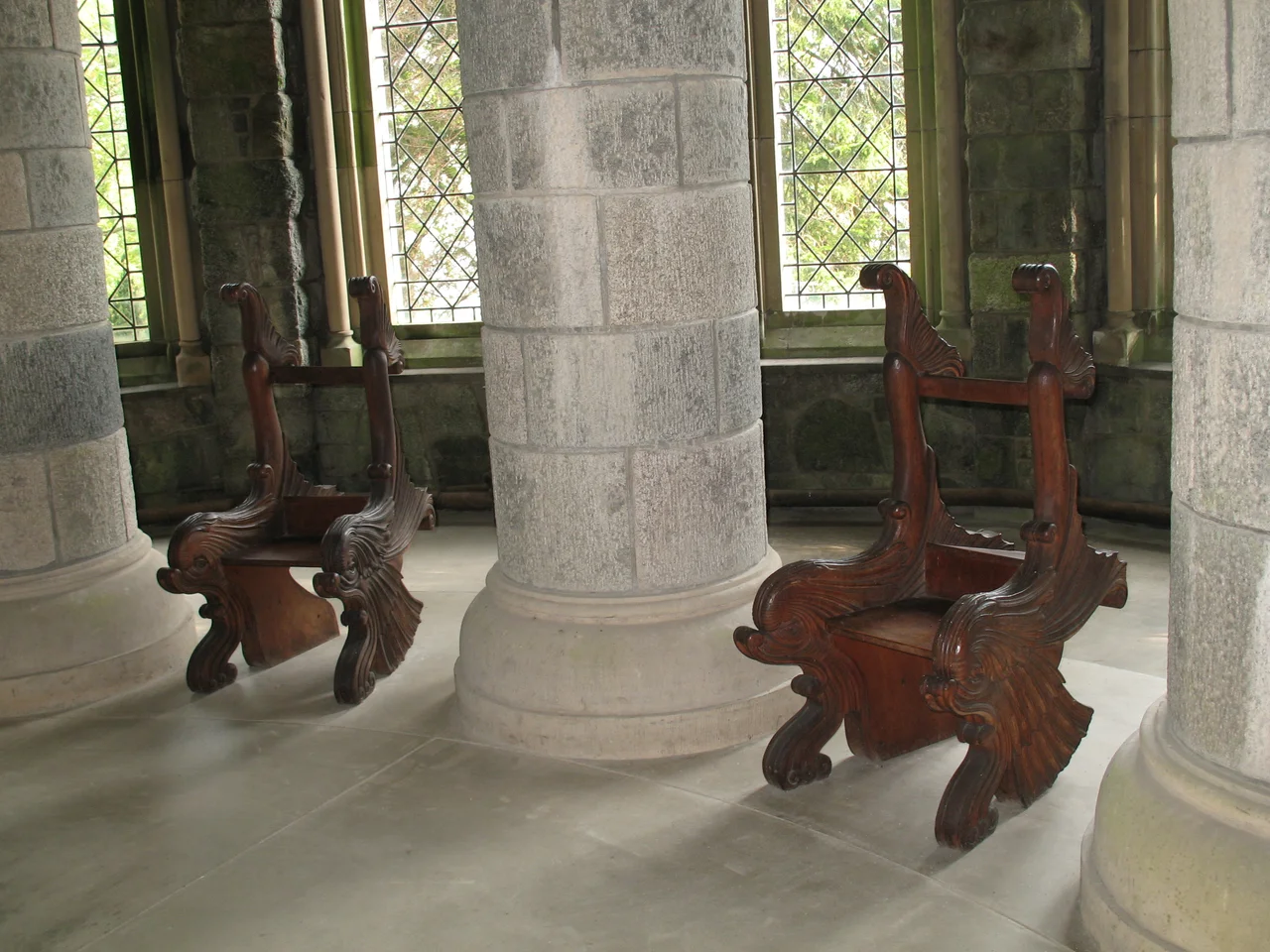
Look up. Look at the rainwater pipes. The downspouts at St Conan's are carved into chasing dogs and running hares, animals frozen mid-pursuit on the side of a church. Stone owls hide in the masonry. Dolphin chairs sit inside. A statue of St Conan himself stands somewhere on the patron's plinth. The kirk was made by people who refused to take stone seriously in only one way. Walter Douglas Campbell's signature, scattered across the walls and waterspouts, is a sense of play that you do not expect from a Highland church. Outside, the building faces Loch Awe and the long view down the loch toward Kilchurn Castle. Inside, half the surfaces seem to be smiling at something.
From the Air
St Conan's Kirk sits at 56.395 N, 5.054 W on the north shore of Loch Awe in Argyll and Bute, in the village of Lochawe. Recommended viewing altitude 1,500-3,000 ft AGL; Ben Cruachan rises sharply just to the north and dominates the skyline. Loch Awe itself is the navigational anchor, a long narrow ribbon of water running roughly southwest to northeast. Nearest ICAO airport is Oban (EGEO) about 20 nm to the west; Inverness (EGPE) is the wider regional reference well to the north. Watch for orographic cloud on Ben Cruachan and rapidly changing visibility off the Atlantic.
Nearby Stories
- Easdale 5.5 km away
- Buchanan Castle 6.2 km away
- Cowal 6.8 km away
- Clachaig Inn 7.4 km away
- Loch Katrine 9.9 km away
- Lochaber 23 km away
- Ben Alder 25 km away
- Jura Distillery 34 km away