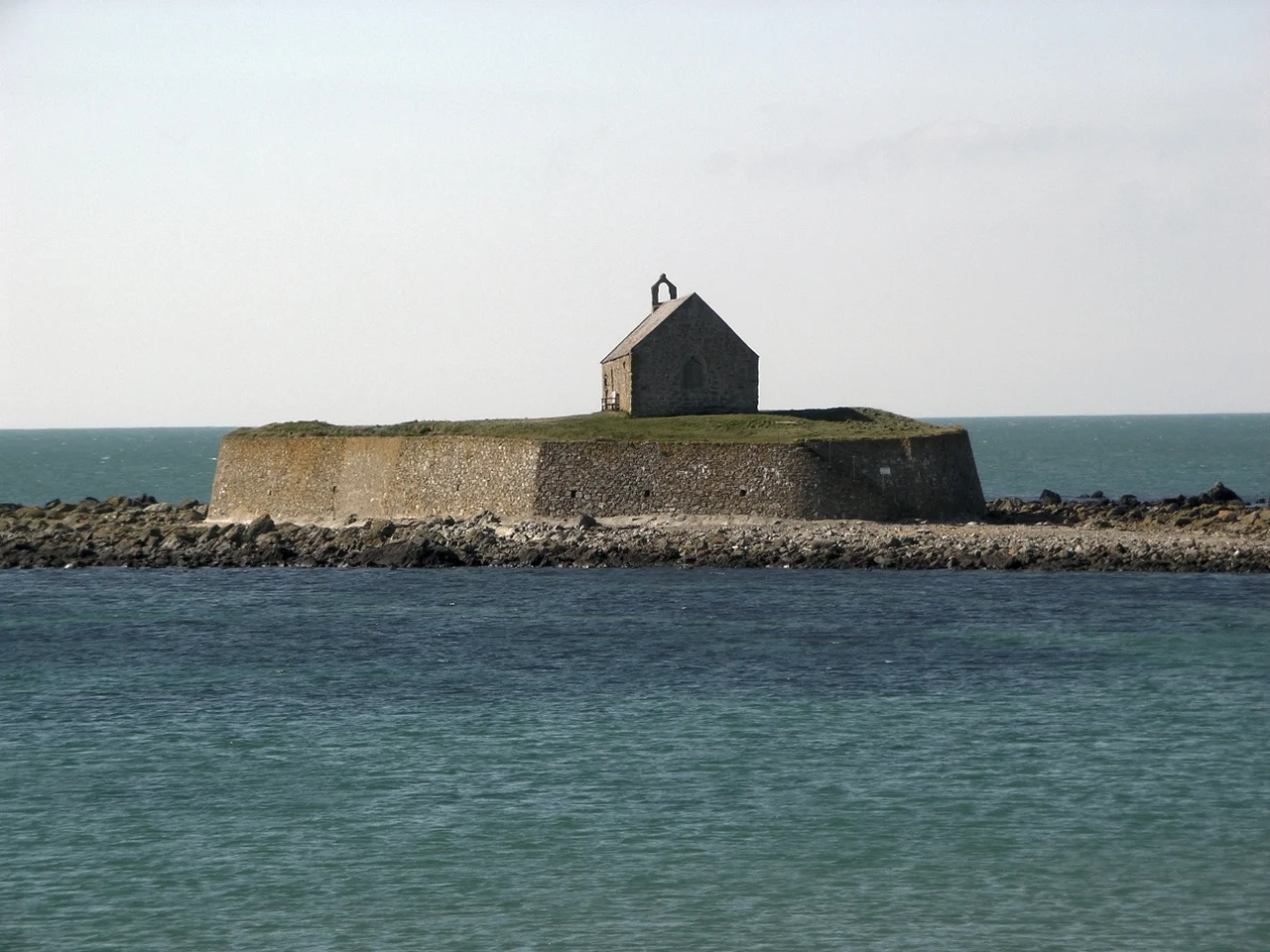

St Cwyfan's Church, Llangwyfan
Twice a day, the sea closes around St Cwyfan's. The 12th-century church sits on a small grass-topped mound of rock called Cribinau off the south coast of Anglesey, no more than fifty yards across, ringed by a low stone wall built to keep the Atlantic from finishing the job it had already started. At low tide a stone causeway emerges from the beach and you can walk across. At high water, the causeway disappears and the church is left alone with the gulls and the wind. In Welsh it has a quieter name than its English nickname suggests: Eglwys fach y mor, 'the little church of the sea'.
An Irish Dedication on a Welsh Coast
Cwyfan - or, more familiarly across the water in Ireland, Saint Kevin - was a 6th-century Irish abbot best known for founding the monastery of Glendalough in County Wicklow. Welsh dedications to Irish saints turn up surprisingly often along this coast; the Irish Sea was less a barrier than a highway for the early Celtic church, and Kevin's name travelled with monks and traders. The church was first built in the 12th century. At that point it was not on an island. It stood at the end of a long peninsula, sheltered between two bays - Porth Cwyfan to the east and Porth China to the west. Over the centuries the sea ate around the headland, cutting first one channel and then another, until the church was marooned on what was now a tidal islet. The local population built a causeway. In the 19th century, when erosion was threatening to take the church itself, a sea wall was built around the islet to anchor it against further loss.
The Trial of Doctor Bowles
In 1766 the Bishop of Bangor, John Egerton, appointed an elderly English priest named Dr Thomas Bowles to the parish of Trefdraeth - which included St Cwyfan's as its chapelry. Bowles spoke no Welsh. The parish and chapelry between them had about five hundred parishioners; all but five spoke only Welsh. The Welsh parishioners, supported and funded by the Honourable Society of Cymmrodorion in London, petitioned against the appointment. The Court of Arches heard evidence in May 1770. Arguments were not made until January 1773. The prosecution argued that Bowles's inability to minister in Welsh violated Article XXV of the Articles of Religion, the 1563 Act for the Translation of the Scriptures into Welsh, and the 1662 Act of Uniformity. The defence argued that even if true, Bowles held the ecclesiastical freehold and could not be dispossessed.
A Ruling for the Language, a Reprieve for the Priest
The Dean of the Arches, George Hay, delivered his judgement in January 1773. He ruled - clearly and on the record - that only clergy who could speak Welsh should be appointed to Welsh-speaking parishes, and that Bowles should not have been appointed. But, he added, Bowles now held the freehold of the benefice and the case to deprive him of it had not been proven. Bowles was therefore allowed to stay in post. He died in November of that same year, ten months after the ruling. He was replaced by Richard Griffith, a priest who spoke Welsh. The judgement set no statutory precedent, but it became one of the first formal acknowledgements in English law that the Welsh language deserved protection in its own pulpits. The little church in the sea, by the accident of being in a Welsh-speaking parish under a Welsh-speaking-parish dispute, sat at the centre of it.
Walking Out at Low Tide
Today the church is still consecrated, occasionally used for services on summer evenings, and accessible at low water across the causeway. The building is small - a simple nave, slate roof, whitewashed walls, a single bellcote. Inside, a few pews, an altar, the smell of damp stone. Outside, the wall holds the sea back from the graveyard. Some of the headstones lean toward the wall as if the wind has been working on them for centuries, which it has. From the islet you can see the broad sweep of Porth Cwyfan and the Lleyn Peninsula across the bay. Twr Mawr lighthouse stands on its own little island a few miles to the southeast. Time the visit wrong and you wait six hours for the causeway to come back. It is, in the most literal sense, a place that requires you to pay attention to the moon.
From the Air
St Cwyfan's Church sits on the tidal islet of Cribinau at 53.186N, 4.492W, just off the south coast of Anglesey near the village of Aberffraw. The site is 4 nm southwest of RAF Valley (EGOV) and 6 nm west of RAF Mona (EGOQ). From the air, look for the small green islet immediately offshore with the prominent low wall and the white-walled chapel - distinctive against the surrounding water at high tide. At low water the causeway becomes visible. Aberffraw village is a mile inland. Caernarfon Airport (EGCK) is 14 nm southeast across Caernarfon Bay.
Nearby Stories
- Wakestock 1.7 km away
- Trefriw 3.8 km away
- Irish Sea 8.7 km away
- Irish Sea Bridge 20 km away
- East–West Interconnector 30 km away
- Machynlleth 36 km away
- HMS Tyler 41 km away
- New Brighton Lifeboat Station 54 km away