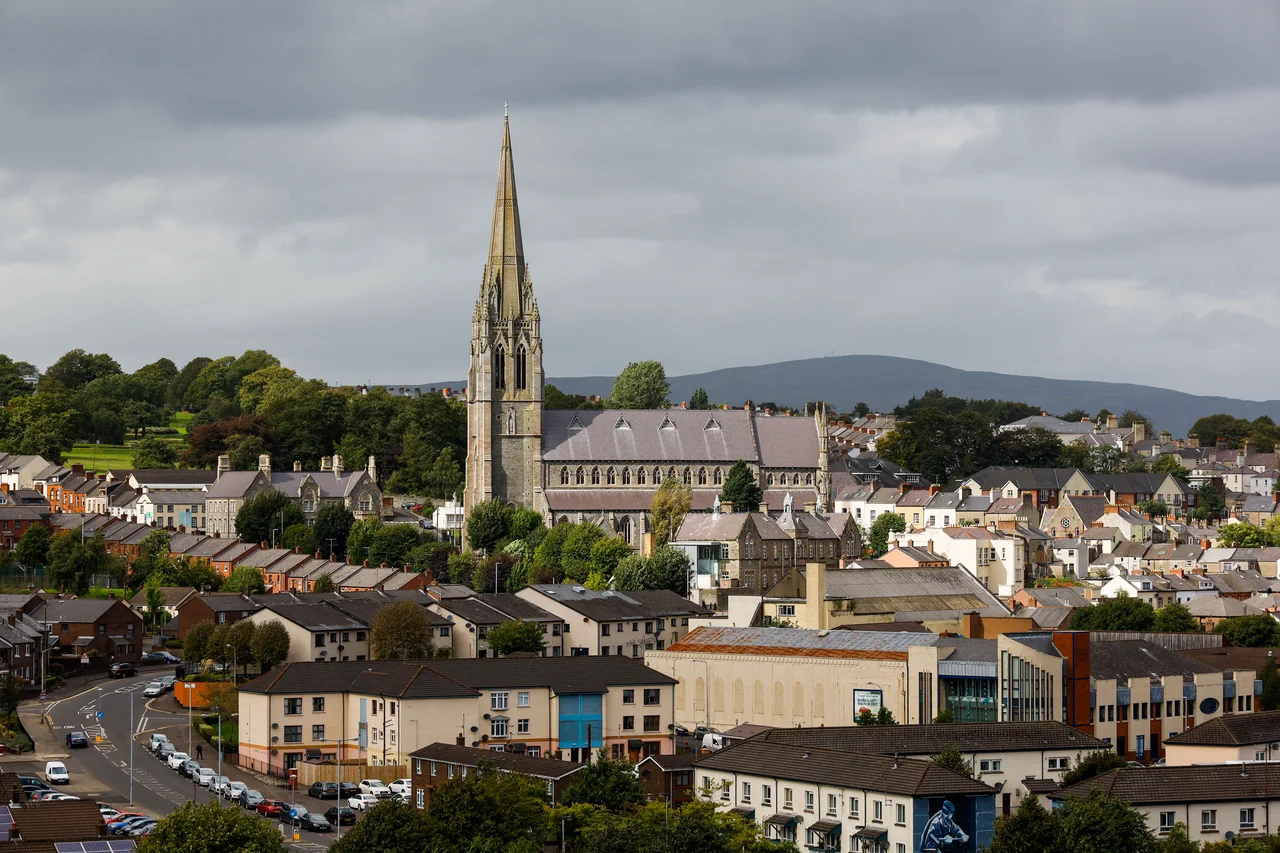

St Eugene's Cathedral
It took a parliament to allow this cathedral. Until the Roman Catholic Relief Act of 1829, building anything as visibly Catholic as a cathedral in a city like Derry was not legally possible. Fundraising began only in 1840. Construction started in 1849, the year the Great Famine was finally lifting from the worst-affected parts of Ireland. The total cost of building St Eugene's came to just over £40,000 - a sum collected mostly in small donations from a community emerging from catastrophe. About £4,000 of it came from America, sent home by Irish emigrants. When the cathedral finally opened on 4 May 1873, twenty-four years after construction began, the windows were plain glass and the bell tower had no spire. Both would come later. The money had run out at exactly the cathedral's roofline.
Forty Thousand Pounds, Slowly
James Joseph McCarthy, an architect who had designed cathedrals across Ireland, drew the plans. The style is neo-Gothic in the simpler key common to nineteenth-century Irish Catholic churches built on tight budgets. The site sits at the junction of Francis Street and Creggan Street, on rising ground above the Bogside. Bishop Francis Kelly officiated at the opening in May 1873. For decades afterwards the cathedral remained unfinished. Stained glass arrived only in the late 1890s. The spire and bell tower project, postponed since 1873 for lack of funds, finally began on 13 August 1900, contracted to Courtney and Co of Belfast. The work was completed on 19 June 1903 - thirty years after the cathedral had first opened its doors. A stone statue of St Eugene, patron of the diocese, was embedded in the bell tower at construction in 1873 and watches over the entrance still.
Bishop Edward Daly
On 8 August 2016 Bishop Edward Daly died at the age of 82. He had been Bishop of Derry from 1974 to 1993 - but he was known to the world for something he had done before he was a bishop, when he was a Father Daly during Bloody Sunday in 1972. A photograph taken that day shows him waving a white handkerchief, leading a group carrying the mortally wounded 17-year-old Jackie Duddy out of the line of fire. The image became one of the most reproduced of the Troubles. When Daly died, his remains were brought to St Eugene's, where for two and a half days an estimated 25,000 people came to pay their respects - in a city of around 85,000 people. His funeral on 11 August 2016 packed the cathedral. Irish President Michael D. Higgins was there. So was Deputy First Minister Martin McGuinness, who would die the following spring. Representatives of the Queen, the British and Irish governments, and the former Church of Ireland Bishop of Derry and Raphoe James Mehaffey - a close friend of Daly's, demonstrating the kind of ecumenical friendship that defined late-twentieth-century Derry - attended together. Daly was buried in the cathedral grounds beside his predecessor Bishop Neil Farren.
The Year of Culture
During Holy Week of 2013, the Good Friday liturgy and the Easter Vigil from St Eugene's were broadcast live by RTE, the Republic of Ireland's state broadcaster, with both ceremonies transmitted across Europe through Eurovision. The broadcasts marked Derry's year as the inaugural UK City of Culture - and the inclusion of Derry's Catholic cathedral on European television was itself a small piece of cultural diplomacy after decades when most external coverage of the city had focused on violence. On 13 December 2015, Bishop Donal McKeown opened the cathedral's Holy Door to mark the start of the extraordinary Jubilee Year of Mercy. The refurbished entrance porch now greets visitors with eight oak statues - Saints Columba, Patrick, Matthew, Mark, Luke, John, Mary, and Joseph - that had once formed part of the cathedral's old pulpit canopy from 1906 until its removal in 1989. The reuse is characteristic of how St Eugene's has handled its own history: keeping pieces of the old liturgical world even when restructuring around new ones.
Templemore Parish
St Eugene's and the Long Tower together form the Templemore Parish - the only parish in Ireland with both a cathedral and a much older parish church. Bishop McKeown is parish priest of both, an unusually direct involvement of a bishop in pastoral life. The cathedral's bells ring four times daily, at 8 a.m., noon, 6 p.m. and 9 p.m., carrying across the Bogside and into the Creggan. As of March 2025 the parish covers a Catholic population of 12,140. In 2023 the cathedral celebrated its 150th anniversary, marked by the installation of a statue of Blessed Carlo Acutis, the Italian teenager beatified in 2020 and known for his digital evangelism. The juxtaposition is apt for a building that has spent its century and a half balancing tradition against change - a neo-Gothic cathedral with electronic organ, paid for by Famine emigrants, finished by Belfast contractors, and broadcast across Europe.
From the Air
St Eugene's Cathedral stands at the corner of Francis Street and Creggan Street on the west bank of the River Foyle at 55.000 N, 7.328 W, on rising ground above the Bogside and just north-west of the historic city walls. The nearest airport is City of Derry Airport (EGAE), six miles north on Lough Foyle; Belfast International (EGAA) is sixty miles east-southeast. From altitude, the cathedral's spire is one of the tallest landmarks on Derry's west bank, visible above the dense Victorian housing of the Bogside and Creggan neighbourhoods.
Nearby Stories
- Portrush Lifeboat Station 1.9 km away
- Main Street, Letterkenny 2.1 km away
- Inishowen 6 km away
- Rosguill 6.3 km away
- County Tyrone 7.1 km away
- St Patrick's College, Maghera 9.6 km away
- St Patrick's Purgatory 11 km away
- Coalisland Canal 17 km away