.jpg)
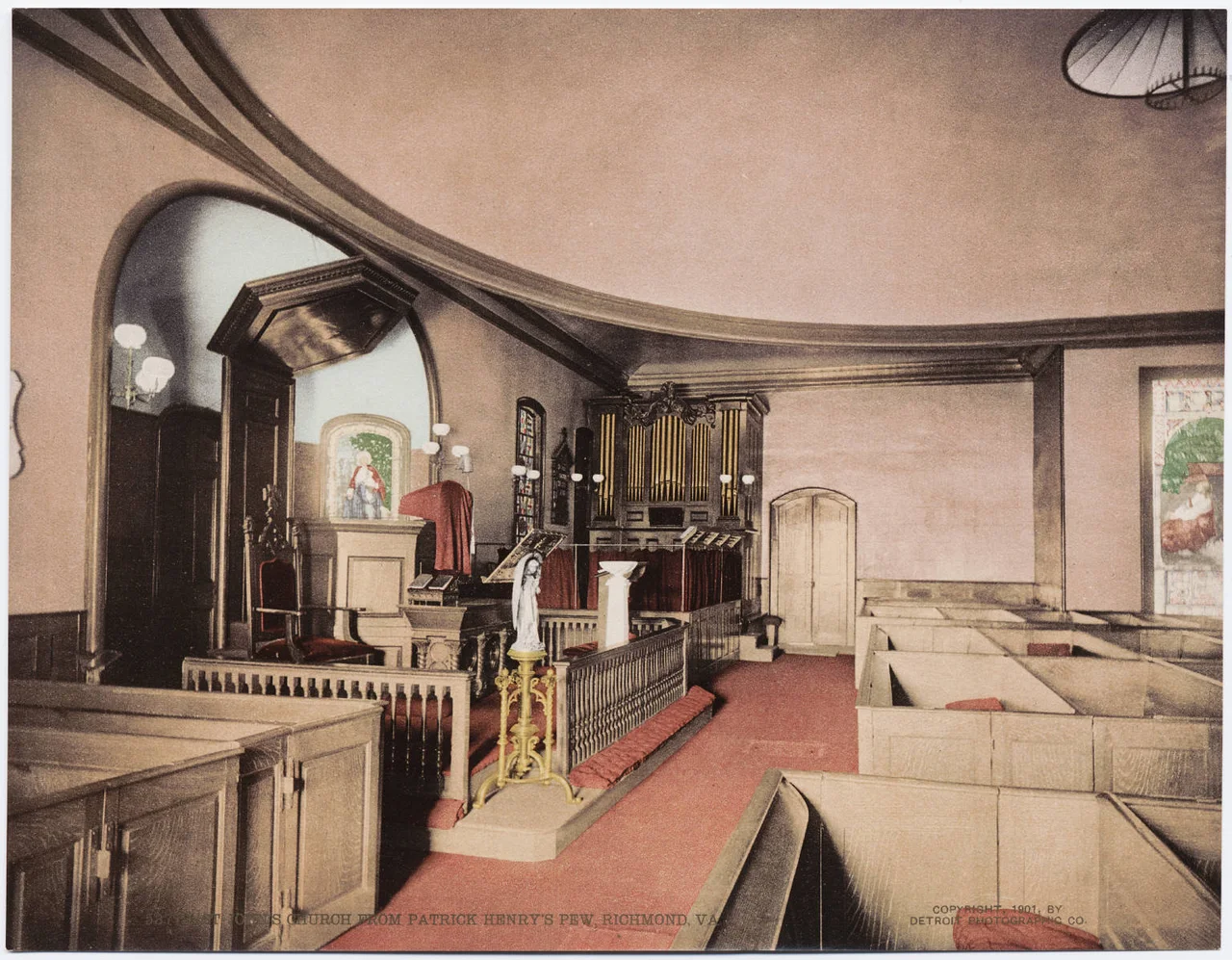
St. John's Episcopal Church (Richmond, Virginia)
"Give me liberty, or give me death!" Eight words shouted inside a small wooden frame church in Richmond on March 23, 1775, and the colony of Virginia tipped toward war. The man speaking was Patrick Henry, a delegate from Hanover County who had earlier in his career been dismissed as too uneducated for serious public life. The room was packed — 120 delegates of the Second Virginia Convention, among them Thomas Jefferson and George Washington, jammed into pews and along the walls. They had moved the convention to Richmond from Williamsburg precisely because the royal governor's troops could not easily reach this hilltop. By the time Henry sat down, the vote to arm a militia was effectively won. St. John's Church on Richmond's Church Hill is the room where it happened, and against considerable odds, the room is still standing.
Henrico Parish
St. John's traces its lineage back further than its 1741 building suggests. The first Henrico Parish Church stood at Henricus, a 1611 colonial settlement seventeen miles upriver — the second permanent English town in Virginia. It was at Henricus in 1613 that Pocahontas, daughter of the Powhatan paramount chief, was held captive by colonists. Rev. Alexander Whitaker taught her Christianity during her captivity, she was baptized as "Rebecca," and she married the tobacco planter John Rolfe. Rolfe smuggled in seeds of sweet Spanish tobacco that rapidly displaced the bitter local strain and made Virginia profitable. On Good Friday 1622, in a coordinated uprising against the colonists, Powhatan warriors destroyed Henricus and killed roughly a third of all Virginia colonists. The town was never rebuilt. The parish, however, moved downriver, eventually settling on Church Hill in 1741, on land donated by William Byrd II. Col. Richard Randolph — great-uncle to Thomas Jefferson — built the original sanctuary, completing it on June 10, 1741. A forty-foot extension added in 1772 turned the church into the cruciform shape it still has today.
The Speech
By March 1775, royal government in Virginia had collapsed. The House of Burgesses had been dismissed and was meeting as a provisional convention; the loyalist forces around Williamsburg made the capital unsafe. So the Second Virginia Convention came to Richmond, and on March 23 the delegates filed into St. John's. The rector, Rev. Miles Selden — known locally as "the Patriot Parson" — was named convention chaplain. The debate was specific: should Virginia raise an armed militia in defiance of British policy? Patrick Henry rose. There is no contemporaneous transcript of what he said; the famous text was reconstructed decades later by his biographer William Wirt from delegates' memories. But everyone present agreed on the ending. Forbid Patrick Henry from his liberty, give him death. The convention voted to arm. The Third Virginia Convention met at the same church on July 17, 1775, naming Henry the first Governor of Virginia. In January 1781, the British took Richmond and General Benedict Arnold — the famous defector — quartered his troops inside this sanctuary.
The Churchyard
The churchyard around St. John's holds names that resonate well beyond Richmond. George Wythe — the first law professor in the United States, signer of the Declaration of Independence, mentor to Thomas Jefferson — is buried here. Elizabeth Arnold Poe, mother of Edgar Allan Poe, also lies somewhere in this ground; her exact spot is lost, but a memorial marker indicates the general area. She was an actress who died of tuberculosis in Richmond in 1811 when Edgar was not yet three years old. The marker in her honor reads simply that the world had given her bread without giving her a home. Over a hundred frame churches of this type once stood in colonial Virginia. Only four survive. St. John's is the most famous of them precisely because of what happened inside on a single afternoon in 1775.
Living Memory
The church still serves an active Episcopal congregation. It is also a working monument to one of the founding moments of the American republic. Reenactments of Henry's speech are performed by professional actors in 18th-century costume every Sunday at 1:30 p.m. from Memorial Day through Labor Day, regularly drawing crowds of over a hundred. The Walter W. Craigie Speaker Series has brought former Virginia governors Douglas Wilder and George Allen back to the same room where the Second Virginia Convention sat. The original baptismal font bowl — older than the building, salvaged from the parish's earlier home at Curles Plantation downriver — is still used. To touch it is to touch a vessel that has been part of this congregation, in three different physical churches, for nearly four centuries.
Church Hill
The neighborhood took its name from the church, not the other way around. Church Hill rises above the eastern edge of downtown Richmond, looking down on the bend where the James River turns south. It is one of the oldest neighborhoods in the city, and one of the most photographed: wooden frame houses, cobblestone streets, a long view westward across the rooftops to the Capitol that Thomas Jefferson designed. From the church's bell tower in clear weather, the trajectory of Richmond's history opens out — the river that brought the colonists, the warehouses where tobacco shipped, the Capitol where Jefferson's classical fantasy still functions as a government building, and somewhere south in the modern sprawl, the airport runways where Charles Lindbergh once landed in 1927 to dedicate Byrd Field.
From the Air
St. John's Episcopal Church sits at 37.53 N, 77.42 W at 2401 East Broad Street, atop Church Hill east of downtown Richmond. The white frame church with its central tower is best viewed from 1,500 to 2,500 feet AGL. KRIC (Richmond International) is approximately 6 nautical miles southeast. A great pairing: the James River bend just south of Church Hill, with Shockoe Bottom in the river valley and the Virginia State Capitol about a mile west.
Nearby Stories
- Kings Dominion 8.4 km away
- Battle of Hatcher's Run 9.7 km away
- Francisco's Fight 14 km away
- Piney Grove at Southall's Plantation 17 km away
- Jamestown Settlement 19 km away
- Battle of Amelia Springs 22 km away
- Menokin 29 km away
- Highland (James Monroe House) 42 km away