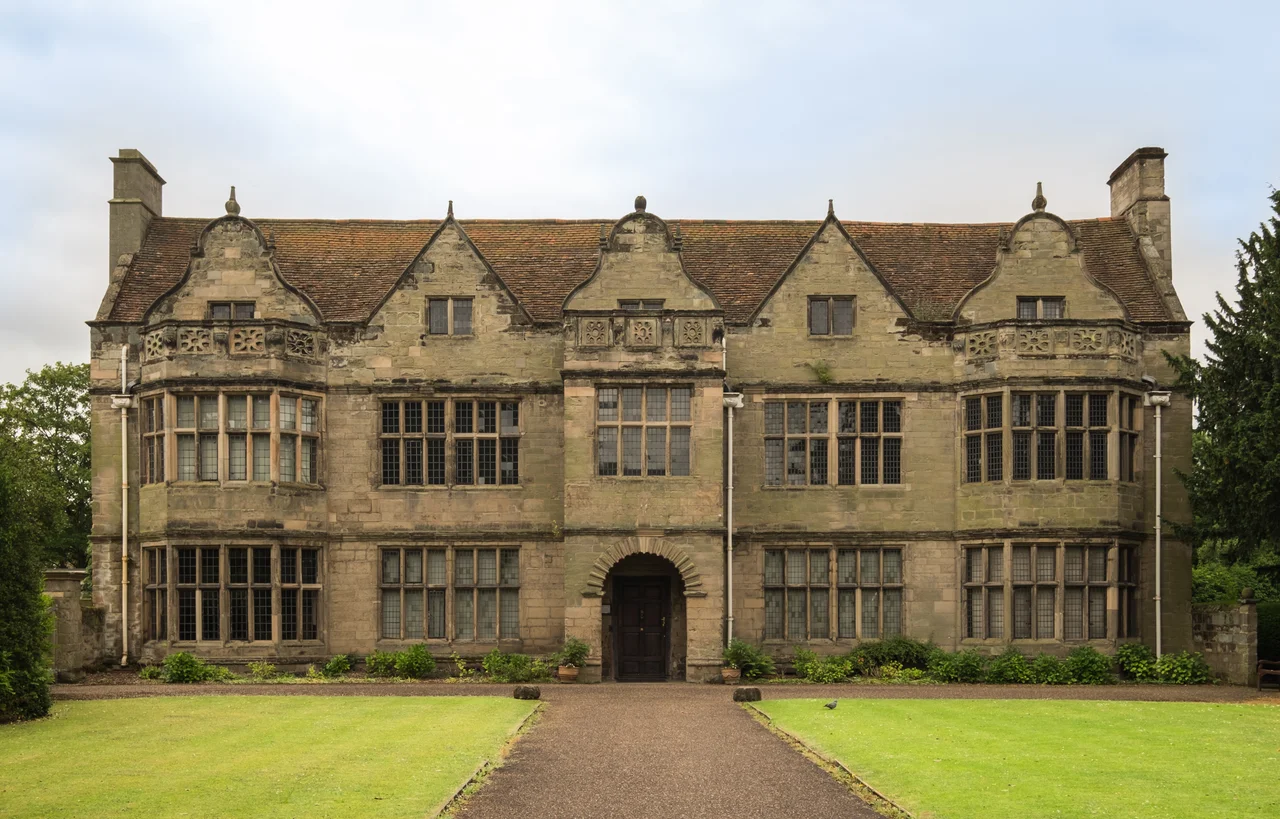

St John's House, Warwick
Two workmen digging behind St John's Court flats in 1987 came up with skulls. They were not the first to discover bones in the soil east of Warwick town centre; in the 1830s, gardeners cultivating the kitchen patch behind St John's House had unearthed human remains. The explanation is one the house has carried for almost nine hundred years: the ground was once a hospital cemetery. In the twelfth century, where the Jacobean mansion now stands, William de Beaumont, Earl of Warwick, founded the Hospital of St John the Baptist - a charitable institution housing the sick poor and providing food and overnight shelter to pilgrims travelling through the town. The bones surface still.
Pilgrims, Lepers, and Alms
Medieval Warwick had two charitable hospitals at its eastern gate, both founded in the mid-twelfth century under the protection of the Beaumont earls. St John's served pilgrims and the local sick; St Michael's, slightly further out, was a leper hospital reserved for those suffering from what the medieval world believed to be the worst affliction a body could carry. Of the original buildings only St Michael's chapel still stands as a recognisable ruin. St John's leaves no medieval fabric above ground - what visitors see today is the seventeenth-century house that replaced it. But the 1291 taxatio records show the Hospital owning a dovecote worth two shillings and a carucate of land valued at ten shillings a year. In 1337 royal protection was granted to its brethren and their attorneys for the collection of alms at churches across England, a sign that even then the institution was struggling to fund itself.
The Mansion Built on the Ruins
The Dissolution of the Monasteries swept the Hospital away in the 1540s, and Henry VIII granted the land to Anthony Stoughton in reward for unspecified services to the crown. The Stoughton family held the property for the next four centuries, though for the first generation or two they leased it out rather than living in it. A new house went up in the early seventeenth century - a door lintel in the East Wing still bears the date 1626 and the initials A.S., almost certainly Anthony Stoughton the younger. The building visible today, however, dates principally from around 1666: a handsome stone-built Jacobean mansion with three gables, mullioned windows, and the kind of restrained symmetrical front that made it, when finished, one of the finest houses in Warwick. It is grade-I listed, considered among the most important buildings in the town.
Young Gentlemen and Young Ladies
From 1791 the Earl of Warwick rented the house out for the first time. William T Fowler converted it into St John's Academy, a school for young gentlemen advertised on hand-bills throughout the area. The school passed in 1845 to Fowler's son-in-law Benjamin Townsend; when Townsend died in 1857 his three daughters - Susanna, Elizabeth, and Sarah - took it over and converted it into a girls' school, which it remained from at least 1861 onwards. For most of the nineteenth century, St John's House was a place where children learned, the formal interiors of a Jacobean mansion accommodating themselves to lessons, slates, and the small scuffles of pupils on stairways.
The War Department, then Montgomery
After a brief spell of private tenancy, the War Department took over the house in the early twentieth century and used it as administrative headquarters for the Home Counties and East Anglian Brigades. The Warwick Castle Estates sold the building in 1959 along with much of the rest of the Earl of Warwick's holdings. Warwickshire County Council acquired it as a museum, and on its opening day in 1960 the ribbon was cut by Field Marshal Bernard Montgomery, 1st Viscount Montgomery of Alamein - the architect of El Alamein, scourge of Rommel, by then in retirement and notoriously available for the unveiling of plaques and the opening of museums across the country. The second floor was given over to the museum of the Royal Warwickshire Fusiliers; the ground floor staged a full-sized replica of a Victorian classroom, with benches, blackboards, abacuses, and charts that schoolchildren could visit to glimpse how earlier generations had learned.
From Museum to Wedding Venue
The museum closed to the general public in 2016 - costs rising, visitor numbers falling, the Fusiliers' collection eventually relocated to Pageant House on Jury Street in central Warwick in 2023. The building did not close. It is now Warwickshire Heritage Learning, hosting school visits that still use the Victorian classroom for living-history sessions, and a venue available for events and weddings. St John's Brook Gardens, a themed outdoor space between the house and the much larger St Nicholas Park behind it, opened in 2011 and remains accessible. The house played a small role in the 2019 horror film Annabellum: The Curse of Salem, its Jacobean interiors evidently lending themselves well to the supernatural. Nine hundred years after the first pilgrims arrived for a night's lodging, the building still receives strangers - dressed for a wedding now rather than the road, but still passing across the same threshold.
From the Air
Located at 52.28N, 1.58W in Warwick, just east of the town centre. The Jacobean stone mansion sits at the entrance to St Nicholas Park, with formal gardens to its side and the larger park spreading north toward the River Avon. The site is half a mile from Warwick Castle. Nearest airports: EGBE (Coventry, 7nm NE), EGBB (Birmingham, 17nm NW). Best viewed at 1,500-2,500 ft AGL.
Nearby Stories
- Stowe House 2.5 km away
- Wolverhampton 3 km away
- Althorp 3.9 km away
- Droitwich Spa 4.3 km away
- Tewkesbury 5.4 km away
- Tamworth Castle 11 km away
- Uppingham School 23 km away
- Woodstock Palace 26 km away