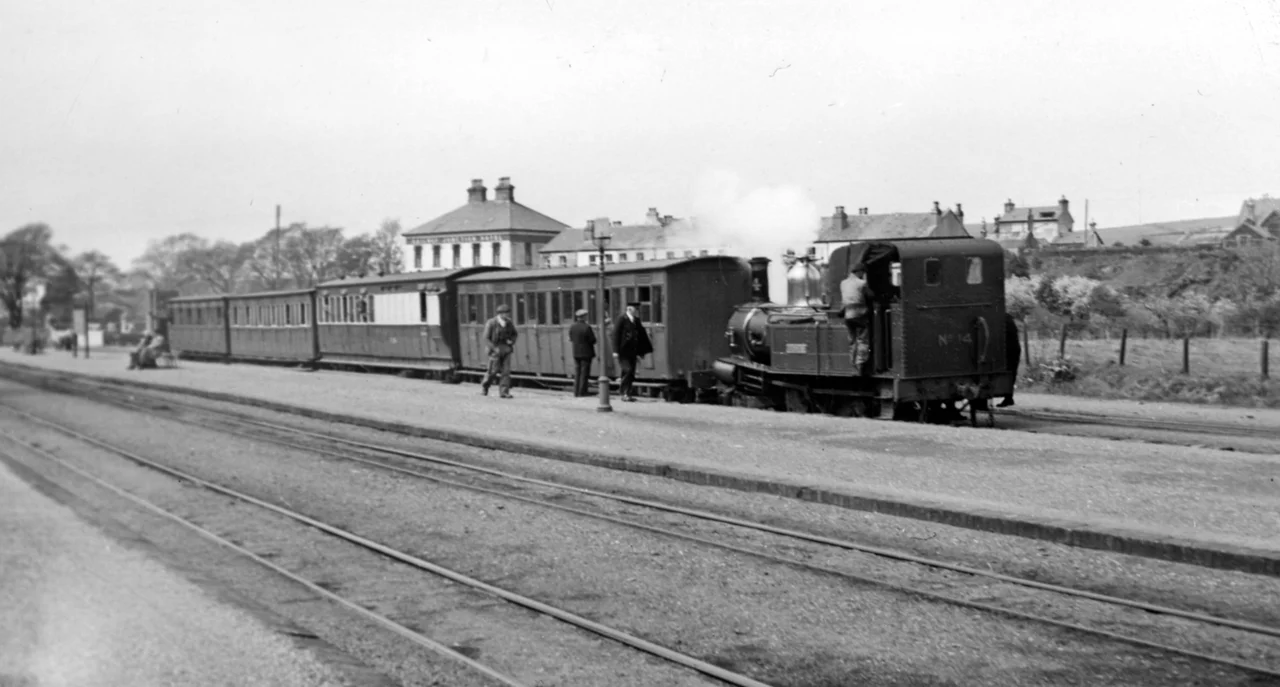

St John's Railway Station
They called it the Manx Crewe. The nickname was a joke and also exactly true - this junction, tucked into a Manx village beside Tynwald Hill, was where three separate railway companies' lines converged on a network only thirty miles across. The Isle of Man Railway's Peel line came in from the east. The Manx Northern Railway swept down from Ramsey in the north. The Foxdale Railway arrived from the south, looping over the others on a stone bridge that still stands. On busy days all three platform faces could be occupied at once, with locomotives being uncoupled, recoupled, and shuffled between trains bound for different parts of the island. For something this small, St John's was extraordinarily busy.
Three Stations, One Site
There were really three stations at St John's, though only one was in continuous use until the end. The original wooden building went up in 1873 to serve the Peel Line, built to the same modest design as the station at Crosby - a waiting shelter with accommodation for the station master, a passing loop, and not much else. Six years later the Manx Northern Railway arrived from Ramsey, and for a few odd years the two operations stitched themselves together. The 1873 building was relocated south of the running lines. A small signal box was added, controlled by a ten-lever Stevens and Co. frame, and the railwaymen called it the Point Box. When the working agreement between the two companies ended, the Manx Northern built its own separate station to the west of the level crossing. By 1884 it had been replaced again, this time on the alignment of the Foxdale Railway, which was then under construction. The history is the kind that only railway enthusiasts can fully untangle - three companies, three sites, decades of revisions, and only the original 1873 station serving traffic right up to closure.
Tynwald Day and the Race
The single busiest day each year was Tynwald Day on 5 July, when thousands travelled to St John's for the open-air parliament ceremony just up the road. The railway threw the whole network at the problem. Trains ran from dawn until well after midnight. Every available carriage went into service - and on the busiest occasions, passengers travelled in open cattle vans, in goods wagons, and in withdrawn carriages pressed back into reluctant duty. The other railway tradition here was the Race. Trains heading west to Peel and trains heading north to Ramsey were timetabled to depart within minutes of each other, their main lines running parallel for some distance before diverging. Officially one always left first. Unofficially, drivers held back so the two could depart together - and then, with the official timings forgotten, they raced. The westbound Peel train always won, because the track ran downhill all the way to the western terminus. The Race is statically recreated today during the Manx Heritage Transport Festival at Douglas, on a spur called Peel East.
George Crellin and the Point Box
For the railway's final decades, the station master at St John's was George Albert Crellin. He was born on 2 November 1897, and by retirement in 1968 - the year the network ceased ordinary operations - he had become one of the most photographed figures on the line. He cycled to the signal box each morning. He bought the original Foxdale Railway station house, which had stopped being a station after amalgamation, and lived there with his wife Olga Evelyn. Crellin features in nearly every late photograph of the station: friendly, unhurried, a man whose working life had been the railway and whose retirement remained tangled with it. He died on 24 February 1974. The house he bought is still in his family today.
Fires, a Schoolhouse, and What Remains
After services ceased in 1968, the carriage shed at St John's became a storage yard for surplus rolling stock. A disastrous fire on 10 December 1975 destroyed many of the historic carriages still kept there - a controlled burn the following June disposed of what was left. The 1873 timber station and the stone-built points box were removed at the same time. The site became a car park, used heavily for Tynwald Day overflow. Today only the Foxdale Line's overbridge remains at the eastern end, along with a few fragments of an old advertisement hoarding. The Foxdale Railway station building survives across the road as a private house. A new primary school - Bunscoill Rhumsaa's sister, opened by Queen Elizabeth II in 2003 - now occupies part of the site. The line could, in theory, be reinstated, but the station would have to be relocated. Trains have not stopped at the Manx Crewe in over fifty years. The unofficial races they once ran out of it have moved to a different stretch of rail.
From the Air
Coordinates 54.201 N, 4.639 W in the central valley of the Isle of Man, immediately south of Tynwald Hill. The station site is now a primary school and car park, but the surviving Foxdale Line overbridge and the level crossing remnants are visible from low altitude. Ronaldsway Airport (EGNS) is about 9 nautical miles southeast; recommended altitude 1,500-2,500 ft AGL. The A1 Douglas-Peel road passes immediately north of the former site.
Nearby Stories
- Ballywalter 14 km away
- Pasages (steam trawler) 15 km away
- SS Georgetown Victory 19 km away
- Celtic Array 31 km away
- Raeberry Castle 34 km away
- German submarine U-1051 36 km away
- St Bees Lifeboat Station 49 km away
- PS Rothsay Castle 73 km away