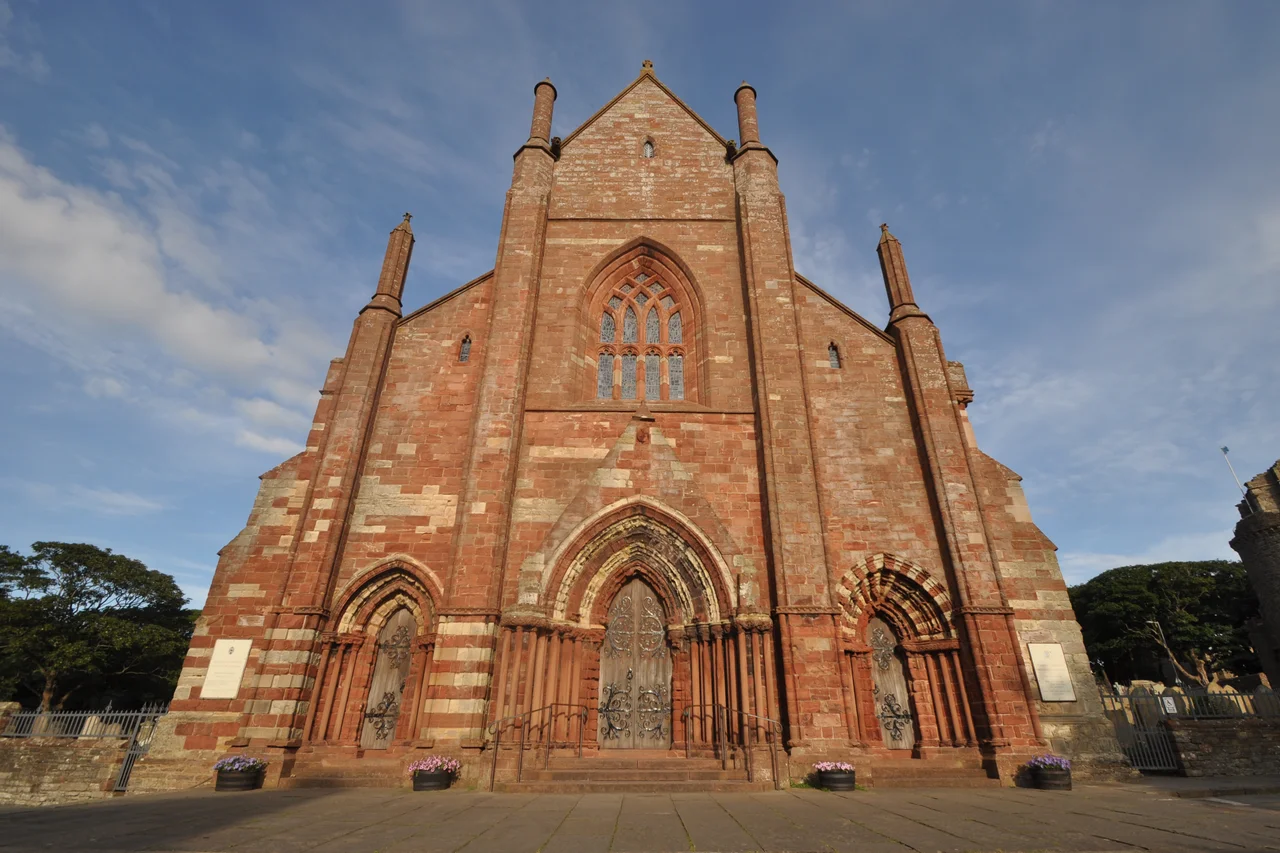

St Magnus Cathedral
In 1919, workmen restoring a column in St Magnus Cathedral discovered a hidden cavity. Inside lay a wooden box. Inside the box lay bones. One was a skull with a wound consistent with the blow of an axe. The bones, almost certainly, belonged to Magnus Erlendsson, Earl of Orkney, killed on the small island of Egilsay in 1117 by men loyal to his cousin in a dispute over the earldom. He had been promised safe passage. The man who built this cathedral two decades later, Rognvald Kali Kolsson, was Magnus's nephew, and he raised these stones in part to honour the uncle who had been betrayed.
The Stones
Work began in 1137 under the direction of Kol, Rognvald's father, who proved both architect and politician. When the money ran out, Kol advised his son to restore the ancient odal land rights to Orkney's farmers, for a price. The strategy worked, and the cathedral kept rising. The masons were English, brought from Durham or trained by men who had worked there, and the Romanesque columns and round-headed arches of the chancel show it. The masonry is the cathedral's signature trick: red sandstone quarried near Kirkwall set in courses with yellow sandstone shipped down from the island of Eday, sometimes alternating, sometimes laid out in a chequerboard that catches the northern light. It is one of the boldest polychrome facades of its century. In 1158, while work was still under way, Rognvald himself was killed by a Scottish chieftain. His bones, too, came home to this church, and he was canonised in 1192. Two saints in one building, and both of them murdered.
Burnt by a Queen, Saved by a Bishop
In August 1557, Mary I of England sent a fleet north to harass the Scots. Her admiral John Clere burnt Kirkwall, brought six cannon ashore from the harbour, and bombarded the Bishop's Palace beside the cathedral. On 13 August, three thousand Orcadians drove the landing party back to the sea. Ninety-seven Englishmen drowned, Clere among them. Half a century later, in 1614, the cathedral came closer to destruction by friendlier hands. Government troops besieging Kirkwall Castle, full of rebels loyal to Robert Stewart, the disgraced son of Patrick, 2nd Earl of Orkney, intended to demolish the cathedral as well, on the grounds that rebels had hidden in it. Bishop James Law talked them out of it. There is a reason St Magnus is the only wholly medieval Scottish cathedral still substantially intact: at every moment when it should have been smashed, somebody decided not to.
The Bottle Dungeon
There is a darker history embedded in these walls. Between 1594 and 1708, people accused of witchcraft in Orkney were typically held in the cathedral itself, and tried in the church. One of the first was Allison Balfour, in 1594. She was accused of having been paid by Patrick Stewart, the 2nd Earl, to poison his brother. Patrick was acquitted. Allison was executed. The opening to the cell, originally a window, is still visible; it is called a bottle dungeon for the way its floor arches upward like the interior of a champagne bottle. She was not the last. The witch-hunts swept Orkney for the better part of a century, and most of those who suffered were women on the wrong side of a quarrel, or simply on the wrong side of someone's fear. The cathedral kept their bones nearby too, though no boxes were ever opened to honour them.
King Haakon and the Moosie Toor
Next door, the ruins of the Bishop's Palace tell their own end-of-era story. King Haakon IV of Norway died here in December 1263, retreating from his defeat at the Battle of Largs. With his death effectively ended Norse rule over the Western Isles. His body lay in St Magnus until the winter weather cleared enough to ship him home to Bergen. Three centuries later, Bishop Robert Reid restored the palace and added a round tower the locals nicknamed the Moosie Toor. Reid's other legacy was a bequest of 8,000 merks for a college in Edinburgh, the seed money for what became the University of Edinburgh in 1583. Major restorations in 1908 gave the cathedral its current copper-clad spire, replacing the squat slated pyramid that had stood since lightning destroyed the medieval steeple in the late 17th century. In 1987, Queen Elizabeth II unveiled a new west window to mark the cathedral's 850th birthday. Magnus had been dead 870 years. The stones kept his memory.
From the Air
Located at 58.98 N, 2.96 W, in the centre of Kirkwall on Orkney Mainland. The nearest airport is Kirkwall (EGPA), about two miles southeast of the cathedral. Best viewed from 2,000-3,000 feet AGL on the approach to or departure from EGPA. The cathedral's distinctive red and yellow polychrome masonry and tall copper spire are landmarks visible across central Kirkwall; the ruined Bishop's and Earl's Palaces sit immediately south. From the air the cathedral marks the heart of the town.
Nearby Stories
- Pentland Skerries 5.4 km away
- Thurso 13 km away
- HMS Daring (H16) 42 km away
- Wolfburn Distillery 42 km away
- Orcadian Basin 55 km away
- Fair Isle 57 km away
- Jarlshof 119 km away
- The Laki Eruption: The Volcano That Changed World History 941 km away