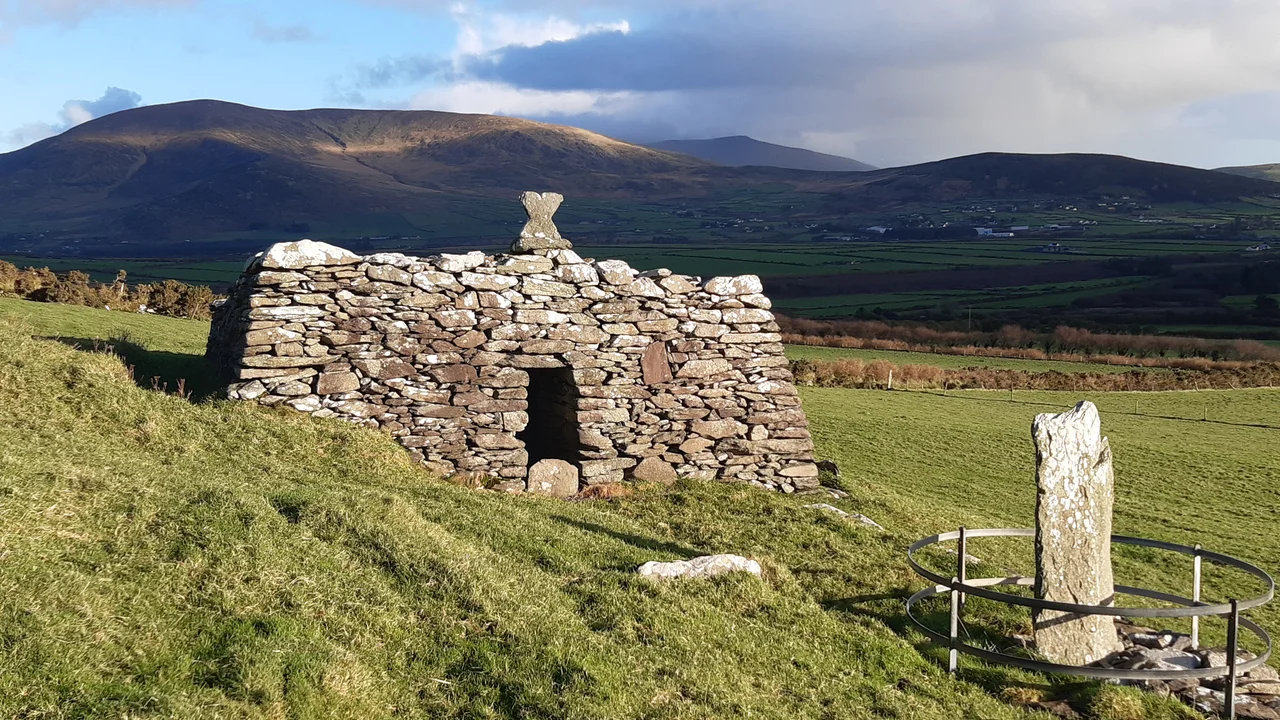

St. Manchan's Oratory
The Irish name says it plain: An Teampall Geal, the bright church. On the southeast slopes of Lateeve hill, four and a half kilometres west-northwest of Dingle, a small stone building stands shaped like an upturned boat, its walls drystone, its single finial reaching toward a Kerry sky that is rarely the same colour for an hour at a time. Beside it stands a slab of stone carved with notches and lines older than most of what passes for history in Europe. This is St. Manchan's Oratory, and the things gathered here belong to a span of time so long that the word medieval barely begins to cover it.
Shaped Like a Boat, Sealed Like a Tomb
The oratory stands 2.75 metres high and follows the same boat-shaped plan as the more famous oratory at Gallarus, a few kilometres to the north. There are no mortar joints here. Each stone has been chosen and laid so that the wall corbels inward, course by course, until the roof closes itself overhead without need for timber or thatch. It is a building made out of the patience of its builders. The walls slope just enough that rain runs down rather than in. Inside, the space is small enough that two adults must stoop and turn to share it, which is exactly the point: this was a place to be alone with a candle and a prayer, not a stage for a congregation. The finial on the gable, a small carved cap of stone, is the only flourish the builder allowed himself.
The Priest's Hole and the Holy Well
A few paces from the oratory the ground dips toward a souterrain, an underground passage of dry-laid stone that locals call Poll na Sagart, the priest's hole. The name carries the memory of the Penal era, when Catholic clergy in Ireland were hunted by law and parishioners hid them where they could. Whether priests actually sheltered in this particular souterrain is the kind of question folklore refuses to settle, but the story has been told here long enough that the stones now belong to it. South of the oratory a holy well, Tobermanaghan, still seeps from the hillside. Around the church an ancient burial ground holds cross-inscribed slabs, their carvings softened by twelve centuries of weather. The whole site reads like a layered manuscript: every generation that came up the hill left a mark, and none erased what came before.
QENILOCI MAQI MAQI-AINIA
The ogham stone at Ballymorereagh stands 1.68 metres high, and along one of its edges runs a line of notches that, transliterated, reads QENILOCI MAQI MAQI-AINIA MUC[OI] — of Cellach, son of the son of Ania, of the tribe of someone whose name the weather has taken away. Scholar Sabine Ziegler dated the inscription to somewhere between the fifth and seventh centuries AD. Ogham is the first writing system the Irish made for themselves, a kind of cipher cut along the edge of a stone where the corner of the rock becomes the stem-line of the alphabet. To read it you let your fingers do as much work as your eyes. Whoever Cellach was, his people thought him worth the labour of cutting this stone, and the stone has outlasted everyone who could have told us why.
Walking Up the Hill
There is no ticket booth at Ballymorereagh, no car park, no railing. The site is reached by climbing a narrow boreen and ducking under a gate that wears moss the way other gates wear paint. Sheep look up, decide you are not interesting, and resume eating. On a clear day, looking back down the slope of Lateeve, Dingle Bay opens out below and the Atlantic does what the Atlantic does, throwing weather at the coast in restless layers of grey and silver. The oratory has watched that sea for at least a thousand years. The ogham stone has watched it for longer. Standing between them on a cold afternoon, with the wind pulling at your jacket and a few pale sheep for company, the centuries press very lightly on the shoulders.
From the Air
St. Manchan's Oratory sits at 52.155 N, 10.331 W, on the southeast slope of Lateeve hill four and a half kilometres west-northwest of Dingle town. From the air the site reads as a tiny dark cell of stone in a green field, with the dark ribbon of the boreen leading down toward the village of Ventry. Nearest airport is Kerry (EIKY) about 60 km east; Shannon (EINN) lies about 100 km north-northeast. Best low passes are made in the morning, when the eastern light catches the corbelled gable; Kerry weather is famously changeable, so reckon on broken cloud and shifting visibility below 2,000 ft.
Nearby Stories
- Ballyheigue Castle 1 km away
- Killemlagh Church 2.8 km away
- Pouldergaderry Sinkhole 6.8 km away
- Derreen Garden 11 km away
- Kilkee 59 km away
- The Laki Eruption: The Volcano That Changed World History 1366 km away
- The Northern Lights: The Sky Show That Vikings Thought Was Bridge to the Gods 1469 km away
- Sao Miguel 1935 km away