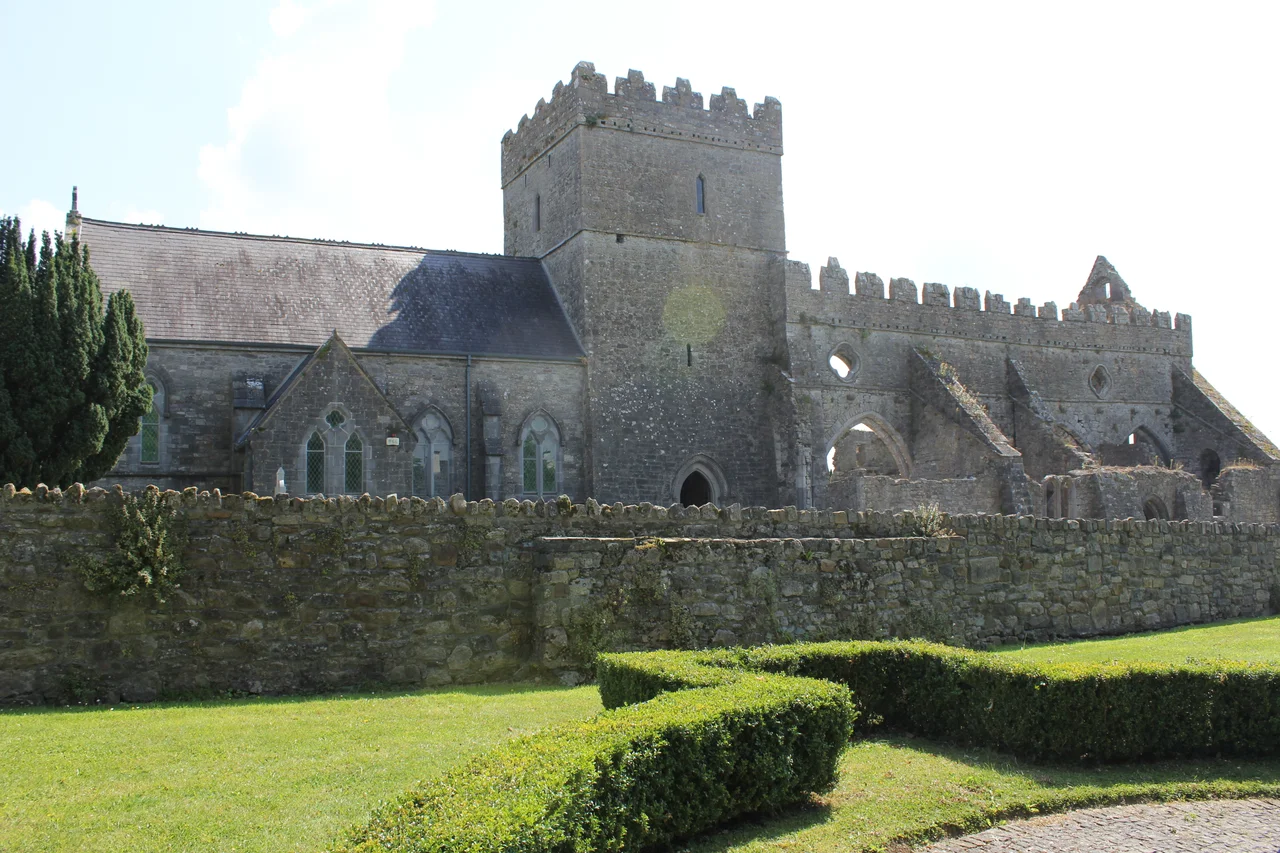

St. Mary's Collegiate Church, Gowran
In the chancel of St Mary's at Gowran stands a piece of stone roughly chest-high, scored down one edge with vertical and slanted notches, and marked across its face with a Christian cross. The notches are ogham - the alphabet used in Ireland from the third or fourth century, the oldest writing system the island ever produced. The cross was carved over the inscription around the sixth century, when the worshippers at this site became Christian without abandoning the stone their ancestors had set up. The stone was used as building material when the church was rebuilt and lost for centuries; it was found again during chancel works in 1826. It is the oldest writing in this building. It is not the only thing here that survived being lost.
The oldest dated burial monument in Ireland
Also in the chancel, on a wall set against the south aisle, is the effigy of a priest in his vestments, his hands folded, his face wearing the calm formal stillness that medieval stonemasons gave to the holy dead. The inscription around the edge is carved in Lombardic capitals in Latin. It commemorates Ralph - Radoulfus - who was portrieve, or chief priest, of Gowran before 1218. The date carved on the stone is 19 March 1253. Among Irish medieval funerary art this is the oldest burial monument carrying a date that any scholar has been able to identify. Ralph would have known a Gowran that was newly Norman, still partly a wooden town, watching the early Butler tenants begin the work of making it Anglo-Irish.
The earls
Beginning in 1312 when Edmund Butler, Earl of Carrick and Lord Deputy of Ireland, made an agreement to fund four priests in St Mary's to celebrate masses in perpetuity for his soul and the souls of his family, the church became the burial place of the Butlers of Ormond. Edmund himself was the first to choose burial here. He and his brother Thomas had walked the Camino to Santiago de Compostela in 1321; Edmund died in London on the way home on 13 September. His body was brought back to Gowran and buried on 10 November 1321. He lies beside his son James, the first Earl of Ormond, and James's son the second Earl, and the third Earl - who built Gowran Castle and made Gowran his usual residence. Four generations of Butler earls in one small church. The 1st Earl's wife Eleanor de Bohun, granddaughter of Edward I of England and niece of Edward II, lies beside him; their effigies are intact.
The carved tombs
Two mensa tombs - flat table tombs - sit in the church carved with knights in armour. The Single Butler Knight Tomb dates to 1500-1515 and was the first major sculpture commissioned at Gowran. The Two Butler Knight tomb, from 1515-1527, is similar. Both are attributed to the O'Tunneys, the workshop of Kilkenny stonemasons who produced some of the finest medieval sculpture in Ireland and whose tombs sit also at Jerpoint and at Kilcooley. Look closely at the armour: the knees, the shoulders, the small chains binding the gauntlets to the mail. The carvers knew exactly what the equipment looked like because they had seen men wearing it ride past their workshop on the street.
1415, 1421, 1650: what the church survived
In 1415 - the year Henry V was at Agincourt - Irish raiders surrounded the church at Gowran and burned it. In 1421 Edward Bruce's army attacked the town and damaged it again. The Pope granted indulgences to those who would give alms for repairs over the next ten years; the tower was rebuilt higher, the walls strengthened, buttresses added to the nave. In 1541 Henry VIII's Reformation changed the rite practised here from Catholic to what became the Church of Ireland; the church was used for Church of Ireland worship for the next four centuries. In 1650 Cromwell's siege of Gowran damaged the building further. By 1791, when Francis Grose drew it for his Antiquities of Ireland, the south wall of the nave was still standing but heavy with ivy and falling slowly into ruin. The 1826 chancel was William Robertson's design - the same Kilkenny architect who designed Gowran Castle and most of the current Kilkenny Castle - and it grafted a working parish church onto the medieval shell.
The window for Aubrey
On the north wall of the chancel is a stained glass window dedicated to Aubrey Cecil White of Gowran, who was killed on 1 July 1916 - the first day of the Battle of the Somme - aged 20. He was one of the 19,240 British soldiers killed on that single morning, the worst day in British military history. The Whites had been one of the families of Gowran for generations; their cousins are buried elsewhere in the church. The window was commissioned by his family. On 23 August 2014, during Irish Heritage Week, the church held a commemoration for him - a talk and presentation about a young man who would now have been over a century dead and was probably forgotten everywhere except this small chancel where his family had chosen to remember him.
Public access and what you find inside
The Gowran Development Association, founded in 1988, restored the church's boundary walls, chancel roof, interior plaster (replastered with traditional lime mortar and goat hair), and the medieval town wall section behind the graveyard. Most of this work was done in the 1990s and 2000s. The chancel is open to visitors from May to August; the grounds and gardens are open all year. The Office of Public Works has care of the site jointly with the GDA. When you stand inside the chancel you can see, in one room: the ogham stone (third or fourth century), the effigy of Ralph (1253), the Butler knight tombs (early 1500s), the Agar Monument (early 1700s, in Grecian classical style with pillars), the Aubrey White window (1916), and the modern restoration plasterwork in lime and goat hair. Eighteen centuries of Irish history, in twenty square metres.
From the Air
St Mary's Collegiate Church Gowran is at 52.629°N, 7.065°W, in the centre of Gowran village. Best viewed at 1,500-2,500 ft. The cruciform church with its central tower is the highest point in the village core and visually dominant from above. The medieval town wall fragments and graveyard surround the south and east sides. Gowran Castle stands a few hundred metres to the southwest; the M9 motorway is visible east of the village. Nearest airports: Waterford (EIWF) ~50 km south, Kilkenny (EIKL) 13 km west.
Nearby Stories
- 2008 Irish Pork Crisis 4 km away
- Civil Defence Ireland 6.1 km away
- Thurles 6.5 km away
- Abbeyleix 9.5 km away
- Castletown Cox 11 km away
- Ardfinnan Woollen Mills 13 km away
- Johnstown Castle 16 km away
- County Wicklow 20 km away