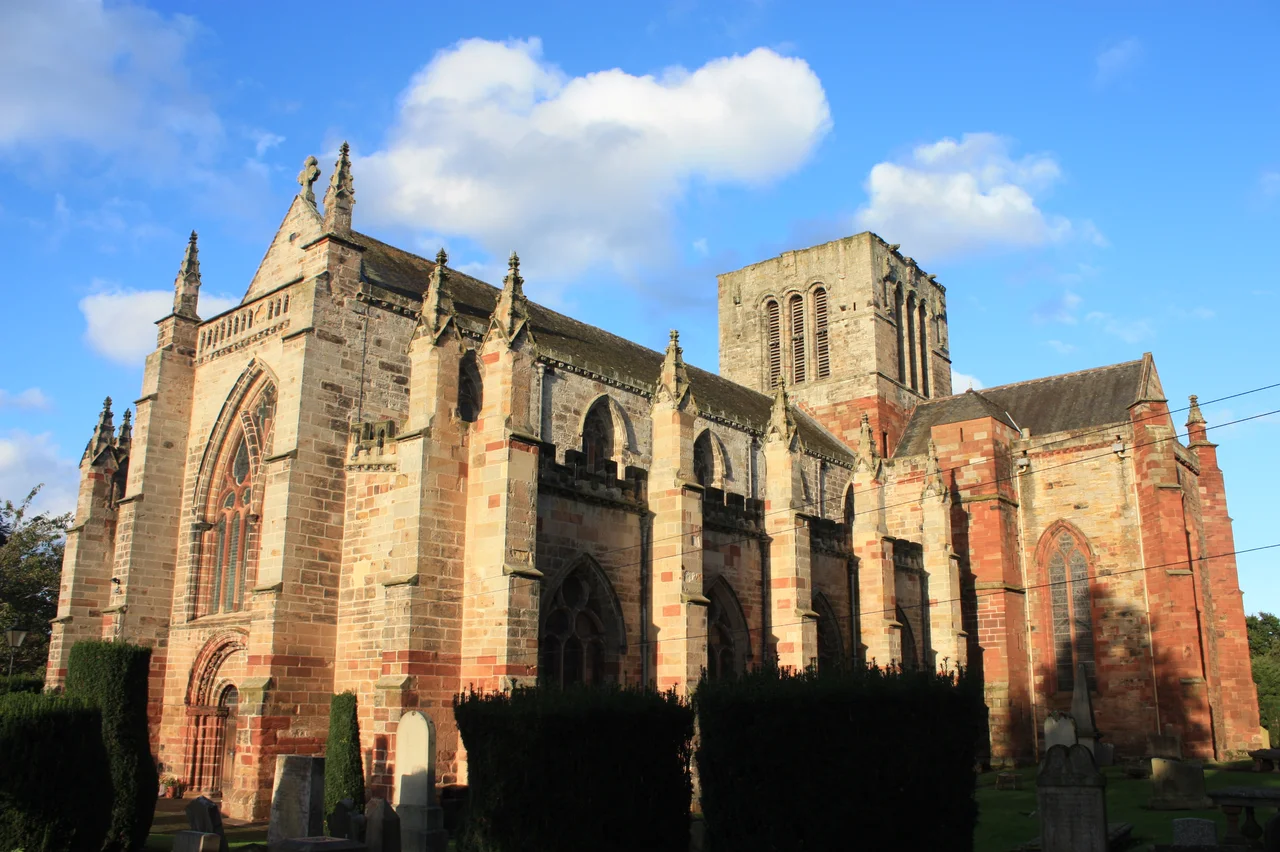

St Mary's Collegiate Church, Haddington
In January 1547, the reformer George Wishart preached two sermons at the parish church in Haddington. Standing below the pulpit, a two-handed sword in his hand, was a young notary from Giffordgate across the river: John Knox, then in his early thirties, soon to become the architect of the Scottish Reformation. Wishart would be burned at the stake at St Andrews two months later. Knox would survive to dismantle the Catholic Scotland that Wishart had died trying to reform. The pulpit they spoke from is gone, replaced in 1891 by a Glaswegian sculptor's elaborate carved version, but the church around it has stood for six centuries, the longest parish church in Scotland, the kirk that watched the Reformation arrive at its own front door.
Cathedral Without a Bishop
Building work on St Mary's began in 1380, with consecration around 1410 by Henry Wardlaw, Bishop of St Andrews. The structure was complete by 1462. It is cruciform, early Gothic in style, and 206 feet (62.8 metres) from end to end, longer than any other parish church in Scotland. The proportions are those of a small cathedral. The choir is aisled, four bays divided by buttresses, with simple curvilinear tracery in the windows and a foliate cornice below the eaves. The tower is cubic, with triple lancet windows on each face and decorative gargoyles. The corbelling at the top suggests the medieval builders intended a crown spire like the one on St Giles' Cathedral in Edinburgh, but whether they actually built it is not known. Whatever stood there, it was gone by the time the English army arrived in 1548.
What the English Took
St Mary's stands just south of Haddington on the floodplain of the Tyne, far enough out of town that it formed part of the besiegers' lines during the eighteen-month siege of 1548-49. The cannon that nearly killed Mary of Guise on 9 July 1548 was, according to the writer Ulpian Fulwell who heard the story from Haddington veterans, called 'Roaring Meg.' It was probably mounted near the nunnery just east of the church. The English garrison removed the three bells from the church tower the same year, and the tower stood silent for 451 years. Not until 1999 did St Mary's hear bells from its own steeple again. A set of eight bells, originally cast for the coronation of George V in 1911 and hung at Dunecht House in Aberdeenshire, were installed between March and May of that year and dedicated on 6 June by the Moderator of the General Assembly.
Burne-Jones and the Maitlands
Among the church's most beautiful possessions are two stained glass windows by Edward Burne-Jones: Christ and the Woman of Samaria from 1895, in the south wall, dedicated to the Reverend John Brown; and The Crucifixion with the Virgin and St John from 1877, in the south transept, donated by the Victoria and Albert Museum as part of a major restoration. The Lauderdale Aisle, a small Scottish Episcopal chapel off the north transept, holds the tombs of the Maitland family, including John Maitland, 1st Lord Maitland of Thirlestane (1537-1595) and John Maitland, 1st Duke of Lauderdale (1616-1682), the powerful chief minister of Charles II in Scotland. The medieval sacristy beside it has become an ecumenical chapel dedicated to the Three Kings of Cologne, who also feature in the iconography of the Maitland family arms.
The Lamp of Lothian
Haddington was the fourth-largest town in Scotland during the High Middle Ages, and the first chartered Royal Burgh. The church's revenues were granted to the monks of St Andrews by David I in a charter dated 1139, probably for a parish church on the site of the present choir. The town was burned twice in the thirteenth century by English kings: by John in 1216, and by his son Henry III in 1246. The most devastating attack came in 1356, when Edward III crossed the Lammermuir Hills as part of the campaign called the Burnt Candlemas and spent ten days sacking the town, destroying the Franciscan friary known as the Lamp of Lothian. By 1380 the townsfolk had recovered enough to begin the present St Mary's. They built it on the scale of what they had lost, perhaps as an answer to the kings who kept burning their town: a church too long, too tall, too well made to be easily destroyed again. Six and a half centuries later, it is still standing.
From the Air
St Mary's Collegiate Church sits on the River Tyne at 55.95N, 2.77W on the southern edge of Haddington in East Lothian. From the air the church is distinguishable by its great length running east-west (206ft, longer than any other Scottish parish church) and its position in open ground south of the town centre. Edinburgh Airport (EGPH) is 17nm west; Dundee Airport (EGPN) lies 22nm north across the Firth of Forth. The Garleton Hills rise just north; the Lammermuir Hills stretch south. North Berwick Law and Bass Rock are 8nm north. Best viewed at 1,500-3,000ft with good visibility.
Nearby Stories
- Leith 0.8 km away
- Crail 1.4 km away
- Falkland Palace 2.8 km away
- Peebles 8 km away
- Mellerstain House 9.9 km away
- Eyemouth Disaster 11 km away
- Battle of Homildon Hill 19 km away
- River Dee Ferryboat Disaster 99 km away