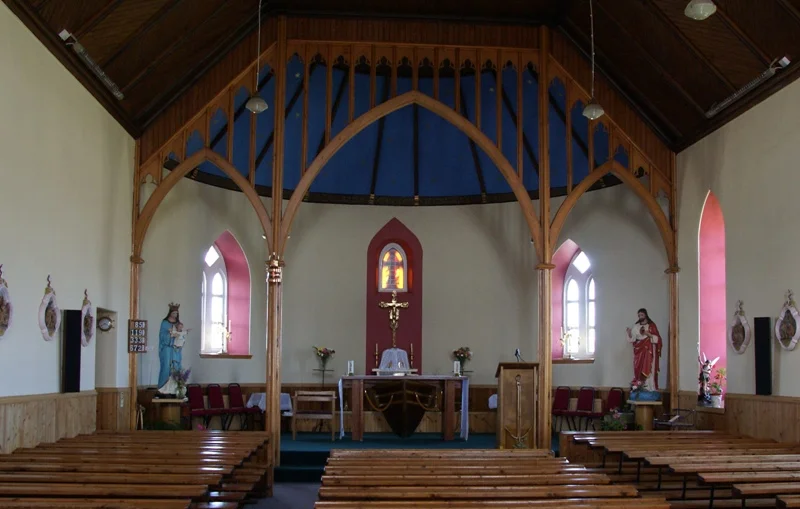

St Michael's Church, Eriskay
Walk into St Michael's of the Sea and the first thing your eye finds is the altar - and the altar is the bow of a boat. The priest celebrates Mass behind the prow of a vessel, with a ship's lamp burning on a nearby column. Outside on the hill, an iron bell hangs on an iron frame, salvaged from the SMS Derfflinger, a German battlecruiser scuttled at Scapa Flow at the end of the First World War. This is a Catholic church on Eriskay, a Hebridean island of fewer than two hundred souls, and every surface here remembers the sea.
The Priest Who Heard the Songs
The church was built in 1903 on the initiative of Fr Allan MacDonald, born 1859 and dead at forty-five in 1905, just two years after his church opened. He was a parish priest and something more - a folklorist and Gaelic poet who collected songs and prayers and stories from the women and men of South Uist and Eriskay during the years when crofters were being pushed off the land and a language was bending under the weight of English. The Scottish Gaelic literary tradition counts him among its most important modern figures, and his hymns are still sung in Gaelic-speaking parishes across the Hebrides. He chose the hill above the village so the church could be seen from the boats coming in - a beacon for the fishermen whose lives, and deaths, gave the parish its shape.
An Altar from a Boat
The building itself is plain - a Gothic apsidal church of coursed square rubble, painted margins picking out the corners, a slate roof, a small belfry corbelled out above the porch. None of this is what people remember. They remember the inside: the triple-arched chancel screen, the stone font that may have come from an earlier building lost to time, and above all that altar. The bow of a boat, supporting the table where the Eucharist is celebrated. On an island where men drowned often and the sea was both larder and grave, the symbolism was not metaphor. It was inventory. The fishermen brought what they had, and what they had was timber that floated.
A Bell from Scapa Flow
The iron bell is the strangest object on the property. In June 1919, the interned German High Seas Fleet was scuttled by its own crews in Scapa Flow, in Orkney, rather than be handed over to the victorious Allies. Among the ships that went down was SMS Derfflinger, a battlecruiser that had fought at Jutland. Decades later, salvage operations raised pieces of the German fleet, and somehow - by what chain of hands no one quite remembers - one of Derfflinger's bells found its way to a small parish on Eriskay, where it now rings on an iron frame to call the faithful. A weapon of imperial war, repurposed as a summons to prayer. The Hebrides have a long history of taking what the sea gives back.
The Island Around the Church
Eriskay itself is barely three miles long. It is famous in song - the Eriskay Love Lilt, collected by Marjory Kennedy-Fraser in the early twentieth century, became one of the best-known Gaelic melodies in the world - and famous in story, as the place where Bonnie Prince Charlie first set foot on Scottish soil in July 1745 to launch his doomed Jacobite rising. It is also famous for the SS Politician, the ship that ran aground here in 1941 carrying 264,000 bottles of whisky, an event Compton Mackenzie turned into the novel Whisky Galore. The church on the hill watches all of this. Since 2002 a causeway has linked Eriskay to South Uist, ending centuries of isolation, but St Michael's still looks out over the same water and waits for the same boats.
From the Air
St Michael's Church sits at 57.087 degrees north, 7.307 degrees west, on a hill above the village of Haun on Eriskay, in the southern Outer Hebrides. The nearest airport is Benbecula (ICAO: EGPL), about 30 nautical miles north on the same island chain. Barra Airport (EGPR), to the south, is closer in line of sight but lands on a tidal beach. From the cockpit at 4,000 feet on a clear day, the church is recognizable as the white-and-grey building topping the rise above the Eriskay-South Uist causeway, with the Sound of Barra to the south and the Atlantic stretching empty to the west. Westerly weather and low cloud are the norm.
Nearby Stories
- Canna 8.3 km away
- Our Lady of the Isles 10 km away
- Wiay, Inner Hebrides 11 km away
- Coll 18 km away
- HMS Sturdy (1919) 35 km away
- St Kilda, Scotland 76 km away
- SS Athelstane (1941) 102 km away
- German submarine U-516 130 km away