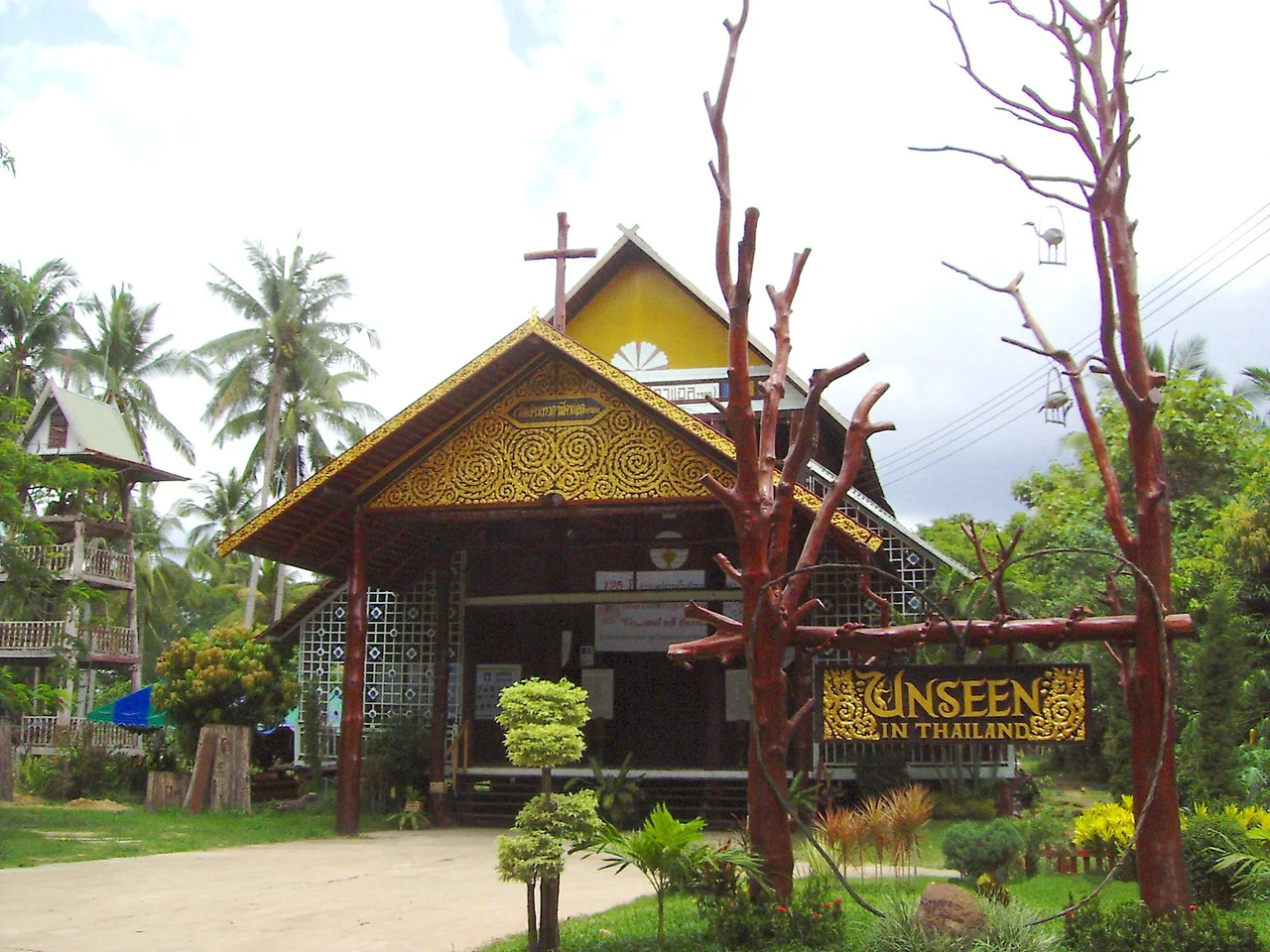

St Michael's Church, Songyae
The first five families arrived at Ban Nong-Song-Yae in 1908 under a cloud. Some had been accused in their former villages of being possessed by spirits — an accusation that, in early-twentieth-century rural Isan, was serious enough to make a person leave. They settled in the marshy land named for its butterfly lizards (the yae of Song-Yae), near the fenland pools the Nong in the village name describes. News reached them of a Catholic priest in a nearby village, and within a year two French missionaries — the Reverends Desaval and Ambrosio — were making monthly visits, staying four or five days at a stretch, sleeping in a rough shelter the congregation built for them. That shelter became the first chapel. What stands today, a century and four constructions later, is billed as the largest wooden church in Thailand.
A Century of Building and Rebuilding
The congregation grew faster than its buildings. The first chapel of 1909 gave way to a second church within years; the second proved too small within a few years more. A third structure, built like a large terrace house with bamboo walls and a wooden roof, stood near the fens until fire damaged four of its six rooms. The congregation repaired it, expanded it, and kept going. By 1919 — just a decade after that first shelter — 400 people were attending services at Song-Yae. The scale of that growth in a remote northeastern Thai village speaks to something that went beyond religious conversion: the community offered belonging to people who, in their previous homes, had been accused of harboring spirits. The church gave them a different story about themselves.
War, Wood, and the Fourth Church
The fourth construction — the building that stands today — has its own difficult history embedded in it. When the Reverend Alazard arranged for 60 cartloads of timber to be delivered in 1936, Thai authorities confiscated the wood before a single plank could be raised. It took another decade. In 1947, under the Reverend Montree, plans were drawn for a church 57 meters long and 16 meters wide, built entirely of timber in a classic Thai style. Skilled carpenters completed the building in 1953. On Sunday, 25 April 1954, Bishop Chaudius Baye presided over the consecration of the fourth church of St. Michael — a ceremony that marked not just a building's completion but a community's century of persistence. The structure was that unusual thing in Thailand: a church built not in the imported European style but in the architectural language of the place that built it.
Termites, Donors, and Restoration
Wood in tropical climates is always a negotiation with time. In 1981, a donation of 200,000 baht from a Bangkok patron replaced the wooden roof with corrugated iron, extending the building's life. In 1994 the real reckoning arrived: termites had eaten 124 of the church's 227 structural poles. Pastor Boonlert Promsena oversaw the replacement of more than half the building's supports, along with new floor planks, elevated door and window frames, and a complete repaint inside and out. A third restoration, beginning in 2006, prepared the church for its centennial celebration in 2008. That anniversary was followed the next year by the opening of a small museum honoring the Reverend Desaval — the man who had made the first monthly visits on horseback more than a hundred years earlier.
What Stands Today
The Tourism Authority of Thailand has designated St. Michael's Church, Songyae as a heritage site of the sort they call Unseen in Thailand — places so distinctive and so off the beaten path that they belong in a category by themselves. The church grounds cover about 100 rai, or 16 hectares, and include the fully accredited Songyae Wittaya school serving kindergarten through senior high school students from the surrounding community. The church itself remains active; services continue in the same timber-framed nave where the congregation gathered for its 1954 consecration. The satellite communities that spun off from Song-Yae over the decades — families who resettled in Udon Thani, Roi Et, Phetchabun, and other provinces — still fall under the pastoral care of St. Michael's parish. The marsh and its butterfly lizards gave the village its name. The wooden church gave it its identity.
From the Air
St. Michael's Church, Songyae is located at approximately 16.07°N, 104.38°E in Thai Charoen District, Yasothon Province, northeastern Thailand. The church sits in a flat agricultural landscape typical of Isan. At 2,000–4,000 feet the distinctive compound — including the long timber church building and school grounds covering 16 hectares — should be identifiable among the surrounding rice paddies. The nearest major airport is Ubon Ratchathani Airport (UBP), roughly 75 km to the south-southeast.
Nearby Stories
- Yasothon 11 km away
- Phu Sa Dok Bua National Park 14 km away
- Mukdahan 56 km away
- Ubon Royal Thai Air Force Base 64 km away
- National Route 9 (Vietnam) 102 km away
- Ban Chiang 139 km away
- 2022 Nong Bua Lamphu Massacre 209 km away
- Scam Centers in Cambodia 271 km away