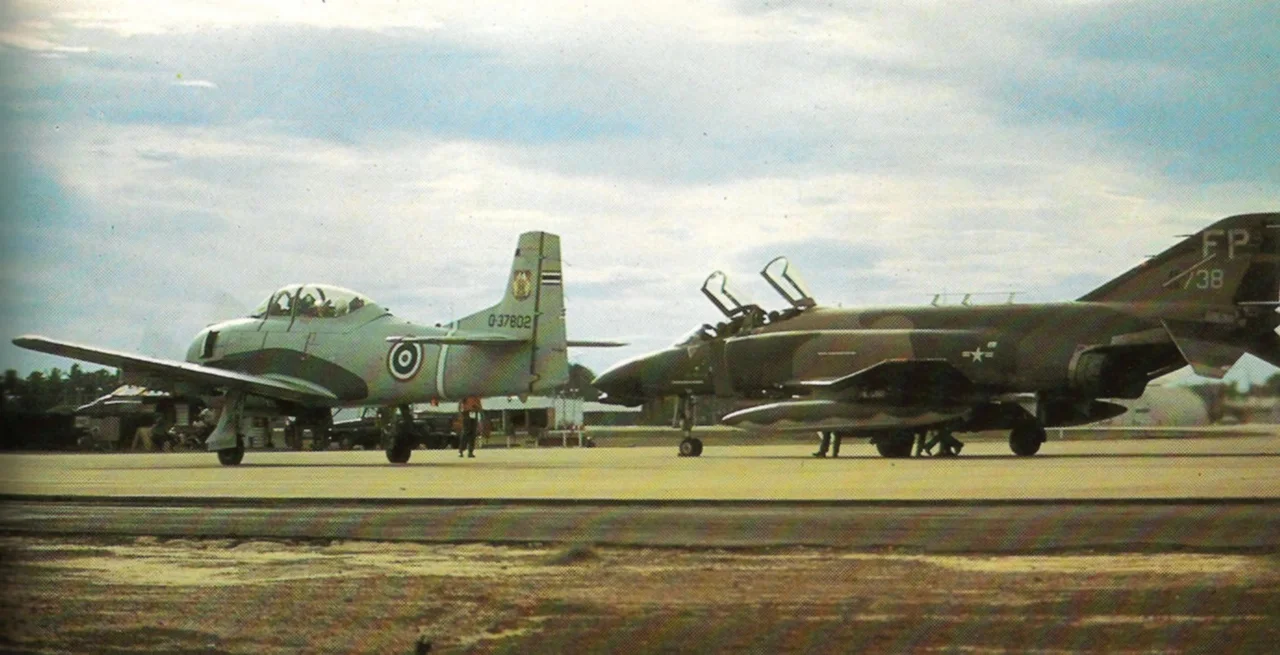

Ubon Royal Thai Air Force Base
The call sign was Channel 51. In pilot radio chatter over North Vietnam during the 1960s, those two words meant one thing: Ubon. The base sat in Ubon Ratchathani Province in Thailand's far northeast, about 60 kilometers from the Laos border — close enough to the war to matter enormously, far enough away that official Washington could keep the arrangement quiet. What happened here between 1965 and 1974 was, for years, one of the worst-kept secrets in Southeast Asia.
A Gentleman's Agreement
Ubon Royal Thai Air Force Base was established in the 1950s, a modest installation at the edge of Thailand's Isaan plateau. It might have stayed that way — a regional airfield commanding broad flat rice country — had events across the Mekong not intervened. When communist forces threatened to tip the balance in Laos in the early 1960s, Thailand quietly agreed to allow the United States to use five Thai air bases, Ubon among them. The arrangement was never officially acknowledged. Thai officers formally commanded their respective bases; US Air Force security police assisted with perimeter defense. The Army Post Office mailing address for American personnel at Ubon listed San Francisco, giving no hint of where letters were actually going. It was a bilateral fiction that suited everyone — until the fighter jets started arriving in numbers too large to ignore.
The Wolfpack Arrives
On 8 December 1965, the 8th Tactical Fighter Wing — known as the Wolfpack — touched down at Ubon from George Air Force Base in California. They brought F-4 Phantoms and a mission: support Operation Rolling Thunder, the sustained bombing campaign against North Vietnam. Within six months of arriving, the Wolfpack had flown more than 10,000 combat sorties and achieved a 99% sortie rate that earned the wing official commendations. But the moment that made the Wolfpack famous came in late December 1966, when the wing's commander, Colonel Robin Olds, conceived an audacious deception. The North Vietnamese Air Force had been avoiding American fighters by identifying them through their electronic signatures. Olds proposed flying Phantoms with the electronic profile of slower, less capable F-105s — a lure. Operation Bolo launched on 2 January 1967. Seven MiG-21s were shot down. Not a single American aircraft was lost.
Allies from Across the Pacific
The Americans were not the only ones who made Ubon their wartime home. On 31 May 1962, the Royal Australian Air Force sent eight CAC Sabre fighters to the base, designating the detachment No. 79 Squadron. The Australians built their own facilities at what became known as RAAF Ubon, and their mission was to provide top-cover for American aircraft while in Thai airspace. On 10 July 1965, pilots of the 45th Tactical Fighter Squadron flying from Ubon were credited with the first USAF aerial victory of the Vietnam War, shooting down two North Vietnamese MiG-17s. The base also pioneered some of the war's stranger technologies. In February 1968, LORAN-equipped Phantoms began dropping electronic sensors along the Ho Chi Minh Trail as part of Operation Igloo White. That same month, the first prototype AC-130A gunship flew its inaugural combat sortie from Ubon, destroying nine trucks and two logistics sites in Laos before going on to transform close air support.
Life on Alert
The air war was not Ubon's only drama. At 10:30 p.m. on 13 January 1970, a Thai villager reported seeing 16 armed Vietnamese moving toward the perimeter. The base went on full alert. Just after 2:00 a.m., a security policeman fired on a sapper who had breached the inner fence. The engagement that followed was brief but intense: five sappers were killed, and 35 satchel charges were found on their bodies. The base also had the distinction of being the only USAF airfield in Thailand that operated opposite-direction runway traffic — aircraft landed on runway 23 and departed on runway 05. It was an operational quirk that complicated every approach briefing and became a point of orientation for veterans swapping stories decades later.
What the Base Became
The last American units departed Ubon in September 1974. What the US Air Force left behind was a well-developed dual-use airfield that the Royal Thai Air Force built upon for the coming decades. Today the base is the home of Wing 21 of the RTAF's 2nd Air Division, and the 211 Squadron Eagles fly Northrop F-5E/F Tiger II fighters from the same tarmac where Phantoms once launched by the hundreds. The civilian terminal at Ubon Ratchathani Airport shares the field, connecting Isaan's largest city to Bangkok and beyond. The runway numbers have changed; the control tower coordinates the same skies. The war receded, but the infrastructure it built remained.
From the Air
Ubon Royal Thai Air Force Base sits at 15.2511°N, 104.87°E on a flat plain in northeastern Thailand. Recommended viewing altitude is 3,000–5,000 feet for a clear overview of the dual-use airfield and the surrounding Isaan rice country. The Mun River is visible to the north and east. The nearest civil/military airport is the airfield itself (ICAO: VTUU). The Laos border lies roughly 60 km to the east, and the confluence of the Mun and Mekong Rivers is about 80 km northeast.
Nearby Stories
- Kaeng Tana National Park 10 km away
- Sisaket 14 km away
- Vat Phou 39 km away
- Ban Singh Tha 46 km away
- Amnat Charoen 57 km away
- Khao Phra Wihan National Park 60 km away
- Anlong Veng 86 km away
- Tadlo 87 km away