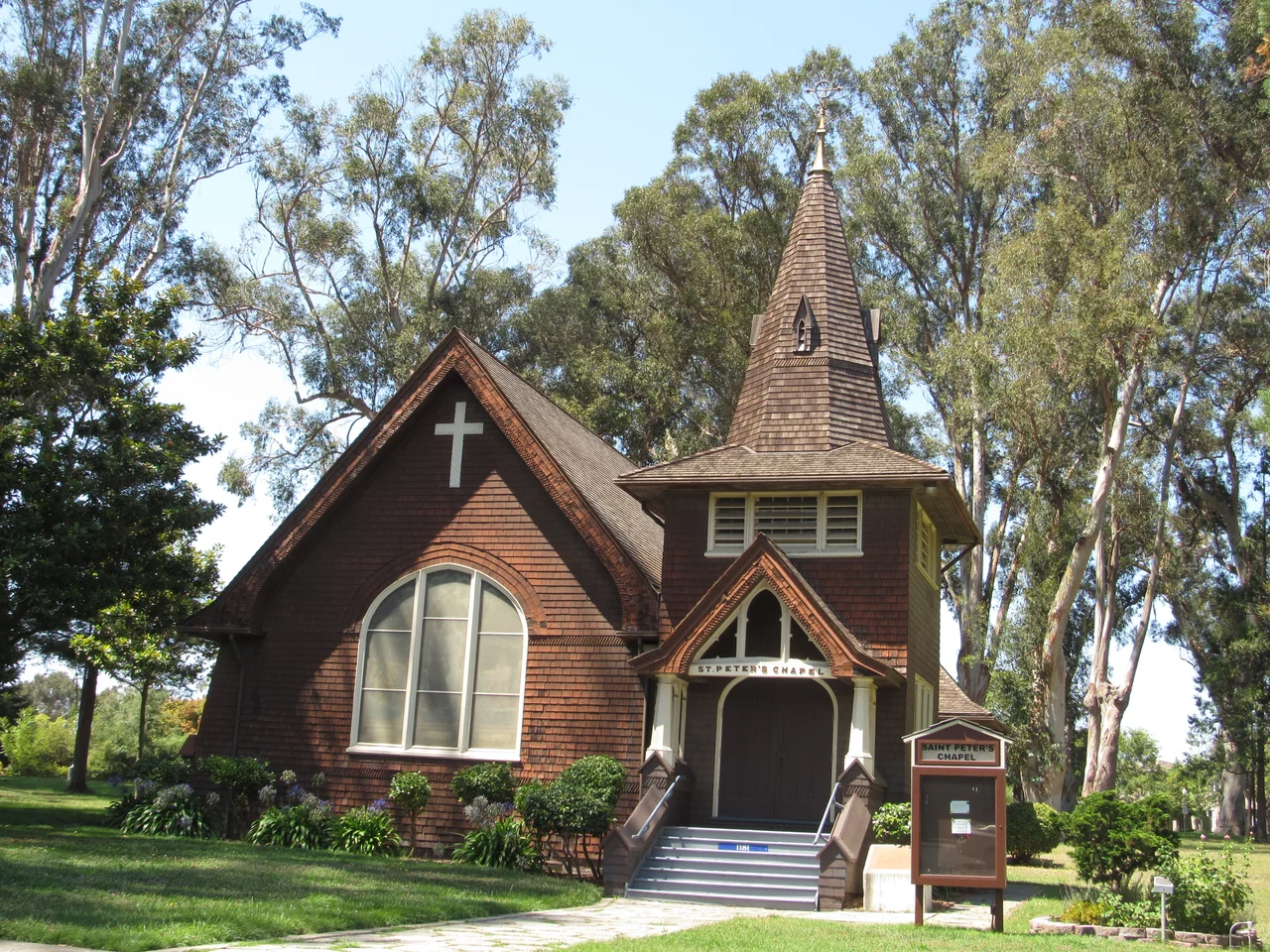

The Navy's Tiffany Chapel
Walk into St. Peter's Chapel on Mare Island and the first thing you notice is not the wooden pews or the cruciform floor plan. It is the light. Filtered through one of the largest collections of Tiffany stained glass windows gathered under a single roof, sunlight enters this small Shingled Gothic church in shades of cobalt, emerald, and gold. Each window memorializes a Navy life -- an admiral, a chaplain, the women of the Navy and Marine Corps. Dedicated on October 13, 1901, this is the oldest extant Naval chapel in the United States, the first interdenominational chapel in the armed services, and a building whose story is inseparable from the community it served for nearly a century on the shores of the Mare Island Naval Shipyard.
A Chaplain's Persistence
For decades, Reverend Adam A. McAlister held services in whatever room on the base could be temporarily rigged for worship -- a practice the Navy called being "rigged for church." McAlister had served as Mare Island's chaplain since 1873, and the makeshift arrangement rankled him. He was a man who could endure the Navy's bureaucratic indifference, but not forever. Eventually he leaned on his friendship with U.S. Senator George C. Perkins, convincing him to slip a $5,000 appropriation into the 1900 Naval Appropriations Act for chapel construction. Architect Albert Sutton drew up a wood-framed, one-story cruciform church on a brick foundation, oriented east to west with the sanctuary and altar at the western end. The building was largely complete by October 1901, though Sutton's full plan was not finished until 1904. McAlister had his chapel. He would spend the rest of his life filling it with memorials.
Windows Like No Other
The stained glass arrived window by window over the next fifteen years, most of it donated by families of Navy personnel in memory of loved ones who had served. The Tiffany Studios pieces are the collection's crown jewels. On the right side of the sanctuary, a pastoral scene depicts the Good Shepherd, dedicated to Chaplain McAlister himself with the inscription: "To whose devotion to this Chapel the placing of many of its Memorials is due." High above the altar, a nine-foot-round Rose window shows the ascendant Christ, dedicated to those "in the U.S. Navy and Marine Corps who served on the Pacific Ocean." The final memorial window, installed in 1930, came not from Tiffany but from Cummings Studio: a Madonna and Child inspired by Nicolo Barabino's painting "The Madonna with the Olive Branch," inscribed "To the Women of the Navy and the Marine Corps." Nearly all the art glass was in place by McAlister's funeral at the chapel in 1916.
Where the Navy Married
St. Peter's Chapel was more than a place of Sunday worship. For generations of Mare Island families, it marked every passage that mattered -- baptisms, weddings, funerals. The chapel's guest books read like a social history of the Pacific Fleet. During World War II, the pace of weddings accelerated sharply as young sailors married before shipping out to the Pacific Theater, uncertain whether they would return. Historian McDonald observed that "the chapel, more than any other building, bears witness to the closeness of the community that developed at the Mare Island Naval Shipyard." The commemorative tablets on the walls and ceiling accumulated alongside the windows, each one placed by parishioners and donors, each one a thread connecting the living community to its honored dead.
After the Shipyard Closed
Mare Island Naval Shipyard shut down in 1996 after 142 years of continuous operation, the longest-serving naval shipyard on the Pacific Coast. The closure left St. Peter's Chapel stranded on a former military base transitioning to civilian use. But the building endures. Its cruciform shape remains mostly intact, altered only by a 1929 rear addition for the organ and two modest 1963 side additions that were carefully integrated into the original design. The brick foundation still supports the original wood frame. The Tiffany windows still catch the morning light. Listed as a National Historic Landmark, the chapel stands as evidence that the most lasting things built on a military base are not the dry docks or the machine shops, but the places where people gathered to mark the moments that mattered most.
From the Air
Located at 38.094N, 122.270W on Mare Island in the Napa River, adjacent to Vallejo, California. The island is easily identifiable from the air as a narrow peninsula extending south into the strait. The chapel sits in the historic core of the former Mare Island Naval Shipyard, among the older brick and wood-frame buildings. Nearby airports include Napa County Airport (KAPC) 12nm north and Oakland International (KOAK) 25nm south. Buchanan Field (KCCR) is 15nm east.
Nearby Stories
- Rancho Nicasio 2.6 km away
- From Wartime Runways to Racing Legends 3.9 km away
- Ghost Ship Warehouse Fire 5.5 km away
- Altamont Free Concert 9.2 km away
- The Night Napa Burned 10 km away
- Isleton: The Half-Square-Mile Town That Made Perry Mason Famous 12 km away
- The Last Lakes in the Valley 14 km away
- The Farallon Islands: California's Forbidden Rock 29 km away