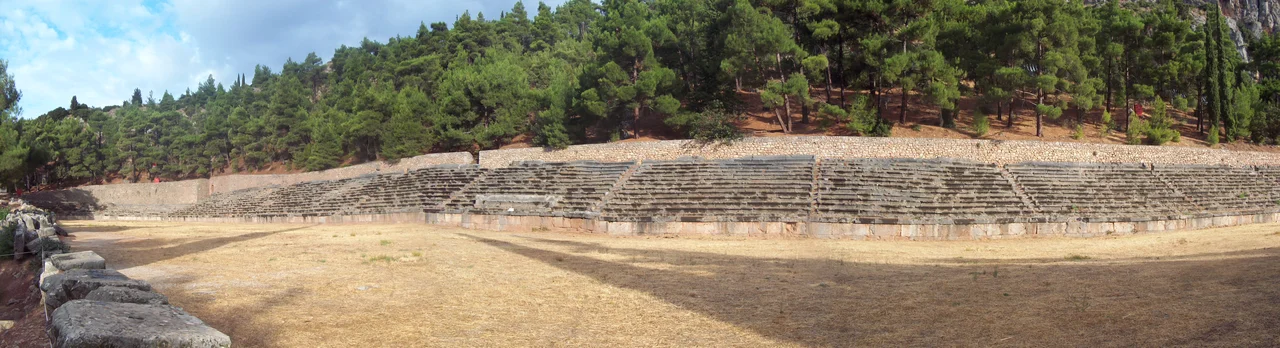

Stadium of Delphi
Climb past the theater, past the Temple of Apollo, past the treasuries and the Sacred Way, and keep climbing. The stadium is at the top — the highest point of the entire archaeological site, tucked against the mountain above everything else. From here the runners could not see the oracle or the temple or the sea. They could see the cliffs of Parnassus above them, the valley below, and the lane of packed earth stretching 177 metres ahead. The stadium of Delphi occupied the most elevated spot in the sanctuary by design: it was where the Pythian Games' physical contests were held, separate and above the religious architecture, as if the effort of athletes belonged to a different altitude than the effort of priests.
Built for Speed and Victory
The stadium at Delphi — epigraphically attested as the "pythikon stadion" — was not built all at once. Archaeological study reveals at least four distinct construction phases. The initial architectural formation dates to either the second half of the 4th century BC or the mid-3rd century BC, roughly coinciding with the Soteria festival, the ceremonial celebration of Delphi's victory against the Galatian invasion. The Aetolian League, which had championed that defense, may have funded the early construction.
The track is 177.55 metres long and 25.50 metres wide. At its peak, up to 20 athletes could run simultaneously, though the lanes were later reduced to 17. The aphesis — the starting positions — were cut from stone, and their grooves survive. The north side of the stadium rested against the natural slope of the mountain; the south side required a constructed retaining wall to support the spectator tiers. Those stone tiers were not added until around 100 BC. A final restoration in the Roman period replaced earlier earthen banks with stone revetment throughout.
Where Music Happened Too
The Pythian Games at Delphi were unusual among ancient Greek festivals for blending athletic and artistic competition, and the stadium seems to have served both. An inscription from the 2nd century BC records a performer named Satyr of Samos who sang a hymn "for the god and the Greeks" to the accompaniment of a string instrument within the stadium itself — evidence that musical contests were held in the same space as foot races. This overlap of physical and artistic performance reflects the broader character of the Pythian Games, which ranked cultural events as seriously as athletic ones.
Another inscription embedded in the eastern side of the stadium's retaining wall forbids removing wine intended for sacred rituals. Archaeologists note that the inscription may not be in its original location, suggesting the stone was reused in a later phase of construction — a small mystery in the margins of the stadium's long history of modification and repair.
The Best Preserved in Greece
What makes the Delphi stadium exceptional is not its size — the stadium at Olympia is larger — but its state of preservation. The stone starting blocks with their runners' grooves are still in place. The retaining wall stands. The tiered seating survives in recognizable form. The mountain that sheltered the north side of the track served it well: landslides that damaged other parts of the Delphi sanctuary left the stadium largely intact, protected by the ridge behind it.
The view from the stadium is part of the experience. The sanctuary below — the theater, the Temple of Apollo, the great polygonal retaining wall — is visible from the upper tiers. Beyond it the Pleistos valley opens southward to the Gulf of Corinth, shimmering in the distance on clear days. Ancient spectators watching the Pythian runners would have had this entire panorama as a backdrop: cliffs above, valley below, sea beyond. Victory here was witnessed against one of the most dramatic landscapes in the ancient world.
Arriving at the Top
The Sacred Way winds up through the sanctuary in a series of switchbacks, past the Athenian treasury, past the Sibylline Rock, past the Omphalos stone and the Castalian dedication, to the theater and finally to the stadium gate. The climb takes time. By the time a Pythian-era pilgrim reached the track, they had passed every major monument in the sanctuary — the gifts of dozens of city-states, the spoils of war arranged as offerings, the treasury buildings of Athens and Siphnos and Thebes. The stadium was the destination at the end of a long processional. Reaching it was itself an accomplishment.
Today's visitors make the same climb, though the route is more direct. The stadium stands quiet between visiting groups, its stone starting blocks worn smooth by centuries of weather. In summer the mountain air is cooler here than in the valley below. The Phaedriades cliffs cast shadows in the afternoon. It is easy, sitting in the ancient tiers, to imagine the sound of the crowd filling the valley.
From the Air
The Stadium of Delphi lies at approximately 38.482°N, 22.497°E, at the highest point of the archaeological site of Delphi on the south slopes of Mount Parnassus. From the air, it is visible as a long narrow clearing above the main terrace complex of the sanctuary — look for the elongated rectangular shape set against the mountain slope. The theater is immediately below, then the Temple of Apollo terrace. The Pleistos valley and Gulf of Corinth are spread to the south. Recommended viewing altitude: 3,000–5,000 ft for full context. Nearest major airports: LGRX (Araxos, ~80 km south across the Corinthian Gulf) and LGAV (Athens Eleftherios Venizelos, ~150 km east, main visitor gateway). The white limestone Phaedriades cliffs above the stadium are a vivid navigation marker visible from considerable distance.
Nearby Stories
- Battle of Leontion 2.8 km away
- Siege of Livadeia 3.1 km away
- Pyre of Heracles 8.2 km away
- Corinth Rail Disaster 8.8 km away
- Rio–Antirrio Bridge 9.9 km away
- Heraion of Perachora 13 km away
- Prousou Monastery 15 km away
- Free and Real 30 km away