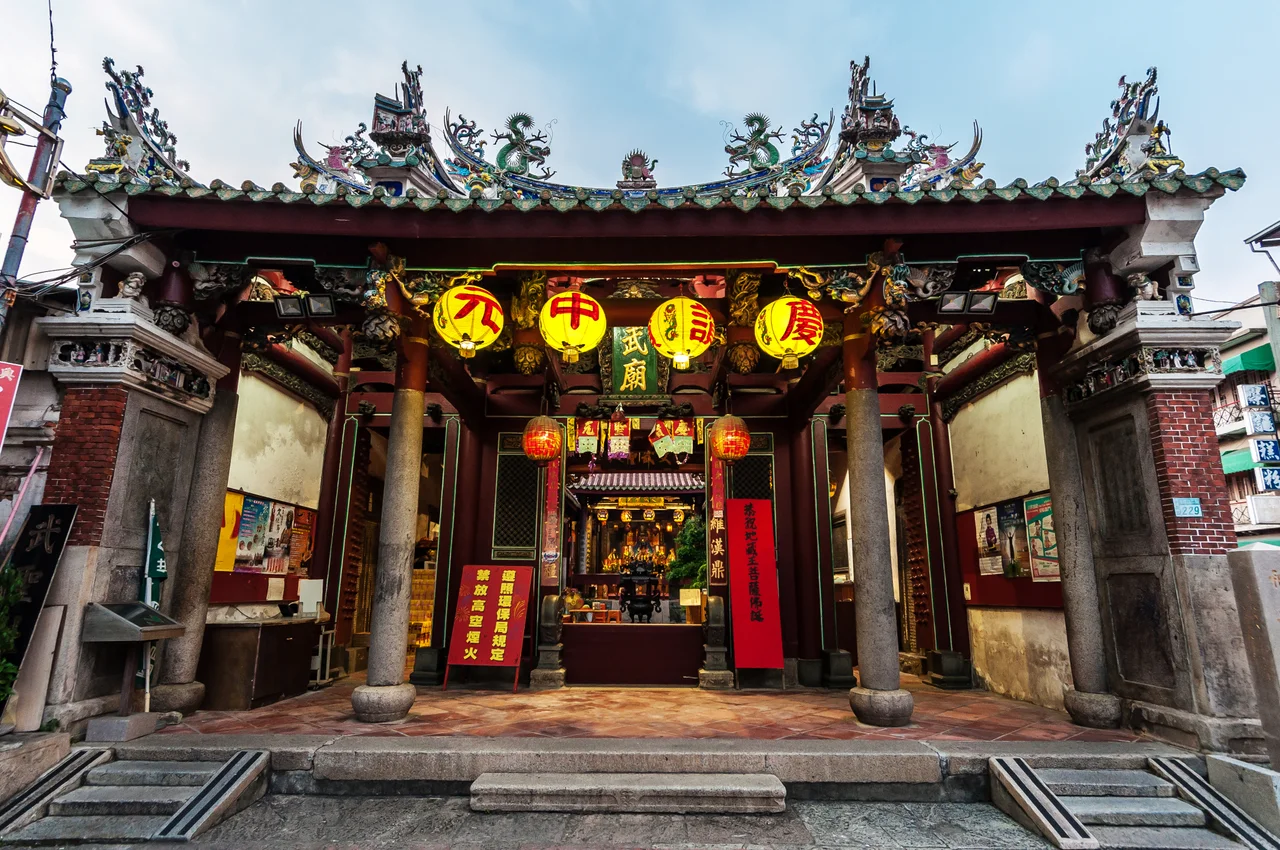

State Temple of the Martial God
When the sun shines through the windows of the State Temple of the Martial God, the floor appears to be covered in coins. The windows are shaped like traditional Chinese currency, circular with a square hole in the center, and the light passing through them casts golden discs across the stone. This is fitting. Guan Gong, the deity enshrined here, was a third-century warrior famed for loyalty, courage, and righteousness. He also became, through one of religion's stranger turns, the patron saint of accountants. The temple built in his honor in 1663 sits on Yongfu Road in Tainan's West Central District, occupying what was once the palace of Koxinga and the Prince of Ningjing, Ming dynasty royals who retreated to Taiwan as their dynasty collapsed.
From Royal Palace to Sacred Ground
Zheng Jing, the eldest son of Koxinga, built this temple in 1663, transforming part of the Ming royal compound into a place of worship for Guan Gong. The statue at the main altar was carried to Taiwan from Fujian Province by relatives of the Prince of Ningjing during the dynasty's final years, and it has not moved since. The temple was renovated and expanded in 1690 and again in 1716, achieving roughly its present form. In 1725, a shrine for three generations of Guan Yu's family was added. Two years later, the Qing government elevated it to the status of an official state temple. The three red doors at the main entrance bear 72 studs on the central door and 54 on each smaller door, all multiples of nine, a number reserved for royalty, a reminder that this was once a palace.
Architecture Without Nails
The temple is a masterclass in Southern Min architectural style, the Hokkien building tradition that flourished in Fujian Province during the Ming dynasty. Its most distinctive external feature is the long, high red wall along Yongfu Road, called a horseback-style wall for its resemblance to a horse's bare back. Above the wall, five different roof styles are visible, the most ornate being the swallow-tail design typical of Hokkien temples. Dragons decorate the rooflines. Above the entrance, carvings of elephants, dragons, and qilin, a mythical creature with a dragon's head and a winged horse's body, guard against evil. Where columns meet beams, lotus-shaped decorations conceal the structural studs. According to tradition, no nails were used in the temple's construction; everything holds together through joinery and these hidden fasteners.
A Temple for Every Need
The State Temple of the Martial God is less a single temple than a small spiritual ecosystem. Behind the main Guan Gong altar, a smaller Guanyin temple houses a statue famous for its benevolent, slightly downcast expression that appears to follow visitors. On either side stand rows of nine Buddhist monks, the 18 Arhats who protect the dharma. Adjacent to Guanyin's temple, the Five Examination Gods receive offerings from students who write their names and test dates on pink slips of paper, returning with red string decorations if they pass. Across the way, the Yue Lao temple draws singles seeking soulmates, who bring wedding cake and fruit in gratitude if love arrives. Behind everything, a rear courtyard contains a fish pond, a fire god temple, and a plum tree said to be over 300 years old, beneath which poets once composed verses and musicians played.
The Horse God Across the Road
Across Yongfu Road, where the street curves opposite the temple entrance, stands a small horse god temple. Nearly every Guan Gong temple has one. Because Guan Gong was always depicted astride his famous Red Hare horse, his followers built separate shrines to honor the animals that served him. The horse god takes the form of a soldier who tends the horses. It is a small gesture of completeness, a detail that speaks to the depth of devotion this temple has sustained for over 360 years. A nameplate above the main entrance, presented by a Qing dynasty general in 1791, reads "Da Zhang Fu," three characters meaning great man of courage, strength, and loyalty. The words describe Guan Gong. They also describe the kind of devotion that keeps incense burning in a temple that began as a palace in the dying days of a dynasty.
From the Air
The State Temple of the Martial God is located at 22.9964N, 120.202E in Tainan's West Central District, along Yongfu Road. The temple complex with its distinctive five-roof profile and long red horseback-style wall is identifiable from lower altitudes. The horse god temple sits directly across the road. Nearby landmarks include the Grand Matsu Temple and Tainan Confucian Temple. Tainan Airport (RCNN) lies approximately 5nm south. Best viewed below 2,000 feet where the multiple roof styles become distinguishable.
Nearby Stories
- Chung Li-ho Museum 0.7 km away
- Jingzaijiao Tile-paved Salt Fields 8 km away
- Wanchin Basilica of the Immaculate Conception 9.3 km away
- Namasia District 16 km away
- Battle of Penghu 21 km away
- Shoushan (Kaohsiung) 21 km away
- Penghu Air Raids 62 km away
- Daya Bay 512 km away