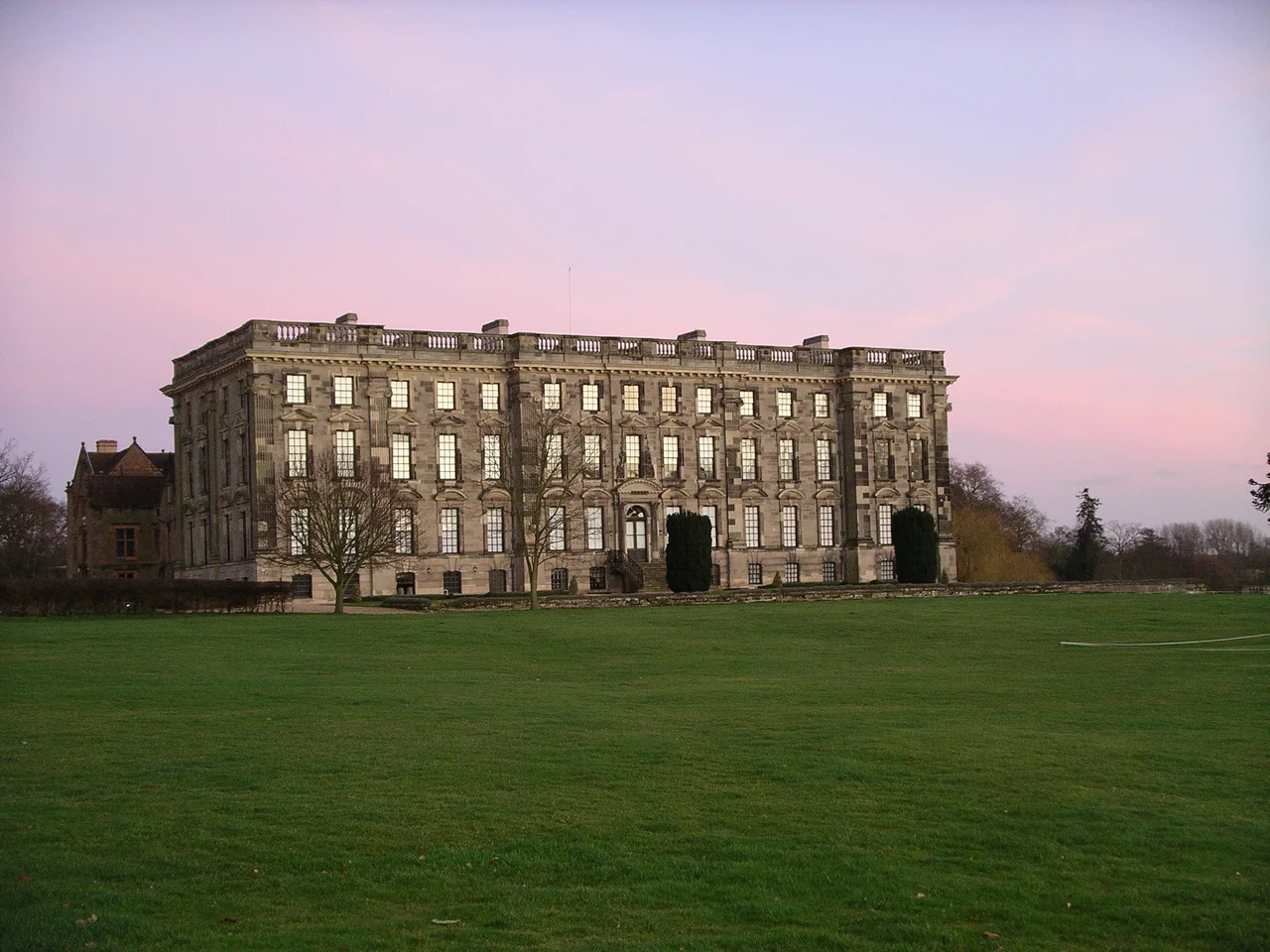

Stoneleigh Abbey
Jane Austen arrived at Stoneleigh Abbey in August 1806, in the company of her mother and sister Cassandra, to inspect a great house that had unexpectedly come into the family. Her cousin once removed, the Reverend Thomas Leigh, had inherited the place; the Austens had come along to see it. Three years later, in 1809, Humphry Repton delivered his Red Book of proposals for the grounds to Reverend Leigh, recommending that the River Avon be redirected to create a mirror lake in which the west front of the house would be perfectly reflected from the far bank. Twelve years later Jane Austen would publish Mansfield Park, in which a fictional landscape gardener named Repton makes improvements to the grounds of a fictional Sotherton Court. The Austen scholars have argued about it ever since, but there is no serious doubt about where she got the idea.
Cistercians in the Forest of Arden
In 1154 Henry II granted land in the Forest of Arden to a community of Cistercians who had moved south from Staffordshire. The abbey they built occupied this stretch of the upper Avon valley until the Dissolution of 1536, when Henry VIII's commissioners arrived to dissolve it like the others. Of the medieval fabric only the fourteenth-century Gatehouse survives recognisably, standing apart from the main house - a stone fragment of the original monastic complex around which everything else was built or rebuilt. The estate was acquired by Sir Thomas Leigh, Lord Mayor of London when Elizabeth I came to the throne in 1558. The Leigh family would remain at Stoneleigh for the next 432 years.
A Barony for Closing the Gates
In 1642 the Leighs did Charles I a favour that would prove dynastic. When the king arrived at Coventry on his way to fight the Parliamentary armies, he found the city gates closed against him - the citizens had decided which side they were on, and it was not the king's. Sir Thomas Leigh of Stoneleigh opened his house to the royal party instead, providing hospitality and shelter in the days before the battle of Edgehill. Charles rewarded him afterwards with a barony. The Leigh family kept their loyalty to the Crown through the wars that followed, and the title with it. A house they had built into the surviving north and east wings of the monastic complex became the seat of a peerage.
Baroque Plasterwork and Georgian Splendour
Between 1714 and 1726 Edward, third Baron Leigh, commissioned the Warwick-based architect Francis Smith to build a vast new west wing onto the old house - a four-storey, fifteen-bay block of pale silver-coloured stone in the baroque style then fashionable. Its great Saloon is one of the finest interiors of Georgian England. Andor Gomme, the architectural historian, called it almost the swansong of baroque figurative plasterwork in England - ceiling and walls writhing with classical figures, military trophies, fruit, and foliage in white plaster against pale grounds. The Saloon was the room into which guests were brought to be impressed, and almost three centuries later it still does its job. Queen Victoria came for two nights in 1858 and was given a five-room suite where the mahogany furniture had been painted white and gold because, William Henry Leigh had been told, this was the Queen's preference.
Cricket Pitches and Sixpence Bribes
By the early nineteenth century the view from the new west wing had been improved by the removal of pigsties, sheds, and other unsightly outbuildings that had once stood in the yard - a relocation prompted partly by Georgian theories about the health risks of farm buildings standing too close to the house. Where the outbuildings had been, a cricket pitch was laid out. Edward Chandos Leigh, second son of William Henry, was an enthusiastic cricketer, and the family obliged him. Lord Leigh used to offer a silver sixpence to any boy who could break a window of the house with a ball. The pitch is still used today by Stoneleigh Cricket Club; Wisden once voted it the most beautiful cricket ground in England. The west wing also contains a bust of Lord Byron by Edward Hodges Baily - Byron had been a schoolfriend of Chandos Leigh at Harrow, and the two had dined together the day before Byron left England for the last time in April 1816.
Fire, Lottery Money, and the Royal Show
A serious fire in 1960 damaged the west wing. The Leigh family transferred the house and its 690-acre estate to a charitable trust in 1996, and between 1996 and 2000 a major restoration - funded by a £7.3 million Heritage Lottery Fund grant alongside £3 million from English Heritage and the European Union - employed up to 45 stonemasons and used more than a thousand tonnes of Grinshill stone to rebuild the exterior. The parkland hosted the Royal Show, the annual showpiece of English agriculture, from 1963 until 2009, when the show ended. Today the abbey is open to the public, the Orangery now houses a tea room, and a restored 1851 Tangye of Birmingham water pump and water wheel can be visited in the grounds. The reflective lake Repton built for Jane Austen to walk around still doubles the silver west wing in its surface, when the wind is calm.
From the Air
Located at 52.34N, 1.53W in Warwickshire, between Coventry and Leamington Spa on the River Avon. The pale silver-stone west wing and the formal Repton landscape are visible from low altitude, the river redirected to form a mirror lake in front of the house. The former Royal Show grounds extend through the surrounding parkland. Nearest airports: EGBE (Coventry, 4nm NW), EGBB (Birmingham, 17nm NW). Best viewed at 1,500-2,500 ft AGL.
Nearby Stories
- Stowe House 2.5 km away
- Wolverhampton 3 km away
- Althorp 3.9 km away
- Droitwich Spa 4.3 km away
- Tewkesbury 5.4 km away
- Tamworth Castle 11 km away
- Uppingham School 23 km away
- Woodstock Palace 26 km away