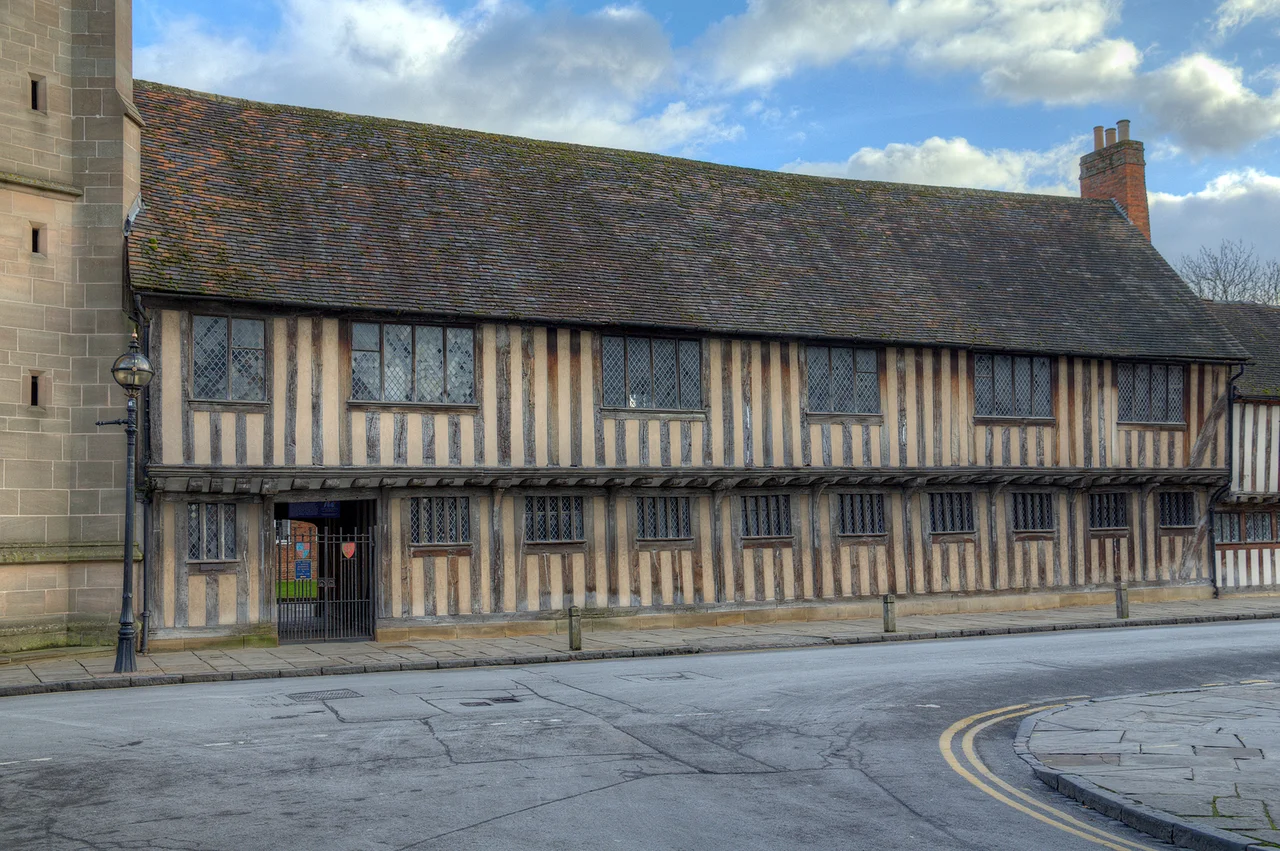

Stratford-upon-Avon Guildhall
If there is one room on Earth where a young William Shakespeare almost certainly sat at a wooden desk and learned his Latin, this is it. The upper floor of the Stratford-upon-Avon Guildhall has been a schoolroom continuously since 1560 -- four years before Shakespeare was born, four hundred and sixty-six years and counting. The King Edward VI School still uses it. Generations of Stratford boys, including the most famous boy who ever lived, have looked out from these mullioned windows at the spire of the Guild Chapel across the street, listened to Latin verbs being conjugated by exhausted masters, and waited for the day to end. The Guildhall did not open to the public until April 2016. For six hundred years it belonged to the town's most enduring institution -- the school.
A Guild's House
Before there was a school, there was a guild. The Guild of the Holy Cross was a religious fraternity of merchants -- a Stratford institution combining business networking, charitable giving, and corporate worship in the way only medieval guilds knew how. They built their meeting hall on Church Street around 1417, completing the structure in oak timber-framing with plaster infill, jettied upper storey overhanging the street below in the classic Tudor manner. The hall had iron gates at one end and six leaded windows on the first floor. The neighbouring Guild Chapel, dating from the thirteenth century, served as the merchants' place of worship; the almshouses, built around the same time, housed the poor of the parish. Together these three buildings still anchor the medieval quarter of Stratford.
The Suppressed Guild and the Refounded School
Edward VI's suppression of religious guilds in 1547 ended the Guild of the Holy Cross. The hall might have been demolished, sold off, or left to rot. Instead, in 1553 the town petitioned the Crown for a charter of incorporation as a borough. The petition was granted; the new Town Council inherited the guild's property; and as part of the same settlement, the King Edward VI School was refounded in 1560, with the upstairs rooms of the old Guildhall as its classrooms. The school is still there. Its current headmaster's desk sits perhaps thirty feet above the spot where the medieval altar of the Holy Cross once stood.
The Shakespeare Schoolroom
John Shakespeare, the glover, was a member of the Stratford Corporation -- he served as bailiff, the town's equivalent of mayor, in 1568. His sons would have been entitled to attend the King Edward VI School free of charge. William, born in 1564, would have started around the age of seven, climbing the steep wooden staircase to the upper room sometime around 1571. There he would have learned Latin grammar from Lily's textbook, read Ovid and Plautus, encountered the rhetorical structures that would later organise his sonnets. No school register survives, no document proves his attendance -- but every modern Shakespeare biographer agrees that this is where he studied, because nowhere else makes sense. The room he learned in is the same room schoolboys still learn in today. The wooden desks are not original, but the floor is, and the timber roof beams, and the windows.
Town Hall, Theatre, Council Chamber
The ground floor of the Guildhall served more secular functions. Through the seventeenth and eighteenth centuries, the open ground-floor hall hosted public assemblies of every kind: borough council meetings, theatre performances, official ceremonies. Touring acting companies played here in the years when Shakespeare was alive and writing. The Stratford-upon-Avon Borough Council met in this hall until 1843, when proceedings shifted to the larger Town Hall in Sheep Street. The upper-floor schoolroom kept its function unchanged. The downstairs space cycled through community uses as Stratford grew and modernised.
Hidden Paintings, Revealed
The 2015-16 restoration cost 1.8 million pounds and was funded by the Heritage Lottery Fund. It was meant to consolidate the timbers and stabilise the structure for another century of school use. What it uncovered was more extraordinary: original medieval wall paintings depicting God the Father flanked by Mary and John the Evangelist, hidden beneath generations of whitewash and panelling. The iconography dated to the building's first century -- imagery deliberately covered up during the Reformation and forgotten for the better part of five hundred years. The restoration carefully conserved what could be saved and opened the building to the public in April 2016, as a museum called Shakespeare's Schoolroom and Guildhall. Visitors can now sit at a desk in the actual room where William Shakespeare almost certainly studied as a boy, six centuries after the timbers were first raised.
From the Air
Located at 52.1904N, 1.70804W on Church Street in central Stratford-upon-Avon, Warwickshire, immediately adjacent to the Guild Chapel and within easy walk of Holy Trinity Church to the south. The Guildhall is a substantial jettied timber-framed building visible from the air primarily as part of the dense historic core. The Guild Chapel spire next door is a useful aerial reference. Nearest airports: EGBB (Birmingham, 22nm NW), EGBE (Coventry, 18nm N). Best viewed at 1,500-2,500 ft AGL.
Nearby Stories
- RAF Defford 3.6 km away
- Great Witcombe Roman Villa 4.1 km away
- Coventry War Memorial 4.5 km away
- Hagley Hall 4.6 km away
- Battle of Naseby 5.4 km away
- Silverstone Circuit 5.9 km away
- Waddesdon Manor 8.8 km away
- Woodstock Palace 15 km away