.jpg)
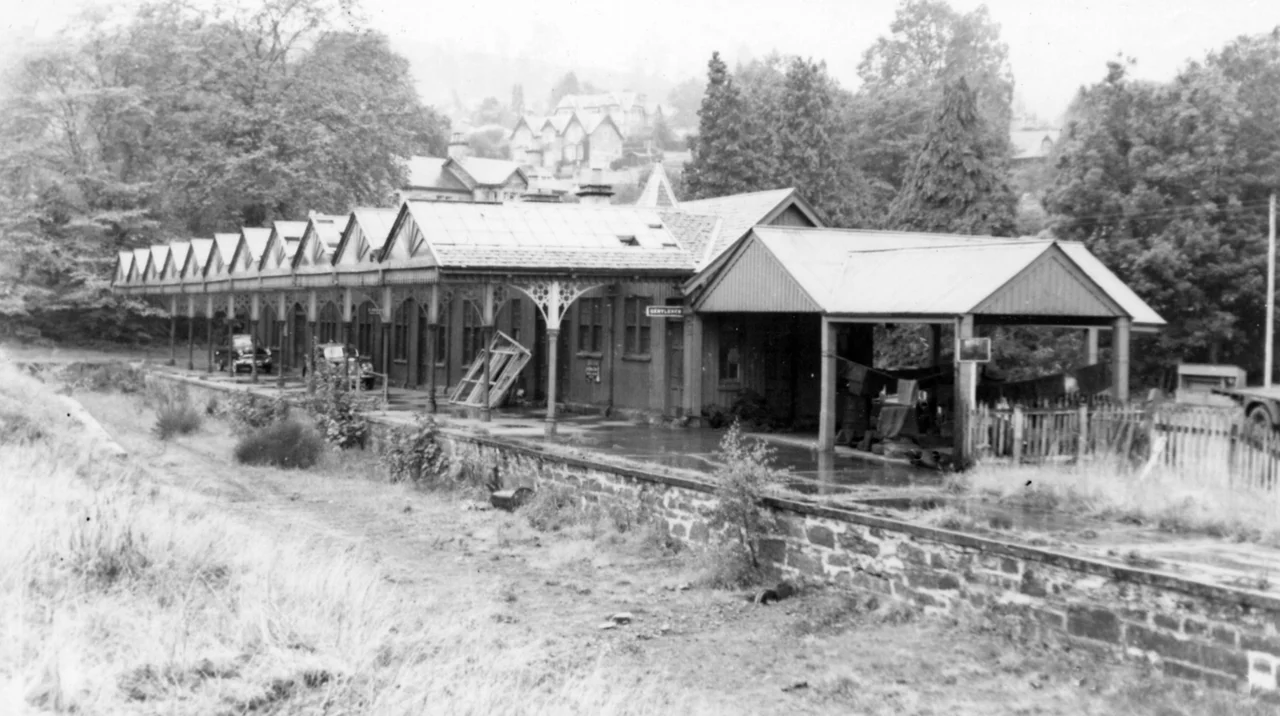
Strathpeffer Railway Station
Sir William MacKenzie of Coul House did not want a railway anywhere near his estate. When Parliament approved the Dingwall and Skye Railway in 1865 over his objections, he demanded the line be built entirely in tunnel under his land. The promoters thought this both impossible and ruinously expensive. So MacKenzie simply blocked construction until the company gave up and routed the line elsewhere. The result was that Strathpeffer, the largest community on the entire route, got its first station two miles north of the town, at the top of a steep hill, accessible mostly to people who didn't mind walking uphill carrying a trunk.
The Wrong Station
When the Dingwall and Skye Railway opened to passengers on 19 August 1870, Strathpeffer's station sat at a place called Achterneed, well above the spa town it was meant to serve. The deviation north had added cost and a 1 in 50 climb to a summit at the Raven's Rock. Sir William MacKenzie died before the line opened. His heir, less interested in the principle of the thing, turned out to be friendly to railways. By then it was too late for the original plan, but it was not too late for a second attempt.
The Branch Line
Strathpeffer's spa was booming. The chalybeate springs and what was described as the strongest sulphur water in Britain were attracting Victorian visitors by the thousand, and the inconvenient station on the hill was bad for business. The Highland Railway built a branch directly into town, which opened in 1885. A 2-2-2 locomotive originally named Breadalbane was renamed Strathpeffer to work the line; it was underpowered even for the easy gradients, and was eventually replaced. Seven trains ran each way per day at the height. The journey from Dingwall took ten minutes.
The Decline
The First World War ended the leisure boom. The branch line never recovered the seasonal traffic that had justified it. Passenger services were withdrawn after 1946 and the branch closed completely in 1951. The original Achterneed station, on the through line, hung on until 1964, briefly reopening as an unstaffed halt in 1965 before closing for good in 1968. The Victorian station building in Strathpeffer itself survived because the village found uses for it: craft shops, the Highland Museum of Childhood, and the Strathpeffer Spa Railway Association, which is trying to put track back where track used to be.
The Museum of Childhood
The Highland Museum of Childhood began as the doll and toy collection of a Strathpeffer resident, Mrs Angela Kellie, and grew into something more ambitious: a story of growing up in the Highlands of Scotland. Birth and baptism, homelife, child labour, education, an oral history film called A Century of Highland Childhood. By 2007 it was drawing 8,500 visitors a year. In 2009 a board of trustees bought the building outright from Highland Council. The Victorian platform is still there. Many of the shops front directly onto it, so passengers waiting for a train that has not run in three quarters of a century can still browse for crafts.
From the Air
Located at 57.5901 N, 4.5346 W, in the heart of Strathpeffer village in Ross-shire. The branch line ran roughly five miles east to Dingwall. Best viewed at 2,000-3,500 feet AGL; the line bed and the station buildings are visible against the village street pattern. Nearest airport is Inverness (EGPE), 20 miles south-east. EGPN (Dundee) lies far to the south.
Nearby Stories
- Nairn 1.7 km away
- Portmahomack Sculpture Fragments 2.4 km away
- Loch Ness Monster 3.4 km away
- Ardgay 5.8 km away
- Glen Affric 5.9 km away
- Strathspey Railway (preserved) 9.2 km away
- Battle of Leckmelm 11 km away
- Corrieshalloch Gorge 22 km away