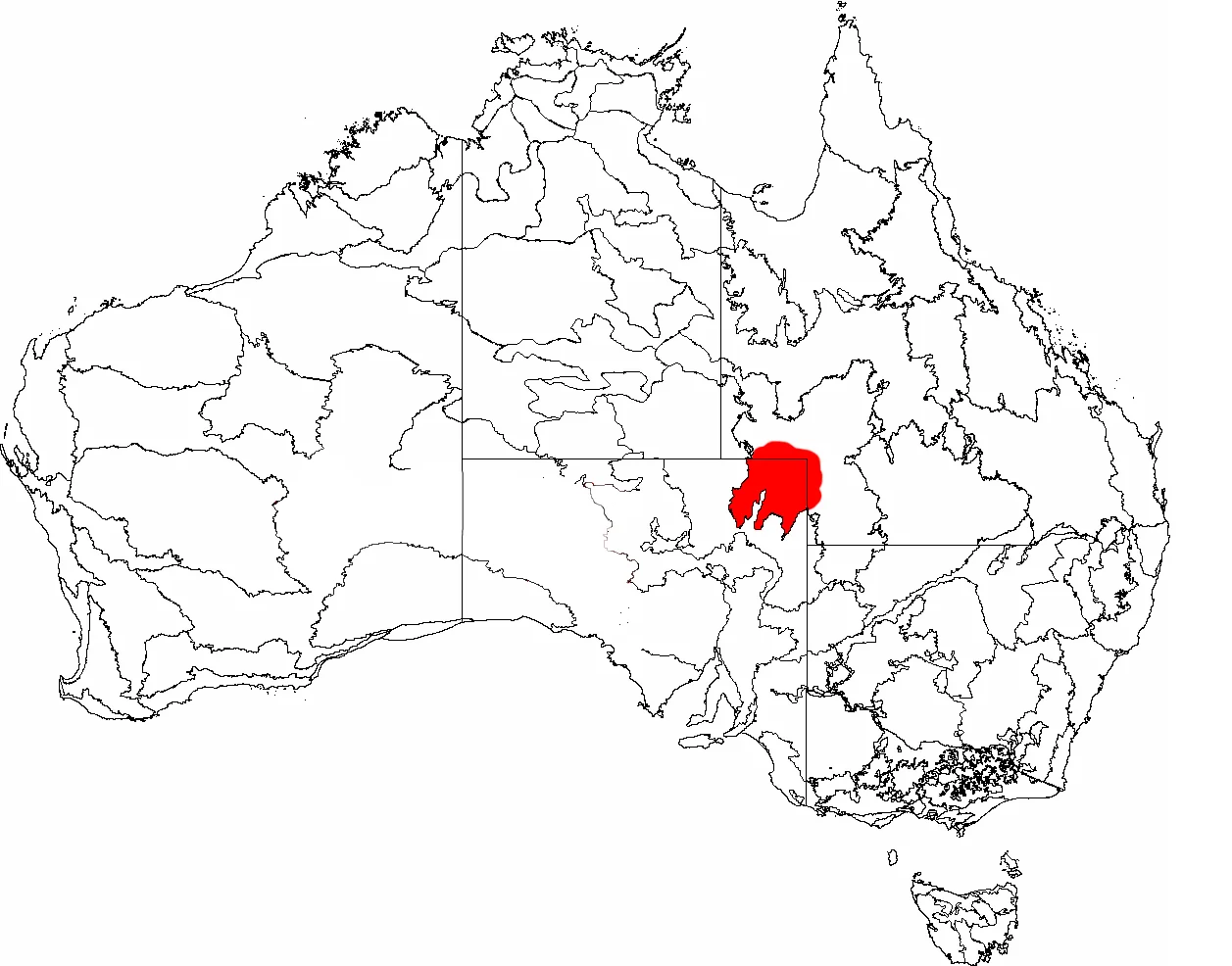

Sturt Stony Desert
Charles Sturt came looking for an ocean. In 1844 he led fifteen men, a flock of sheep, a team of bullocks, and a wooden boat north from Adelaide, convinced that a great sea lay glittering at the centre of the continent. What he found instead was this: a plain so thickly carpeted in sharp, sun-blackened stones that his horses began to limp, the hooves of his cattle wore down to the quick, and the very wheels of his drays ground against rock for mile after grinding mile. He never reached open water. He reached the desert that now carries his name.
A Sea of Stone
The surface here is called gibber - a desert pavement of close-packed pebbles, each one polished and faceted by the wind, locked together like crude mosaic across the flat earth. Sturt, an ocean still on his mind, guessed the stones had been sorted by currents on some ancient seabed. He was wrong about the mechanism but not entirely wrong about the deep past. The gibber is what remains after sheets of desert sandstone, laid down over vast time, slowly weathered away; the soft material blew off as dust, and the hard fragments stayed behind, settling into the armoured crust you see today. The Sturt Stony Desert sits on a low rise called the Gason Dome, wedged between the red sand-ridges of the Simpson Desert to the west and the Strzelecki Desert to the southeast. It is a place defined by what it lacks: no dunes to soften it, no real shade, only stone and sky.
The Year the Expedition Stopped
By the summer of 1845, Sturt's party was trapped. Drought had dried the waterholes ahead, and the men fell back to a permanent pool near present-day Tibooburra they called Depot Glen, where they waited out the heat from late January to mid-July, unable to advance and unable to retreat. The thermometer burst. The ground was too hot to touch. There, Sturt's second-in-command, James Poole, died of scurvy. When the rains finally freed them, the party pushed north one last time, crossed the merciless gibber, and turned back short of the centre, broken by heat and illness. Sturt's inland sea never existed - the continent's heart held no ocean, only more desert. But his name stayed fixed to the plain that defeated him, a small monument to a magnificent wrong idea.
Life on the Anvil
Nothing about the gibber suggests it could hold life, yet it does, and the life it holds is fierce. The kowari, a carnivorous marsupial barely the weight of a few coins, hunts these stony plains by night, a pale-eyed predator with a bristling black-tipped tail that digs burrows between the river channels and dunes. It survives in fragmented pockets across the Sturt Stony Desert and the country around it, one of Australia's most endangered small mammals. Among its prey is the long-haired rat, a native rodent whose numbers normally stay low but, after good rain, explode into plagues that sweep across the inland. During these booms, locals say, so many rats call from so many burrows that the ground itself seems to hum at night - earning the creature its country nickname, the singing rat. On the gibber, abundance and emptiness are simply two phases of the same long rhythm.
Crossing It Today
The old hardship has not entirely gone. The Birdsville Track, the legendary stock route between Marree in South Australia and Birdsville in Queensland, threads along the desert's edge, and the gibber still punishes anything that crosses it. Travellers carry spare tyres by the pair, because the same stones that lamed Sturt's horses slice through modern rubber without effort. Both circular and stepped gilgai - shallow, self-forming clay hollows that crack open in dry weather and brim after rain - dimple parts of the plain. To stand out here at dusk, watching the low sun set the stones glowing copper and rust to every horizon, is to feel the scale that undid an expedition. The land does not announce its dangers. It simply waits, patient and stony, exactly as it did in 1845.
From the Air
The Sturt Stony Desert lies near 27°S, 140°E, on the Gason Dome where the borders of South Australia, Queensland, and New South Wales nearly meet. From the air it reads as a vast, dark, dune-free plain - the gibber's polished stones absorb light, so the desert appears noticeably duller and greyer than the rust-red Simpson dunes to the west or the Strzelecki sands to the southeast. The Birdsville Track traces its eastern margin, a thin pale line between Marree and Birdsville. Nearest airfields are Birdsville Airport (YBDV) to the northeast and Moomba (YOOM) to the south; Innamincka (YINN) lies further southeast. Best viewing is the low golden light of early morning or late afternoon, when the flat stone catches color and the gilgai hollows throw faint shadows. Daytime visibility is usually excellent, but watch for dust haze when the inland winds rise - this region is among the southern hemisphere's largest dust sources.
Nearby Stories
- Malkumba-Coongie Lakes National Park 6.1 km away
- Koonchera Point Massacre 7.6 km away
- Arrabury 36 km away
- Diamantina River 39 km away
- Cordillo Downs 52 km away
- Burke, Wills, King and Yandruwandha National Heritage Place 55 km away
- Haddon Corner 89 km away
- Mungerannie 124 km away