
Sukur
The name itself carries a warning. In the Margi language, Sukur means vengeance; in neighboring Bura, it means feuding. But the hilltop kingdom that bears the name is no battlefield. It is a place of stone-paved paths and dry-stone walls, of terraced fields climbing toward a chief's palace, set high in the Mandara Mountains of Adamawa State near the Cameroon border. In 1999, Sukur became the first cultural landscape anywhere in Africa to be inscribed on the UNESCO World Heritage List, and Nigeria's first World Heritage Site of any kind.
The Palace on the Hill
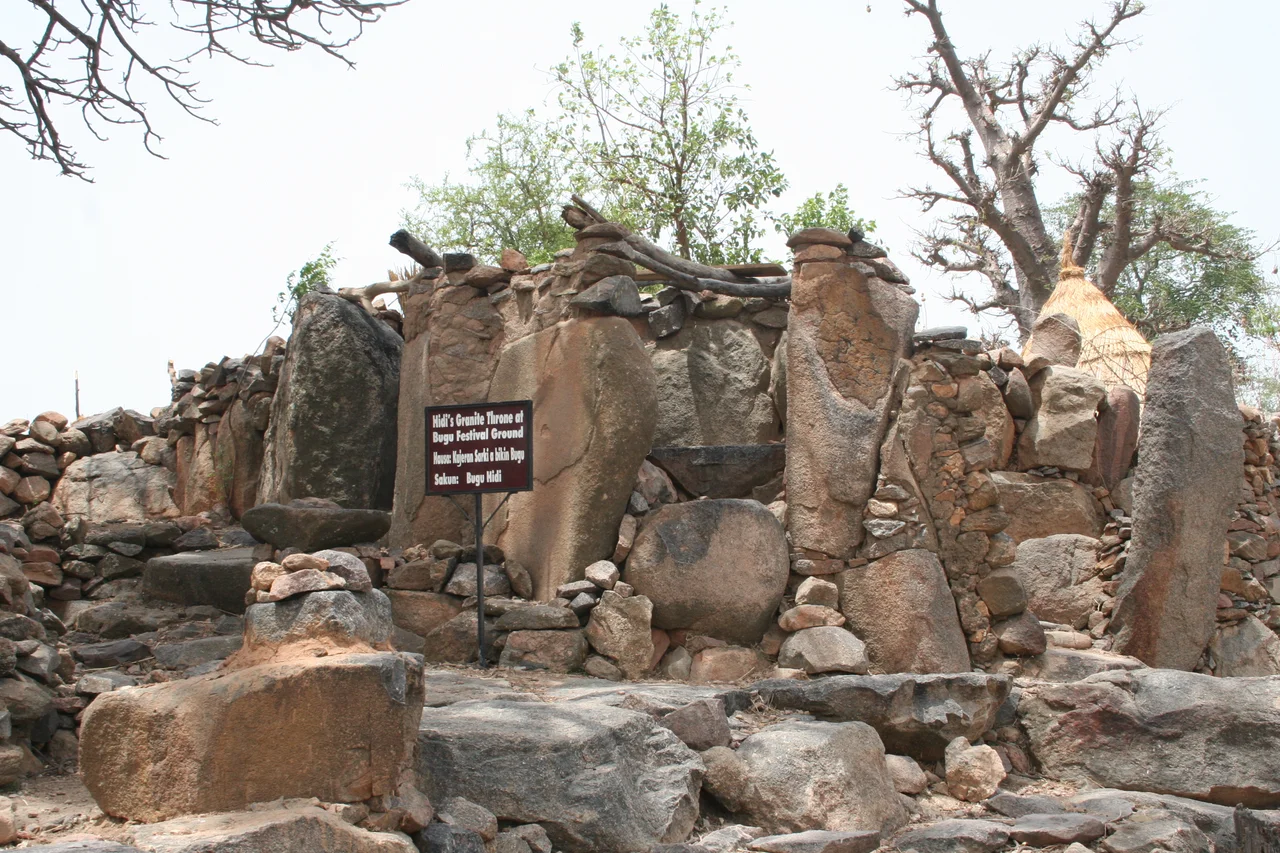
The settlement divides in two. The upper town, Sakur Sama, holds the palace of the Hidi, the chief who is both political and spiritual head of the community; the lower town, Sakur Kasa, spreads below. To reach the palace, visitors climb broad stone-paved walkways laid by hand long ago, processional routes that wind up the hillside and pass through dry-stone gateways built entirely without mortar, their stones fitted so precisely they have held for generations. The Hidi's palace is itself a work of dry-stone architecture, its walls and enclosures shaped from the mountain it sits on. What makes Sukur extraordinary is how completely it survives, not as a ruin but as a living place: the terraces still farmed, the paths still walked, the office of the Hidi still held. UNESCO called it a remarkably intact expression of a society and its spiritual and material world.
Masters of Iron
Sukur's wealth was forged, literally. From around the sixteenth century into the early twentieth, this was a renowned center of iron smelting, and the hillsides still hold the furnaces, the slag, the ore, and the grindstones of that long industry. The smiths of Sukur supplied iron across the region, and that trade underwrote the chiefdom's power and prestige. As in much of the Mandara, the blacksmiths formed a distinct social group, masters of fire and metal who were both essential and set apart. Older still are traces of Iron Age and even Neolithic activity, marking these slopes as a place people have worked and reworked for thousands of years. The terraced landscape, with its mix of intensive and extensive farming and its sacred symbols, grew up alongside the forge.
A New Idea of Heritage
When UNESCO inscribed Sukur in 1999, it was doing something it had rarely done before in Africa: protecting not a single monument but an entire living landscape, the fields and paths and shrines together with the people who keep them. The idea of the cultural landscape, where human work and the natural world are inseparable, was relatively new, and Sukur became its first African example. The committee judged the place an outstanding example of a settlement and its way of life, evolved over centuries and still intact. For a hilltop kingdom of farmers and smiths in a remote corner of Nigeria, it was an extraordinary recognition, one that placed Sukur in the company of the world's great heritage sites.
What the Insurgents Could Not Erase
In December 2014, Boko Haram fighters overran the area and set buildings ablaze, damaging structures at a World Heritage Site that had stood for centuries. It was a deliberate blow against a place that embodied the heritage the insurgents despised. But Sukur endured. By early 2015, Nigerian forces and their allies had driven the militants out of Adamawa State, and the people of Sukur came home to rebuild their houses, their fields, and their community. Heritage workers assessed the damage and began restoration; the worst losses were to modern visitor buildings rather than the ancient core. The palace of the Hidi still crowns the hill. The stone walkways still climb it. The terraces are green again with sorghum and millet, worked as they have been for centuries. A landscape that survived the rise and fall of an iron industry has now outlasted an insurgency as well, and the chiefdom endures on its mountain, vengeance in name only.
From the Air
The Sukur Cultural Landscape sits at roughly 10.74 degrees north, 13.57 degrees east, on a hill in the Mandara Mountains of Madagali district, Adamawa State, near Nigeria's border with Cameroon. From altitude, look for terraced hillsides rising to the chief's palace on the high ground, set within the rugged volcanic terrain of the Mandara range. The nearest airports are Maiduguri (ICAO DNMA) to the north in Nigeria and Maroua Salak (ICAO FKKL) across the border in Cameroon. Give the surrounding peaks ample terrain clearance. Harmattan dust can reduce visibility from November to February, while the wet season brings cloud buildup over the mountains; the early dry season generally offers the clearest views.
Nearby Stories
- Rhumsiki 10 km away
- Gwoza 17 km away
- Murder of Hauwa Liman 20 km away
- Yola 160 km away
- Palace of Rey Bouba 209 km away
- Bouba Njida National Park 252 km away
- African theatre of World War I 984 km away
- Dori, Burkina Faso 1453 km away