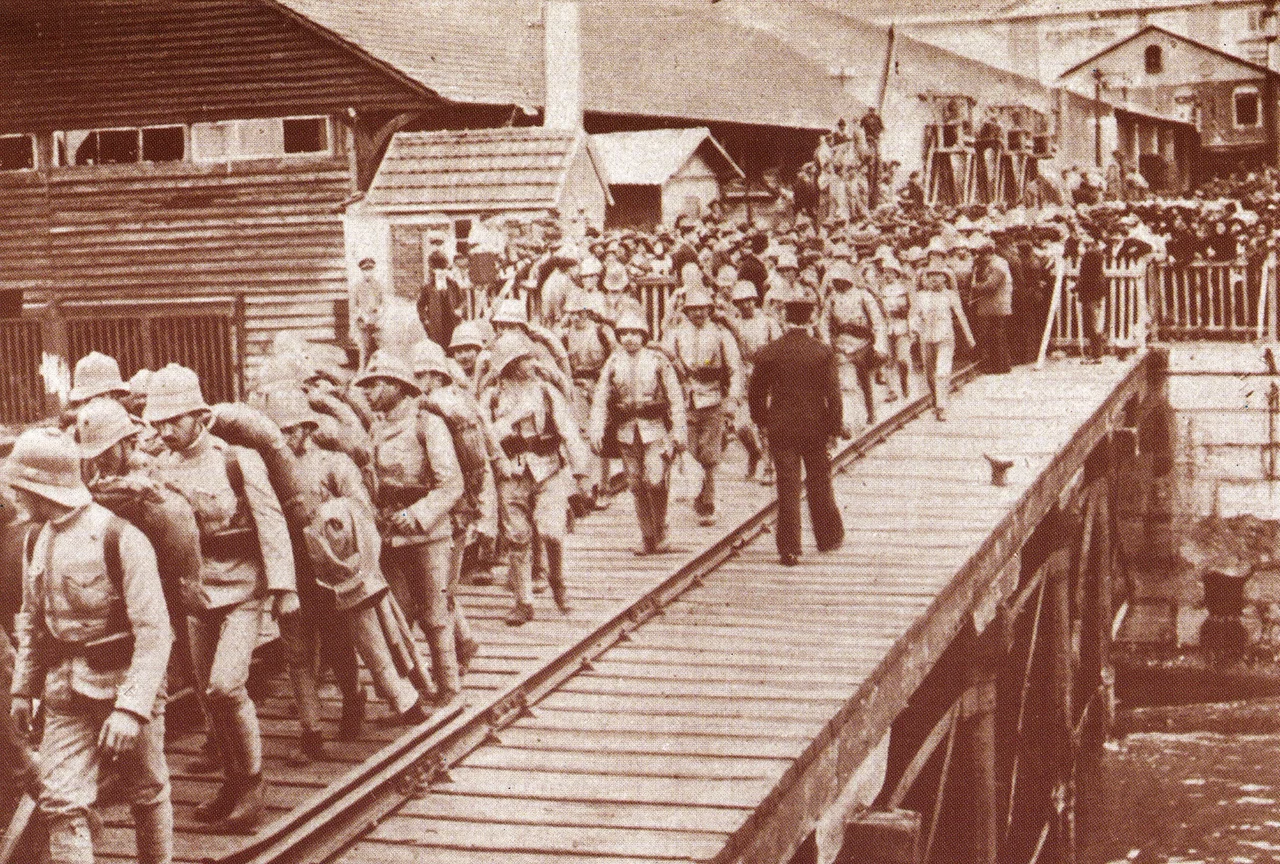

African theatre of World War I
On 22 August 1914, in a place far from Flanders and the Marne, the East African Standard published an editorial arguing that Europeans in Africa should not fight each other. The reasoning was not pacifism. It was simpler than that: there were so few white colonists, and their conquests so recent and unstable, that war risked everything they had extracted so far. The Berlin Conference of 1884 had even made provisions for African colonies to stay neutral in a European war. None of that held. Within weeks, African soldiers under British, French, Belgian, Portuguese, and German command were killing each other across a continent that none of their governments had ruled for more than a generation.
The Carriers Who Did Not Come Home
The war that Europe fought in trenches, Africa fought on foot. For every soldier on the African front there were sometimes five or six carriers, men conscripted or pressed into service to move food, ammunition, and the tents that kept officers dry. They walked hundreds of miles through bush, swamp, and tsetse country. They died in numbers that were recorded imprecisely because they were not considered soldiers. In East Africa alone, the British Carrier Corps reached hundreds of thousands strong, and by 1918 more than half of the British Army in the region was African. Disease took more of them than bullets. Dysentery, malaria, influenza, and hunger thinned the columns as surely as combat. The 9th South African Infantry started February 1916 at full strength and was reduced by October mostly by illness. Imagine that ratio extended across the continent for four years.
Togoland, Kamerun, and a Wireless Station
The first German colony to fall was Togoland, from 9 to 26 August 1914. French forces from Dahomey and British forces from Gold Coast converged on Kamina, where a wireless station linked Berlin to the Atlantic. The Germans surrendered on 26 August. The campaign in Kamerun was longer and bloodier. Battles at Tepe, Garua, Ngaundere, and Banjo ground on through 1915 and into 1916. When the German commander Carl Zimmermann ordered his troops to retreat into Spanish Rio Muni, they did so after implementing a scorched earth policy against the Duala people, who the German command accused of a "people's war." Women suffered wartime sexual violence. A commander at Jabassi is recorded as having ordered his soldiers to "kill every native they saw." The paramount chief of the Beti people eventually ended up in Madrid, living as visiting nobility on German funds. Most Kamerunians who followed the retreat never left.
South West Africa and the Afrikaner Rebellion
In German South West Africa, now Namibia, Jan Smuts and Louis Botha conducted a rapid campaign that ended in German surrender on 9 July 1915. But while they were fighting Germans, some of their own generals were fighting them. The Maritz rebellion of 1914–15 saw Afrikaner officers, including Manie Maritz and Christiaan de Wet, rise against South Africa's alignment with Britain. Koos de la Rey, under the influence of the seer Siener van Rensburg, believed the war heralded the return of the old republic. He was shot at a police roadblock meant to catch the Foster gang; many Afrikaners believed he had been assassinated. The rebellion failed. Its leaders were captured or killed. But it was a reminder that the war had a way of opening every fault line it touched.
Lettow-Vorbeck and the Long Walk
The commander who never quite surrendered was Paul von Lettow-Vorbeck in German East Africa. Outnumbered often ten to one, he kept the British, Belgians, Portuguese, and Indians chasing him across what is now Tanzania, Mozambique, and Zambia for four years. At Tanga in November 1914, his Schutztruppe handed the British one of the most humiliating defeats in British military history. Charles Hordern, writing the official British history, called it "one of the most notable failures in British military history." Lettow-Vorbeck kept marching. Through the Rufiji delta, where the cruiser Königsberg was hunted down and scuttled. Across into Mozambique in November 1917 to raid Portuguese garrisons. Into Northern Rhodesia in August 1918. On 13 November, two days after the Armistice was signed in France, his men took Kasama unopposed. The next day he received the telegram about the armistice at the Chambezi River and agreed to cease fire. He formally surrendered at Abercorn on 23 November 1918, the last German field commander to do so.
The Risings the Colonies Forgot
While Europeans fought Europeans, Africans fought Europeans too, and European rule sometimes nearly cracked. John Chilembwe led a millenarian Baptist uprising in Nyasaland (now Malawi) in January 1915, against forced labor, racial discrimination, and the fresh burdens of wartime conscription. The rebellion was crushed within days; more than forty were killed and many more imprisoned. In French Morocco, the Zaian War ground on from 1914 to 1921 under Mouha ou Hammou Zayani. The Volta-Bani War of 1915-17 in what is now Burkina Faso and Mali mustered twenty thousand fighters from a coalition of peoples. In Niger the Tuareg leader Kaocen held Agadez and much of the north for three months in 1916-17. In Sudan, the Anglo-Egyptian Darfur Expedition of 1916 ended the Fur Sultanate of Ali Dinar, killed him in November near Gyuba, and brought Darfur into colonial Sudan. The Adubi War erupted in Nigeria in 1918 over new taxes. The Makonbe rose in Mozambique in 1917. In each case the colonial response was the same: crush, execute leaders, extract further labor.
What the Maps Didn't Show
When peace came in 1918, the maps changed. Togoland was partitioned between Britain and France. Kamerun too. German East Africa became Tanganyika under British mandate and Ruanda-Urundi under Belgian. German South West Africa became a South African mandate. But the maps did not show the carriers who had been left in unmarked graves along a thousand miles of bush path. They did not show the villages burned by scorched earth policies, the Duala women who had been raped, the Tuareg and Fur elders summarily executed in market squares. They did not count the Congolese, Kenyan, Nigerian, Tanzanian, Ghanaian, and Sudanese men who had fought Europe's war so that Europe could keep the colonies. Africa paid for the Great War in lives that the armistice at Compiègne never tallied. The war Europe calls the First World War was, for Africa, one chapter in a longer conquest.
From the Air
The African theatre spanned the entire continent. Key campaign centers included Darfur (13°N, 25°E) in Sudan; Lake Tanganyika (ICAO airport Kigoma HTKA, Mwanza HTMW); Dar es Salaam (ICAO: HTDA); Windhoek (ICAO: FAWK); and Lomé (ICAO: DXXX). The coordinates 13.40°N, 22.80°E mark the region of the 1916 Darfur expedition that incorporated Darfur into Anglo-Egyptian Sudan. Best appreciated from cruising altitudes in clear weather across the Sahel.
Nearby Stories
- West Darfur 63 km away
- Marrah Mountains 118 km away
- Ain Farah 135 km away
- 2025 Tarasin landslide 136 km away
- Kutum 220 km away
- Zakouma National Park 376 km away
- Manovo-Gounda St. Floris National Park 555 km away
- Great Man-Made River 1307 km away