
Sultanate of Aussa
The Awash River runs through one of the hottest lowlands on earth, a country of salt pans and basalt, where the Ethiopian highland people were considered by everyone - including themselves - to be unsuited by nature. The Sultanate of Aussa ruled this country. For most of its existence, which stretched from 1734 into the 20th century and briefly returned in 1991, the sultanate held out against every power that tried to absorb it: the Ethiopian emperors, the Khedive of Egypt, even initially the Italians. When Ethiopian highland armies pushed into the Afar Triangle, one 19th-century observer noted, they found themselves "unsuited by nature to operations in these hot and feverish lowlands." The Afar were suited by nature. Aussa was their capital.
Origins in the Adal Split
The Sultanate of Aussa traces through an older kingdom - the Imamate of Aussa, carved out of the Adal Sultanate in 1577 when Muhammed Gasa moved his capital from Harar to the town of Asaita in the Afar lowlands. Adal had been one of the great Muslim polities of the Horn of Africa, the kingdom that under Imam Ahmad ibn Ibrahim had very nearly conquered Christian Ethiopia in the 1530s before Portuguese intervention turned the war back. After 1577, what remained of Adal's geographic imagination settled in Aussa. In 1672, the Mudaito branch of the Afar people destroyed the Imamate and founded the sultanate that would define the region for the next three centuries. The first known sultan was Kandhafo, who ruled from 1734 to 1749. He was followed by his son Kadhafo Mahammad, then grandson Aydahis - a dynastic pattern with long reigns that suggested, as the historian Richard Pankhurst observed, a certain degree of political stability unusual in the region.
The Afar Way of War
The Afar were respected throughout the region as formidable warriors. Abyssinian soldiers reportedly considered killing an Afar a greater achievement than killing an Oromo, and the Ethiopian armies that ventured into Afar country paid heavily for the attempt. The Afar held their terrain through absolute mastery of desert warfare - knowledge of water, of shade, of the narrow hours when movement was possible, of the long nights when ambush was easy. The late 18th century saw sultans enlisting Yemeni matchlockmen from Aden to strengthen their firepower. According to the missionaries Krapf and Isenberg, these matchlockmen numbered several hundred and gave the sultanate a monopoly of gunpowder weapons in the Danakil. Sultan Yusuf ibn Idjahis - who according to William Cornwallis Harris equipped his armory with cannons and matchlocks - led a defense that surprised would-be attackers in their sleep and, in Harris's phrase, cut "all save one" of their throats. Yusuf was eventually killed when the enemy returned with fresh coastal allies. The sultanate survived.
Munzinger's End
In 1875, Sultan Mahammad ibn Hanfadhe defeated and killed Werner Munzinger. Munzinger was a Swiss-born colonial administrator working for the Khedivate of Egypt, leading an Egyptian army that was trying to push into Ethiopia through Afar country. The expedition ended with Munzinger dead in the sands of the Danakil and Egyptian ambitions in the Horn of Africa effectively collapsed. This was the same sultan who later began signing treaties with newly unified Italy, which had bought the port of Assab from a different local sultan in 1869 and was assembling what would become the colony of Eritrea. Article 5 of one treaty obligated the Sultan to oppose any other power attempting to occupy his territory and to raise the Italian flag if necessary. Article 3 recognized the whole Danakil coast from Amphila Bay to Ras Doumeira as Italian possession. The Ethiopian Emperor Menelik II stationed an army near Aussa during the First Italo-Ethiopian War to ensure the Sultan did not actually honor his Italian promises.
The Second War and Exile
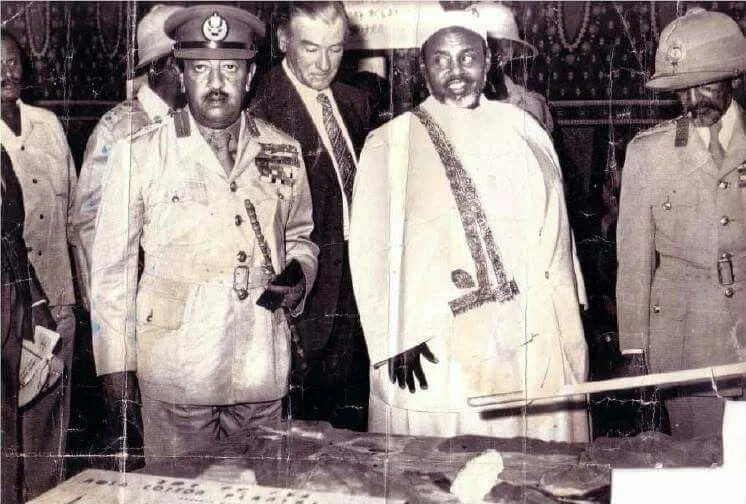
The Second Italo-Ethiopian War of 1935 to 1936 brought a different outcome. Sultan Mahammad Yayyo agreed to cooperate with the Italian invaders. By April 1, 1936, Italian troops had completed the occupation of the sultanate. The Sultan himself went to Rome, met Benito Mussolini at Palazzo Venezia, and gave a speech declaring his loyalty to the Italian Empire. When Ethiopia's reinstalled government came back in 1943, a military expedition captured Sultan Muhammad Yayyo, exiled him, and installed a relative. Sultan Alimirah Hanfare took the throne in 1944 and spent the next decades negotiating the sultanate's relationship with Haile Selassie's centralizing Ethiopian state. Alimirah sought to unite the Afar across Hararghe, Shewa, Tigray, and Wollo into a single autonomous sultanate within Ethiopia. Haile Selassie refused. In 1975, after the Derg revolution, Alimirah was exiled to Saudi Arabia. He returned to Asaita in 1991 following the Derg's fall, and ruled until his death in 2011.
Continuity
The sultanate's present claimant is Ahmed Alimirah, who succeeded his father Hanfare Alimirah in 2020. The political power of the position is constrained by Ethiopian federal and regional governance, but the cultural weight remains substantial. The Afar Triangle, the geographic region spanning southern Eritrea, eastern Ethiopia, and western Djibouti, still holds roughly four million Afar people whose traditional relationship to the sultanate forms part of their identity. Sunni Islam is the dominant religion, and the traditional religious elites carry the honorific title Kabir. Asaita remains the symbolic capital, though its practical importance has declined over the last century. The story of the sultanate is an example, increasingly rare in modern Africa, of an indigenous African political tradition that outlasted colonial rule, survived Marxist revolution, and preserved the right to speak for its own people even when others had stopped listening.
The Danakil from the Air
From altitude the Afar Triangle resolves into an alien landscape - salt pans glittering where seawater has evaporated over millennia, dark basalt fields from active volcanism, cinder cones dotting the horizon, and the green thread of the Awash River following its narrow valley before disappearing into the brackish Lake Abbe. Asaita appears as a small geometric cluster near the river. The Ethiopian highlands rise sharply to the west. The Djiboutian coastline curves to the east. This is the heart of a region the Afar have held for centuries against everyone who thought they could take it. Most of them could not.
From the Air
Located at 11.57°N, 41.43°E in the Afar Triangle of eastern Ethiopia. Extremely hot lowlands - recommended viewing altitude FL280+ to reduce thermal turbulence. Asaita (the historical capital) sits near the Awash River. Semera Airport (HASR) is the nearest aviation facility, serving the Afar regional state. The Danakil Depression and Erta Ale volcano are dramatic features visible from altitude. Expect severe daytime heating and associated thermal activity; best conditions early morning or late afternoon.
Nearby Stories
- Lake Abbe 53 km away
- Djibouti 65 km away
- Lake Assal (Djibouti) 65 km away
- Wollo Province 85 km away
- Lalibela 191 km away
- Harar 218 km away
- Awash National Park 264 km away