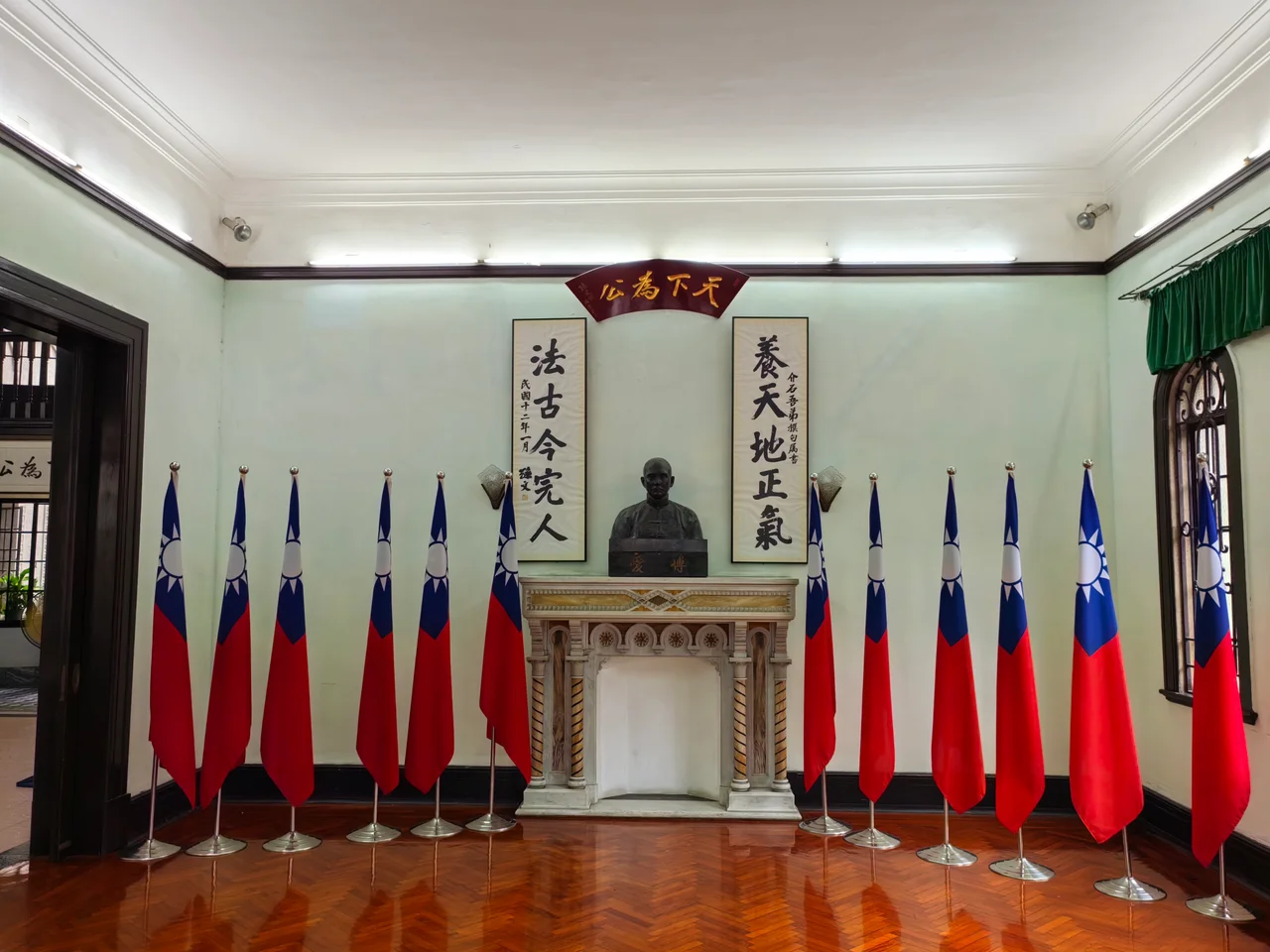

Sun Yat-sen Memorial House
A shoe cobbler's son who grew up to topple an empire left a curious imprint on Macau: a three-storey villa with ornate Moorish verandahs tucked into the São Lázaro neighborhood, where his family lived, his allies plotted, and over 20,000 mourners gathered when news of his death finally arrived. The Sun Yat-sen Memorial House is not a birthplace or a battlefield. It is something rarer — the domestic headquarters of a revolution, the quiet address where the upheaval of modern China was managed between medical appointments and newspaper editorials.
The Cobbler's Son and the Colony
Sun Yat-sen's connection to Macau began before he could choose it. His father, Sun Dacheng, arrived in Macau as a sixteen-year-old and worked in a shoe shop near the Largo do S. Domingos before eventually returning to his village in Xiangshan County to farm and marry. When Sun Yat-sen was thirteen, his mother brought him to Macau — the same harbor from which he would later depart for Hawaii aboard the British iron ship S.S. Grannock, bound for a Western education that would change everything. Macau was never incidental to his story. It was the threshold.
The territory's unique position as a Portuguese colonial port, absorbing Chinese and Western culture since the sixteenth century, made it a useful refuge for a young man who kept criticizing the Qing Dynasty in print. His first major essay, the 'Letter to Zheng Zaoru,' was published by a Macau newspaper in 1890. The colonial administration offered a buffer that the Qing court's reach could not always cross.
Doctor, Dissident, and the 'Four Bandits'
In 1892, Sun Yat-sen became the first Chinese doctor to practice Western medicine in Macau, invited by Kiang Wu Hospital to set up its Western Medicine Department — treating patients for free with borrowed funds. He soon opened the Chinese-Western Medicine Joint Clinic on Rua das Estalagens. His reputation as a physician was genuine and widely admired. His reputation as a radical was equally well-earned.
While shuttling between Hong Kong and Macau for his medical studies and early practice, he fell in with three colleagues — Chan Siu-bak, Yau Lit, and Yeung Hok-ling — who shared his conviction that the Qing regime was rotten beyond reform. Together they were nicknamed the Si Da Kou: the Four Bandits. The nickname was affectionate among friends and damning to imperial officials. Sun also struck up a deep friendship with Fernandes, a Macanese printer who launched Macau's first weekly Chinese newspaper, the Echo Macaense, in July 1893. It gave Sun's early revolutionary writing a platform and a sympathetic editor.
A Family Installed, a Revolution Managed
The house itself — known in earlier years as the 'Mansion of Sun' — was built in 1912 as a residence for Sun's first wife, Lu Muzhen. Designed in mock-Moorish style with ornate verandahs and spacious courtyards, it sits within walking distance of Lou Lim Ieoc Garden, where Sun stayed during his visits. Lu Muzhen moved in the following year with their daughters Sun Yan and Sun Wan, their son Sun Ke, and Sun's elder brother Sun Mei, who organized a fishermen's association in Macau and died there in 1915 at sixty.
Lu Muzhen lived in the house for forty years, dying in Macau on 7 September 1952 at the age of eighty-five. Her son-in-law and a granddaughter also made Macau their permanent home. Meanwhile, Sun himself was rarely present. After February 1912, when he resigned as provisional President of the Republic of China, he visited in May 1912 and June 1913 — and then military affairs kept him away for good. Distance did not diminish the house's function: through 1915 and beyond, Sun and his associates considered Macau a crucial base for their activities in southern China, and his son Sun Ke later opened a nearby office to support the Constitutional Protection Movement.
Twenty Thousand in the Streets
Sun Yat-sen died in Beijing on 12 March 1925. When the news reached Macau, more than 20,000 people — roughly one-fifth of the city's entire population at the time — gathered at Kiang Wu Hospital on 29 March for a solemn memorial ceremony. The scale of public grief reflected something that the house embodies architecturally: Macau's Chinese community had supported Sun materially and spiritually throughout his revolutionary years, and they understood what had been lost.
The house was reconstructed in 1933 and received its current name in 1958. A bronze statue of Sun cast by his Japanese friend Shokichi Umeya in 1934 stands in the courtyard. Three identical statues stand at the Sun Yat-sen Mausoleum in Nanjing, the Whampoa Military Academy, and Sun Yat-sen University in Guangzhou. Today the house is open to the public, displaying his books, letters, photographs, and personal belongings. It carries an unresolved tension: the property is owned by Taiwan's Mainland Affairs Council, and as of 2022, Beijing signaled it might seek to seize the site over the one-China principle. The revolution that ended one dynasty inadvertently created a new dispute across the same threshold.
From the Air
The Sun Yat-sen Memorial House sits in the São Lázaro district of the Macau Peninsula at approximately 22.1999°N, 113.549°E. Approaching from the south over the Pearl River Delta, Macau's dense urban peninsula is immediately distinguishable against the surrounding water. The nearby Lou Lim Ieoc Garden provides a patch of green that helps orient ground-level navigation. The closest airport is Macau International (VMMC), roughly 3 km to the southeast on the reclaimed Cotai Strip. Hong Kong International (VHHH) lies about 60 km to the northeast across the Pearl estuary. For aerial viewing, a low pass at 1,500–2,500 feet on a clear day reveals the characteristic low-rise colonial streetscape of São Lázaro against the high-rise backdrop of central Macau.
Nearby Stories
- 2024 Shenzhen Stabbing 0.8 km away
- Lantau Peak 1.5 km away
- Kweilin Incident 2.4 km away
- Taishan City 7 km away
- Wanshan Archipelago Campaign 38 km away
- Hong Kong 12 68 km away
- Battle of Nanpeng Island 82 km away
- Erhai Lake 1335 km away