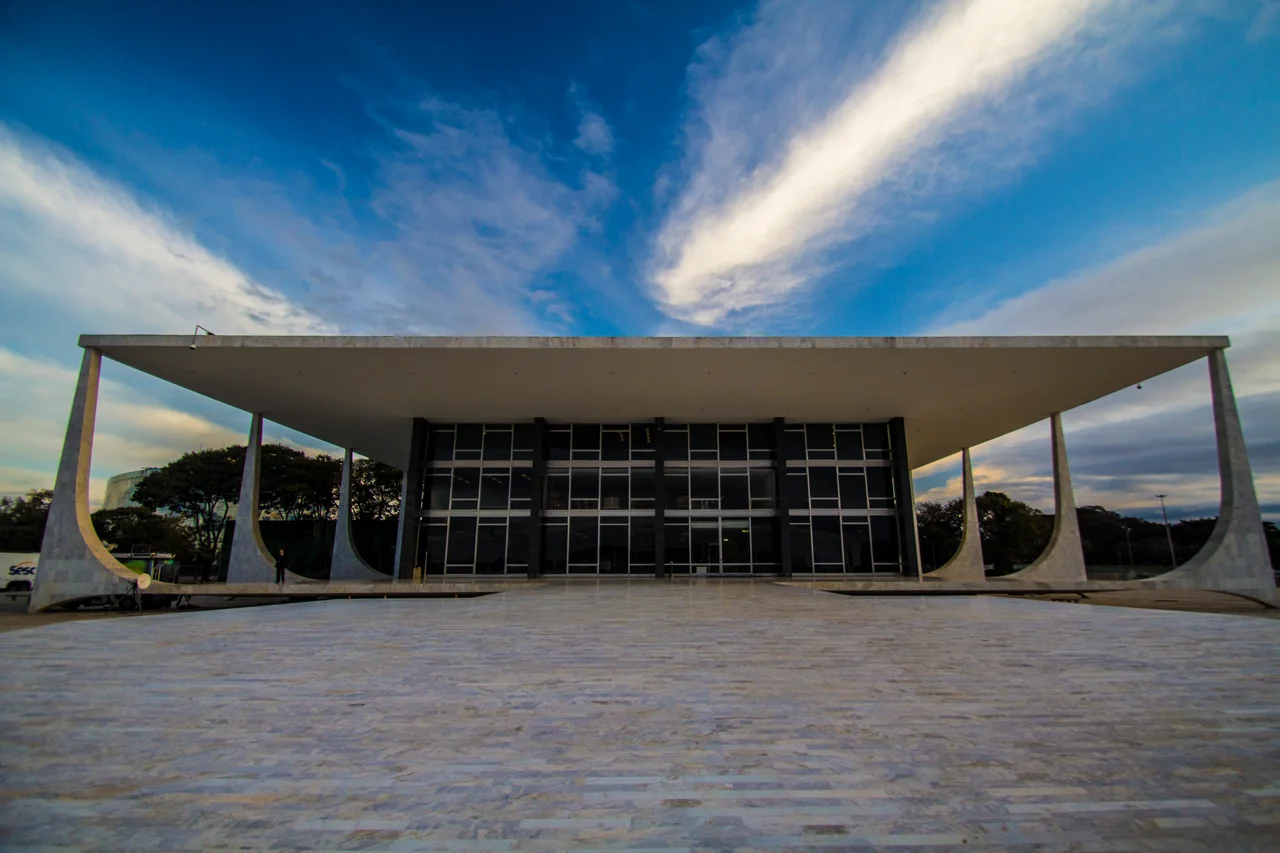

Supreme Federal Court Palace
The building barely seems to touch the ground. Oscar Niemeyer's design for the Supreme Federal Court Palace rests on a colonnade of thin, tapered side pillars, and the engineer Joaquim Cardozo worked out the structural mathematics that let the foundations lie almost on the surface - the same feat of load calculation he performed for the Cathedral of Brasilia and the other palaces of the capital. From below, the court seems to hover. Standing in front of it, at the center of the Praca dos Tres Poderes, Alfredo Ceschiatti's 1961 sculpture "A Justica" - a seated, blindfolded figure in dark granite - holds the sword that made the building's name.
The Three Powers Plaza
Niemeyer laid out the capital's political heart as a triangle of buildings, each facing the others across an open plaza. The National Congress to one side, the Palacio do Planalto presidential office to another, the Supreme Federal Court palace to the third. Three powers of the Brazilian state, rendered in glass and concrete at the end of a long, empty Monumental Axis. Niemeyer himself worked for roughly seventy years on Brasilia's buildings. IPHAN, the national heritage institute, declared the court palace a protected site in 2007, the year Niemeyer turned 100. It is worth remembering that all of this modernist confidence - the clean lines, the thin pillars, the open democratic plaza - was built by the same Brazil that, four years later in 1964, would fall to a military coup that kept the country under dictatorship for more than twenty years.
How the Foundations Barely Touch
Cardozo, the engineer, is less famous than Niemeyer but the partnership was essential. The visual effect that makes Niemeyer's buildings feel light - the floating white volumes, the improbably thin columns - required calculation. Cardozo was also a poet of some standing in the Brazilian literary world, and he approached structural engineering the way he approached a sonnet: working toward the minimum that would hold. For the Supreme Federal Court, that meant side pillars fine enough that the massive roof slab reads as hovering. The practical payoff: the building has survived six decades of equatorial rain and intense afternoon sun with relatively little structural distress. The aesthetic payoff: when visitors walk up the ramps, they sense the structure's trust in itself.
"A Justica" Without Eyes
The statue in front of the palace does what statues of justice usually do - holds a sword, wears a blindfold, waits - but Ceschiatti's figure is quieter than its European prototypes. Seated, granite, robed. The 1961 sculpture presides over whatever is happening in the plaza: school groups taking photographs, tourists orienting themselves, television crews setting up for broadcasts about whatever decision the justices have handed down that morning. On the afternoon of January 8, 2023, what was happening in the plaza was a riot.
January 8, 2023
Around 4,000 supporters of defeated President Jair Bolsonaro marched out of the Brazilian Army headquarters and across the Monumental Axis that afternoon, trying to provoke a military coup against the newly inaugurated Lula da Silva government. They broke police lines before 3 p.m. They climbed the ramp of the National Congress and occupied its roof. They stormed and vandalized the Congress, the Planalto Palace, and the Supreme Court building itself. Neither Lula nor Bolsonaro was in Brasilia that day. By 9 p.m. more than 400 people had been arrested, and by March of 2023 the total had grown to 2,182. The Supreme Federal Court ruled that the attack constituted an act of terrorism. International observers drew comparisons to the January 6 attack on the U.S. Capitol two years earlier and, more distantly, to the 1938 Integralist Uprising. Within days, hundreds of thousands of Brazilians held counter-demonstrations in defense of democracy in Sao Paulo, Rio de Janeiro, Porto Alegre, Recife, Curitiba, Belo Horizonte, and across the country. The building, like the institution it houses, absorbed the attack and went on functioning.
From the Air
Located at 15.80°S, 47.86°W on the Praca dos Tres Poderes at the east end of Brasilia's Monumental Axis. At altitude, the plaza forms a recognizable triangle of modernist structures at the tip of Lucio Costa's airplane-shaped master plan, with the twin towers of Congress visible adjacent. Nearest airport: Brasilia/Presidente Juscelino Kubitschek (SBBR), approximately 11 km west. Brasilia sits at about 1,170 meters elevation on the central plateau.
Nearby Stories
- Valparaíso de Goiás 7.8 km away
- Formosa, Goias 26 km away
- Pireneus State Park 36 km away
- Planaltina, Goiás 40 km away
- Anápolis 59 km away
- Unaí 73 km away
- Ceres, Goiás 117 km away
- Mambaí 181 km away