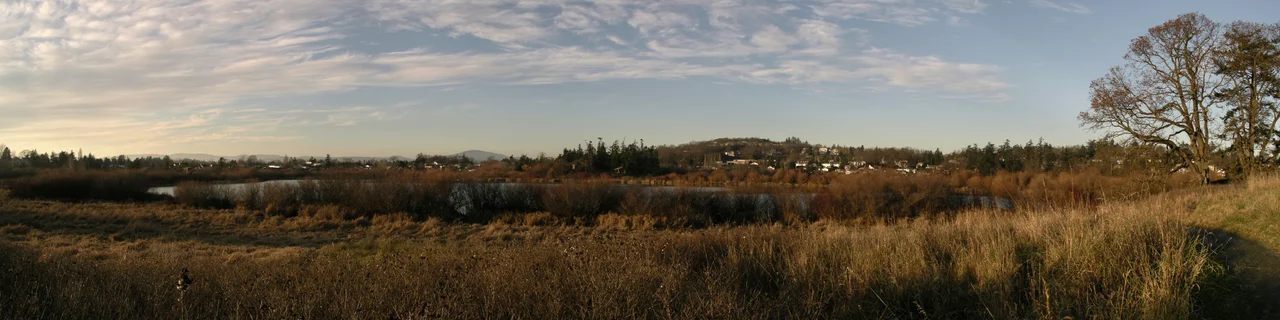

Swan Lake Nature Sanctuary
Every autumn for nearly twenty years, Swan Lake turned over and the neighbourhood held its breath. Summer heat had stratified the water into layers; the bottom layer, starved of oxygen by the sheer volume of rotting algae above it, filled with methane and hydrogen sulphide. When the cooling surface water finally sank and the lake mixed, all of that came up at once. Saanich residents called the place a cesspool and avoided it. Fish had been dying here since at least 1952. That this same lake is now a nature sanctuary drawing more than twenty thousand people a year into its education programs is not a story about a landscape that was always beautiful. It is a story about one that was fixed.
Nets Between Two Poles
Long before any of that, Swan Lake was a hunting and gathering ground for the Songhees people, and the archaeological record bears it out — arrowheads and spear tips have turned up repeatedly in the fields and hillsides around the water. More than a hundred plant species were known and used here: camas lily, wild onion, western crab apple, chocolate lily bulbs, Oregon grape, salmonberry, elderberry, Pacific blackberry, red huckleberry, thimbleberry, fern rhizomes. Cat-tails and swamp rushes came off the shoreline for weaving into mats, baskets, shelter, and clothing. The most elegant technique was for waterfowl: a net strung between two tall poles, held low, then raised suddenly into the flight path of ducks dropping toward the water at dusk. Nothing was discarded afterward. Down was twisted with goose skin and stinging nettle fibre into a textile for shirts and robes, and stored in a bag made of swan skin; feathers went onto masks, headdresses, and ritual objects. On the Garry oak slopes of Christmas Hill, the Songhees cultivated camas, using prescribed burning to keep the ground open — which is why the oak meadows of Greater Victoria looked the way they did when Europeans arrived. That landscape was not wild. It was tended.
A Lake and a Hill
The sanctuary is really two places that have agreed to be one. At the bottom is Swan Lake itself — 9.4 hectares of open water, ringed by 43.4 hectares of marshy lowland, a body of water that swells to cover 32.4 hectares of that low ground when it floods in winter. Above it stands Christmas Hill, a rocky knoll crowned with Garry oak, an ecosystem now rare enough that every remaining stand matters. The two are linked by a corridor trail along the old Nelthorpe Road allowance, crossing McKenzie Avenue at a pedestrian-controlled crosswalk — a stitch of public land holding two habitats together through the middle of suburban Saanich. A gravel loop of roughly two and a half kilometres circles the lake, with further trail climbing the hill above it. Both names were finally settled by the Geographic Board of Canada on 1 May 1934, after decades in which the hill had also been called Lake Hill and nobody could agree on whose Christmas it commemorated.
What Went Into the Water
The poisoning of Swan Lake was thoroughly ordinary. Three streams of nutrients fed the inflow as the city grew around it: fertilizer runoff from farms in the Blenkinsop Valley and around the lake, effluent from a sewage treatment plant at Quadra and McKenzie serving almost five hundred homes, and two wineries that between them discharged more than two thousand kilograms of fermentation sludge into the inflow stream every year. In a shallow, warm lake, that load produced exactly what it always produces — algae in summer thick enough to change the water's colour, then bacteria consuming oxygen as the algae died, then a dead zone at the bottom. Cold-water fish could not survive it. Saanich announced a cleanup in 1963, and in 1975 the whole Swan Lake area was connected to the city sewer system, which at minimum diverted the worst of it. Recovery has been partial and slow. The lake still goes green with duckweed in summer, and its deep water still runs low on oxygen, but trout moving up from the Colquitz River can now live here for most of the year.
Incorporated, 16 June 1975
Saanich began quietly buying land around the lake and hill in the early 1960s with the intention of keeping it undeveloped, spending roughly $650,000 between 1965 and 1978. The Swan Lake Christmas Hill Nature Sanctuary Society was incorporated on 16 June 1975 to run the place, and it still does, under a management agreement with the municipality. The first education programs ran in 1976 and drew 850 participants; that figure now exceeds twenty thousand a year. A new Nature House opened in September 1988, and it remains an unpretentious building with a library, a working bee colony, a classroom, and a resident turtle. A native plant garden finished in 1998 holds seventy species of flowers and shrubs, all native to southern Vancouver Island. Out on the water, the floating boardwalk — originally built by members of the Canadian military — was replaced in two phases and unveiled anew in October 2018. Dogs are not permitted anywhere in the sanctuary, because this is a refuge for ground-nesting and migrating birds, and the birds get priority. That rule, more than any plaque, is what the sanctuary is.
From the Air
Swan Lake Christmas Hill Nature Sanctuary lies at 48.4636 degrees north, 123.3730 degrees west, in Saanich, immediately north of Victoria on southern Vancouver Island. Best viewed from 1,500 to 3,000 feet AGL — the sanctuary is easy to pick out as a dark green wetland with an open lake at its centre, set inside an otherwise continuous suburban grid, with the rocky bald of Christmas Hill rising just to the east. The Pat Bay Highway (BC 17) runs along the lake's western shore and makes the best line-up reference; Saanich Road bounds the east. Note the seasonal difference: in winter the lake floods well beyond its summer outline, roughly tripling its apparent size. Nearest airports: Victoria International (CYYJ) about 17 km north on the Saanich Peninsula, and Victoria Harbour water aerodrome (CYWH) about 6 km southwest in the Inner Harbour; William R. Fairchild International (KCLM) lies across the Strait of Juan de Fuca at Port Angeles, Washington. Expect Victoria terminal airspace and steady floatplane traffic. Morning fog forms readily over the wet lowland in autumn and winter.
Nearby Stories
- Lummi Island 1.9 km away
- Koksilah Ridge 2.6 km away
- Deception Pass Bridge 4.4 km away
- Gettysburg, Washington 5.7 km away
- Otter Point, Greater Victoria 5.9 km away
- Whidbey Island 9 km away
- Pender Island 11 km away
- Hurricane Ridge 28 km away