.jpg)
Swan Theatre, Stratford-upon-Avon
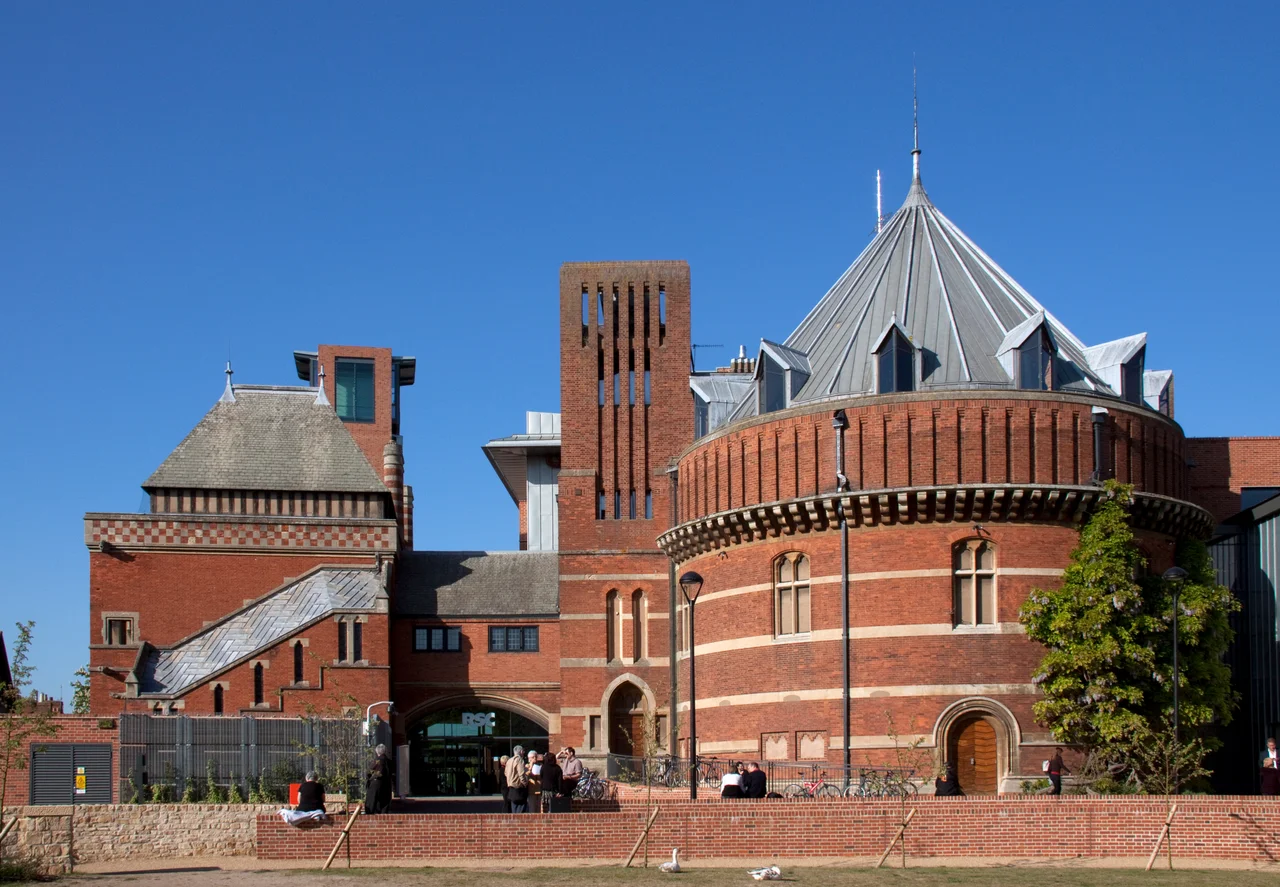
The 1926 fire that destroyed the original Shakespeare Memorial Theatre did not, in fact, destroy all of it. The pinnacled Victorian Gothic facade and the side wings -- the brick-and-stone bookends of the auditorium -- survived. They had served for sixty years as a kind of architectural ghost attached to Elisabeth Scott's 1932 replacement: too elaborate to demolish, too damaged to use. In 1986 the Royal Shakespeare Company found them a purpose. They emptied the surviving Gothic shell, slotted a 450-seat thrust-stage chamber inside it, and called the result the Swan Theatre -- after the rough wooden Elizabethan playhouse on Bankside where Shakespeare's plays were first staged.
Built Inside a Ruin
Michael Reardon, the English architect commissioned to design the Swan, had a peculiar brief: design a working theatre inside a partially gutted Victorian Gothic structure, on a thrust-stage plan inspired by Elizabethan playhouses, holding around 450 people, sharing walls with the existing Royal Shakespeare Theatre. The solution he devised is one of the most admired theatrical spaces in Britain. Three tiers of wooden galleries wrap around an oak-stained thrust stage. The audience encloses the actors on three sides, never more than a few rows from the action. Above, the surviving Victorian timber roof structure was preserved and made visible. The atmosphere is more Elizabethan inn-yard than modern auditorium -- the kind of space Shakespeare would have recognised.
A Stage for the Other Renaissance
Trevor Nunn and Terry Hands, joint artistic directors of the RSC in 1986, dedicated the Swan to a specific repertoire: the works of Shakespeare's contemporaries, of European playwrights, and the occasional Shakespeare. The reasoning was simple. The vast English Renaissance dramatic tradition -- Marlowe, Jonson, Ford, Webster, Middleton, Massinger, Beaumont and Fletcher -- almost never reached major stages, crowded out by Shakespeare's own canon. The Swan gave them a permanent home. The opening production on 8 May 1986 was The Two Noble Kinsmen by William Shakespeare and John Fletcher, a late collaborative play not published until 1634 and thought to be Shakespeare's final work for the stage. Barry Kyle directed. Six months later, on 13 November 1986, Queen Elizabeth II returned to Stratford to officially open the Swan; the evening performance was The Fair Maid of the West by Thomas Heywood, directed by Trevor Nunn.
Chekhov, Ibsen, and Everything Else
Over four decades, the Swan's remit expanded well beyond its original brief. Chekhov was staged here, and Ibsen, and Tennessee Williams. The thrust stage proved astonishingly versatile -- intimate enough for chamber drama, large enough for Jacobean spectacle. Major new commissions premiered here. The space became the RSC's laboratory, the place where experimental and risky work could happen without the pressure of filling 1,040 seats next door. Critics often noted that the Swan was the better theatre. Actors often agreed. There is no auditorium in Britain where the proximity between performer and audience is so consistently rewarding.
The 2022 Refurbishment
Between January 2022 and April 2023 the Swan went dark for a 112.8 million pound RSC transformation project that also included works to the main theatre. The improvements were thorough rather than glamorous: the auditorium was re-carpeted, the seats re-upholstered, a new induction hearing loop installed, the sound and lighting systems modernised, the air conditioning replaced. The new air handling system freed up roof space, restoring the theatre's capacity to fly and hang scenic elements above the stage -- a capability lost decades earlier. The Swan now shares back-of-house and front-of-house with the main theatre for the first time, linked by a new Colonnade. A wind vane and door handles forged by the metalworker Antony Robinson -- whose work hangs in the Victoria and Albert Museum -- are still in place from the 1986 build.
Who Made It Possible
The Swan exists because of the generosity of the Pittsburgh-born financier Frederick R. Koch, who anonymously donated 1.5 million pounds in the early 1980s to fund the build -- a contribution only publicly acknowledged years later. Without his cheque, the Victorian Gothic shell might still be empty, or might have been quietly demolished. The 1879 Memorial Theatre, designed by William Unsworth and Edward Dodgshun, ended up serving the Royal Shakespeare Company in a way nobody could have anticipated when the original auditorium burned in 1926. What survived the fire became the Swan. What was destroyed became the foundations of the modern RSC. It is the kind of architectural improvisation that Britain does better than almost anywhere else -- finding a new use for what cannot be either repaired or thrown away.
From the Air
Located at 52.1904N, 1.7044W on the west bank of the River Avon in central Stratford-upon-Avon, immediately adjacent to and structurally joined with the Royal Shakespeare Theatre. From the air, the Swan is the older Gothic-roofed section of the combined theatre complex, distinguishable from the more modern Bennetts Associates building by its pitched slate roofing and surviving pinnacles. Nearest airports: EGBB (Birmingham, 22nm NW), EGBE (Coventry, 18nm N). Best viewed at 1,500-2,500 ft AGL.
Nearby Stories
- RAF Defford 3.6 km away
- Great Witcombe Roman Villa 4.1 km away
- Coventry War Memorial 4.5 km away
- Hagley Hall 4.6 km away
- Battle of Naseby 5.4 km away
- Silverstone Circuit 5.9 km away
- Waddesdon Manor 8.8 km away
- Woodstock Palace 15 km away