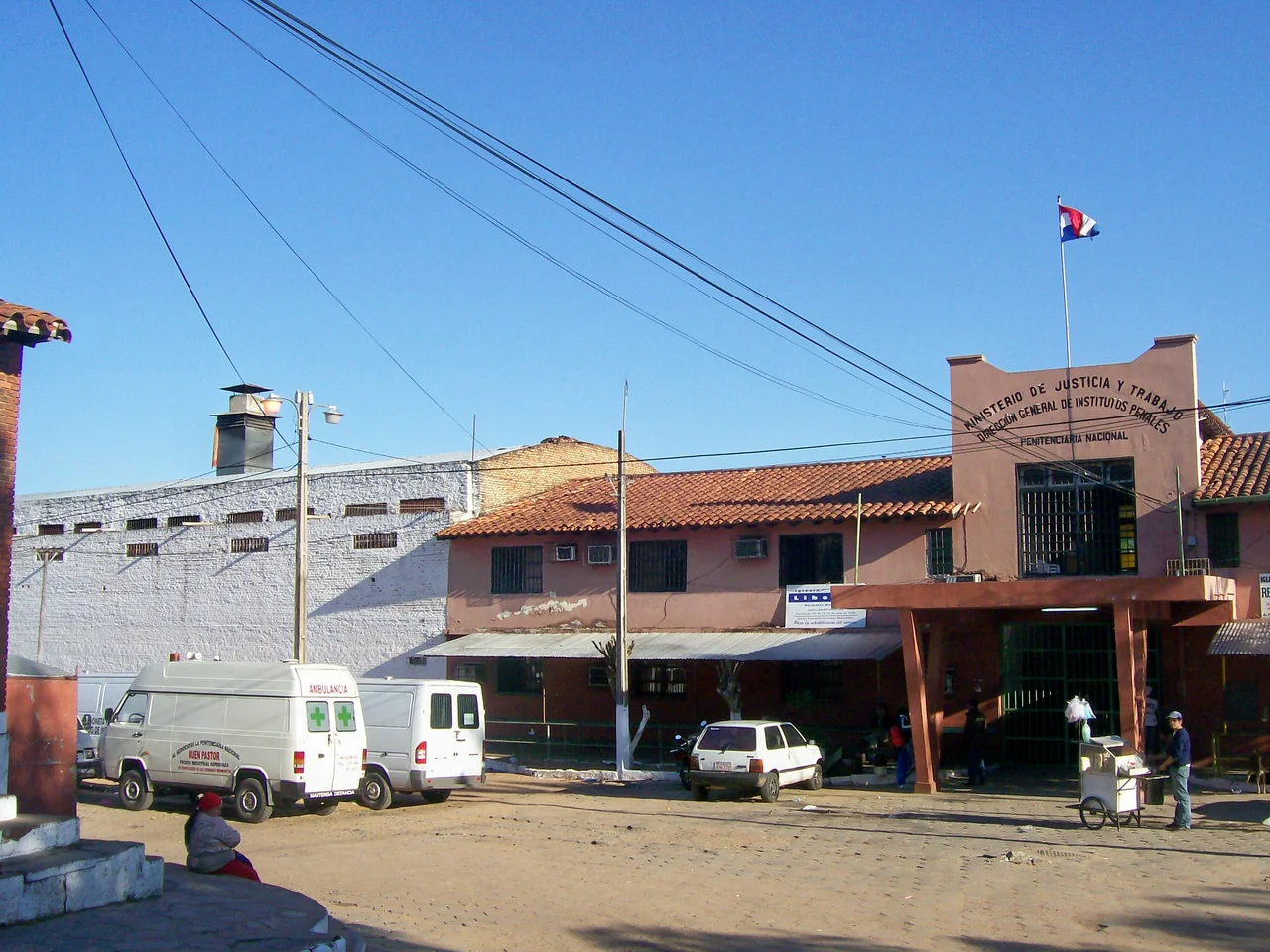

Tacumbú prison
Look at the cobblestones of old Asunción and you are looking at Tacumbú. The hill that rises in this working-class barrio, just five minutes from downtown, was quarried for the rock that paved much of the capital and the towns around it. But the name Tacumbú now carries a heavier weight. It belongs to a prison built for 800 people that, by 2020, held 4,231, and to the thousands of men inside it who are, in the eyes of the law, still presumed innocent. It is a place where Paraguay's hopes and its hardest failures sit only a few city blocks apart.
The Hill That Built a City
Tacumbú is older and broader than its prison. It is a neighborhood of ordinary working families, close enough to the center of Asunción that the downtown is a short drive away. Its defining feature is the hill, a hump of stone that gave the city something it needed: paving. For generations, rock cut from Tacumbú was hauled out to cobble the streets of Asunción and the surrounding districts. Walk the older roads of the capital and the neighborhood is quite literally underfoot, a quiet contribution that long predates the institution most outsiders now associate with the name.
Built for 800, Holding Thousands
When the prison opened in 1956, it was designed for 800 inmates. The capacity was soon pushed to 1,500. By 2020 it held 4,231 people, many of them sleeping outside on the bare ground because there was nowhere else to put them. The arithmetic of supervision is just as stark. In 2019 the director, Jorge Fernández, told the outlet InSight Crime that 40 to 43 guards were responsible for roughly 4,000 prisoners, when keeping order would require at least 100. These are not abstractions. They are men living in conditions of profound overcrowding, the human cost of a justice system stretched far past its limits.
Presumed Innocent, Still Inside
The most telling figure is this: by Fernández's account, only about a quarter of Tacumbú's inmates had actually been convicted of a crime. The other three-quarters were awaiting trial, held for months or years before a court ever ruled on their guilt. Many were poor, unable to make bail or hire a lawyer to speed their case. The overcrowding, in other words, is not simply a problem of too many criminals; it is a backlog of unresolved lives, people suspended in a legal limbo that the law itself calls innocence. Behind every number is a family on the outside, counting the days.
A Window the World Looked Through
With so few guards, the institution lost much of its grip on what happened within. Contraband moved freely, and on visiting days, which Paraguay permits four times a week, on Tuesdays, Thursdays, Saturdays, and Sundays, as many as 7,000 visitors could enter at once, a flood that blurred the line between inside and out. Rivalries between criminal factions turned deadly; a clash in 2019 between the Rotela clan and the Brazilian-born Primeiro Comando da Capital left at least twelve people dead. The British journalist Raphael Rowe filmed inside Tacumbú for the documentary series Inside the World's Toughest Prisons, bringing global attention to a place most of the world would never see. The country has since launched raids to wrest the prison back from gang control. The cameras left. The men, and the system that holds them, remained.
A Crisis Larger Than One Prison
Tacumbú is the largest and most crowded facility in a system buckling everywhere. Paraguay's roughly eighteen prisons were built to hold close to 10,000 people; by the end of 2023, they held more than 17,600. The pressure is the same one visible in Tacumbú's yards, only multiplied across the country: too many people awaiting trials that never seem to come, too few resources to house them humanely. The hill that gave Asunción its streets still stands above the barrio, indifferent to all of it. The harder question the prison poses is not about stone or capacity at all. It is about how a society treats the people it has decided to lock away, and how many of them should be there in the first place.
From the Air
Tacumbú lies in southwestern Asunción at 25.3089 degrees south, 57.6487 degrees west, near the bank of the Paraguay River and only a few minutes' drive from the city center. From the air, look for the prominent Cerro Tacumbú, the quarried hill that names the district, with the dense prison complex and surrounding working-class blocks nearby. Recommended viewing altitude is 1,500 to 2,500 feet. The Paraguay River, bending along the city's western and southern edge, is the clearest navigation reference, with the downtown grid to the north. The nearest airport is Silvio Pettirossi International (ICAO: SGAS, elevation 292 feet) in Luque, roughly 11 nautical miles northeast. Visibility is generally good, though river humidity and afternoon haze can reduce clarity in the warm months.
Nearby Stories
- Yaguarón 21 km away
- Río Pilcomayo National Park 22 km away
- New Australia 45 km away
- La Colmena, Paraguay 46 km away
- Nueva Germania 120 km away
- Pilar, Paraguay 155 km away
- Concepción 174 km away
- First Battle of Nanawa 241 km away