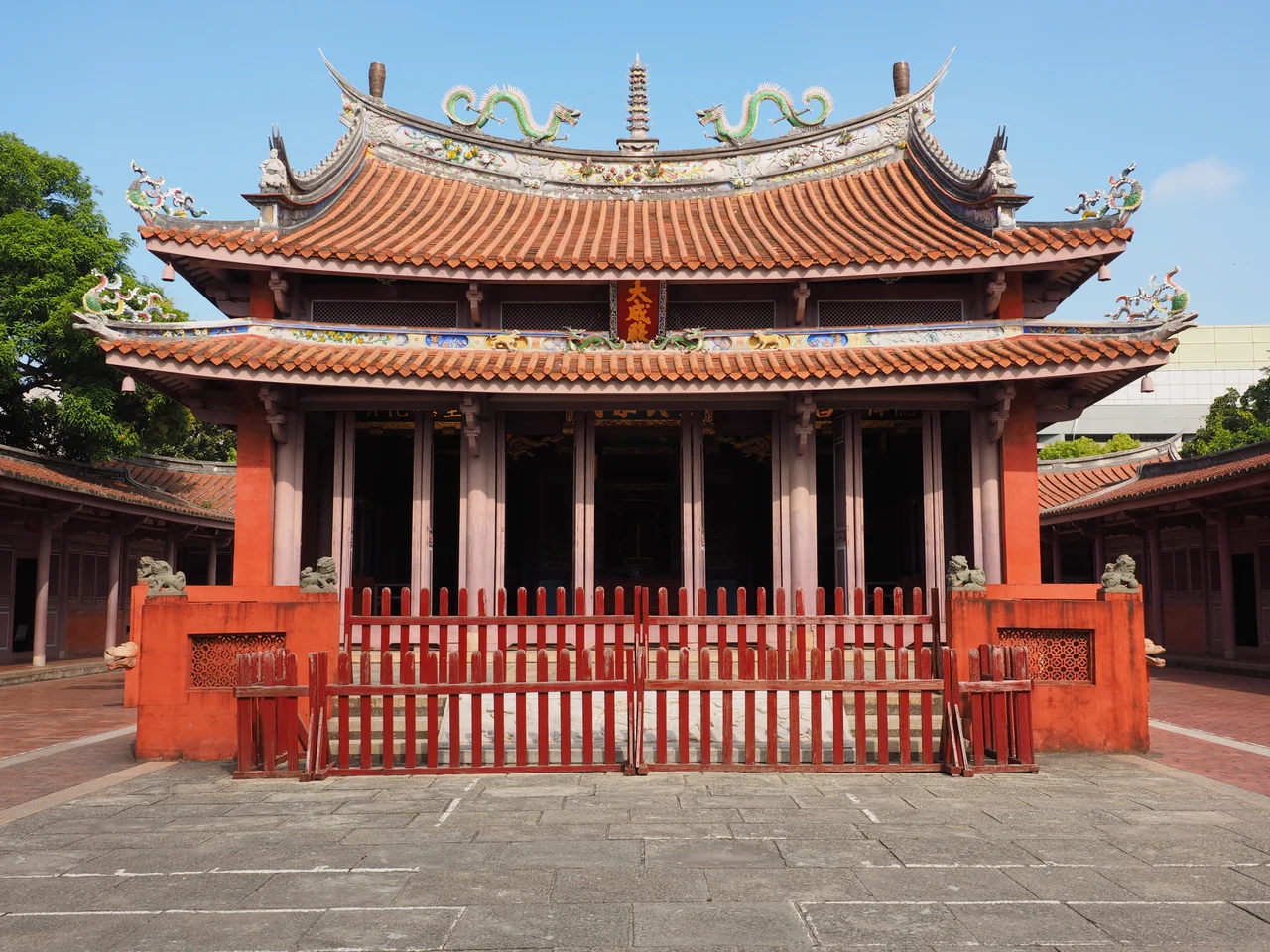

Tainan Confucian Temple
The gate says it plainly: Quan Tai Shou Xue, the First Academy of Taiwan. Before this temple existed, there was no formal Chinese educational institution on the island. In 1665, two years after his father Koxinga's death, Zheng Jing approved a proposal from his chief of staff Chen Yonghua to build a Confucian temple and national academy on a south-facing hill in what is now Tainan's West Central District. On the east side, they erected the Hall of Ethics, where instructors would lecture and cultivate intellectuals. On the west, the Hall of Great Achievement housed the mortuary tablet of Confucius and his distinguished disciples. It was the beginning of formal education in Taiwan, and 360 years later, the compound still stands on Nanmen Road.
The Kingdom's Classroom
The Kingdom of Tungning, established by Koxinga after he expelled the Dutch from Fort Zeelandia in 1662, needed institutions to govern a Chinese society on what had been a colonial outpost. Chen Yonghua, the chief administrator who designed much of the kingdom's civil infrastructure, understood that a government without a scholarly class could not endure. The temple-academy compound he proposed placed worship and education side by side: the Wen Miao, or literary temple, to the right; the Guo Xue, or national academy, to the left. Students studied the Confucian classics, took examinations, and entered government service. The pattern was borrowed wholesale from mainland Chinese tradition, but its establishment on Taiwan was new. For the first time, the island had an intellectual center recognized by a Chinese government.
Renovation Upon Renovation
When the Qing dynasty annexed Taiwan in 1683, the first regional administrators immediately set about renovating the compound and reconstituting it as Taiwan Prefecture Academy. A major expansion in 1712 under Chief Administrator Chen Ping established the layout that largely persists today: the Ta-Cheng Gate at the front, the Chung-Sheng Shrine for Confucius's ancestors in the backyard, East and West Wu chambers flanking the main hall, and the Gate of Rites and Path of Righteousness marking the compound's boundaries. The Ming-Lun Hall became the academy's lecture center, with residential chambers for faculty behind it and the Chu Tzu Altar honoring the scholar Zhu Xi to the east. In 1777, another major renovation reshaped details. When Taiwan became a province in 1887, Tainan became the seat of the new Tainan Prefecture, and the academy was renamed accordingly.
Damaged But Enduring
Japanese rule after 1895 brought the temple's lowest point. The Wen Miao was repurposed as a public school and military barracks, suffering considerable damage. A 1917 renovation tore down some structures but stabilized what remained, essentially fixing the compound's scale and layout as it exists today. Under the Republic of China, the temple has been renovated several times, most recently between 1987 and 1989. The imperial inscribed plaques in the Ta-Cheng Hall survived all of these transformations, tangible links to the Qing emperors who recognized the temple's importance. Today visitors pass through the same gates that examination candidates once entered, walk the same courtyards where scholars debated, and stand before the same mortuary tablet of Confucius that Zheng Jing's government installed in 1665.
The Weight of Being First
Tainan's Confucian Temple carries a particular burden of significance. It is not the grandest Confucian temple in Asia, nor the most architecturally elaborate. What it possesses is priority. This is where formal Chinese education began on Taiwan. Every school, university, examination hall, and scholarly institution that followed traces a lineage back to this compound on Nanmen Road. The Wenchang Pavilion, with its staircase visible from the courtyard, and the Ming-Lun Hall, with its quiet interior, are not just architectural artifacts. They are the physical expression of a decision made in 1665 that Taiwan would be governed not only by military force but by the cultivation of learning. Three and a half centuries later, incense still rises from the altars and students still visit before examinations, carrying on a tradition older than any government currently operating on the island.
From the Air
The Tainan Confucian Temple is located at 22.9903N, 120.204E on Nanmen Road in Tainan's West Central District. The temple compound, with its traditional Chinese rooflines and tree-shaded courtyards, is visible in the urban fabric near the State Temple of the Martial God and other historic sites. The Wenchang Pavilion rises above the surrounding rooflines. Tainan Airport (RCNN) is approximately 5nm south. The compound's layout, with its series of gates, courtyards, and halls arranged on a north-south axis, is best appreciated from lower altitudes.
Nearby Stories
- Chung Li-ho Museum 0.7 km away
- Jingzaijiao Tile-paved Salt Fields 8 km away
- Wanchin Basilica of the Immaculate Conception 9.3 km away
- Namasia District 16 km away
- Battle of Penghu 21 km away
- Shoushan (Kaohsiung) 21 km away
- Penghu Air Raids 62 km away
- Daya Bay 512 km away