.jpg)
Tainan Judicial Museum
Justice has worn different faces in this building. When an unnamed Japanese architect completed it in 1914, the Tainan District Court was an instrument of colonial administration — a physical assertion of the Governor-General of Taiwan's authority over the island's southern capital. The symmetry of its Baroque facade, the solemnity of its main hall, the coffered dome overhead: all of it designed to project the weight and permanence of law. More than a century later, the building still projects that weight, but the institution inside has changed entirely. It is now a museum about the history of law and the history of the building itself.
Built to Command Respect
The courthouse went up in 1914, a decade and a half into Japanese rule, when the colonial government was investing heavily in institutional architecture across Taiwan. Courts, post offices, railway stations, and government halls all followed a similar playbook: European Baroque forms translated into tropical climates, their facades communicating order and civic seriousness to a colonized population. The Tainan building was no exception. Designed by a Japanese architect in the Baroque style, it sat near the center of the city as a visible landmark of colonial legal authority, answering directly to the Governor-General in Taipei.
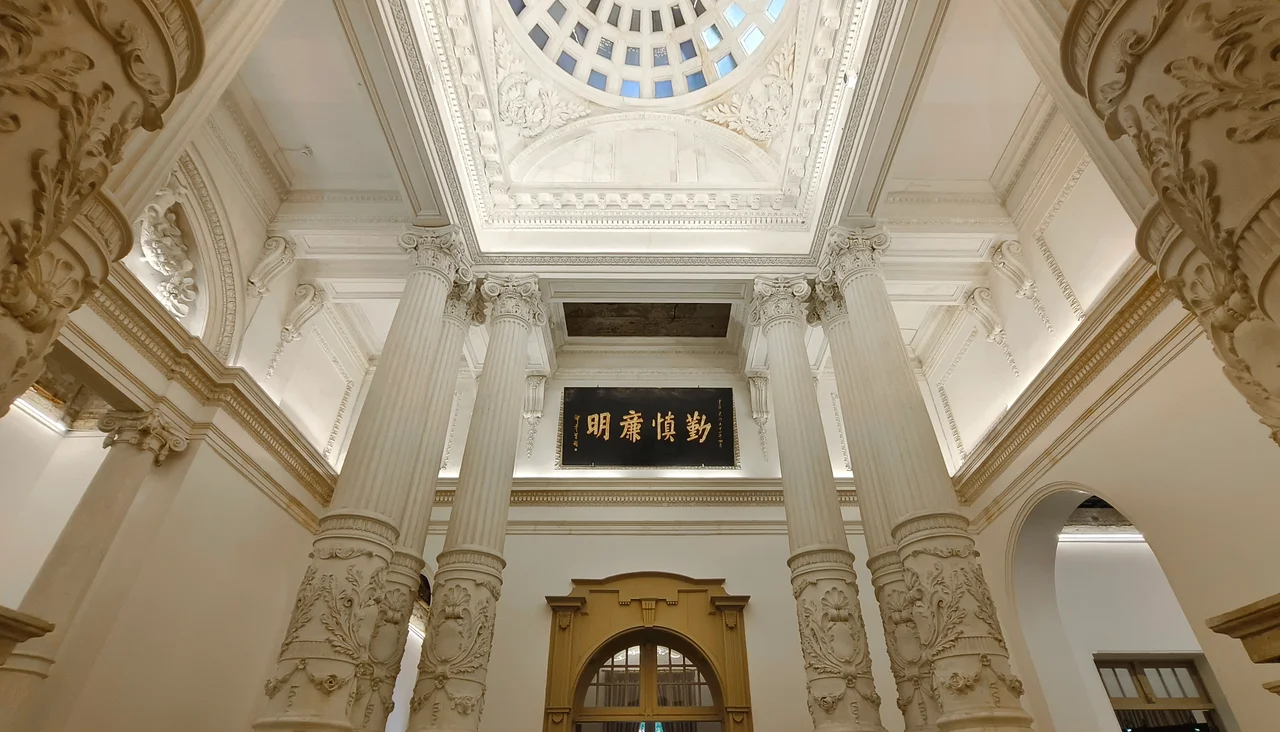
The interior matched the ambition of the exterior. The main hall rose to a coffered dome, its openwork pattern filtering light down into the chamber below. Catwalks ran inside the roof, accessible to maintenance workers maintaining the structure from within. The detention room occupied a less ceremonial corner, a reminder that the building processed not just law but people.
Handovers and Hard Years
When Japan surrendered in 1945 and Taiwan passed to the Republic of China, the courthouse transferred with it. The building continued functioning as a court under the new government, though the power it represented had shifted entirely. Over the following decades it underwent several renovations as the structure aged. In 1969, the western portion of the building collapsed and was demolished, leaving the courthouse with a different footprint than the original plans had specified.
The building's significance was formally recognized in 1991, when the National Historical Monument Conference designated it a second-class historical monument under the Ministry of the Interior — an acknowledgment that what had survived was worth preserving. Renovation work began in earnest in 2003, a painstaking effort to stabilize and restore what remained. That work concluded on November 8, 2016, in a ceremony attended by Judicial Yuan President Hsu Tzong-li.
What the Museum Holds
The museum doesn't confine itself to the building's own story, though that story is certainly on display. Exhibits trace the history of the structure through construction documents, archival photographs, and documentation of the lengthy restoration process. There are displays about the architect and the design decisions that shaped the building, and an exhibition dedicated to the craftspeople and engineers who brought the renovation to completion.
The broader exhibition rooms reach into the history of law in Tainan and Taiwan: historical legal documents, law-related writings spanning both colonial and postwar periods, records of how the district's legal landscape evolved across more than a century of political change. A small room reconstructs the conditions of colonial detention. Together, the exhibits map both the particular history of this address and the larger story of what law has meant — and done — in southern Taiwan.
A Dome Still Overhead
The building sits in West Central District, within easy walking distance southwest of Tainan Station on the Taiwan Railway. The neighborhood is dense with other survivors of the colonial period — temples, administrative buildings, old commercial blocks — and the Judicial Museum reads naturally as part of that fabric. But it stands out. Most of Tainan's colonial buildings have been repurposed for commerce, education, or government. This one was repurposed for reflection.
Visitors who look up in the main hall encounter the coffered dome intact, its geometric pattern pulling the eye upward toward filtered light. Visitors who look closely at the surrounding rooms encounter fragments of a more complicated past — a past in which the same vaulted ceilings presided over proceedings that had very little to do with justice in the modern sense. The building holds both things simultaneously, as good preservation tends to do.
From the Air
The Tainan Judicial Museum is located at approximately 22.990°N, 120.201°E in West Central District, Tainan. From the air at 2,000–3,000 feet, it is identifiable as a large civic building with a symmetrical Baroque facade near the center of Tainan's urban core, close to Tainan Railway Station. The nearest major airport is RCKH (Kaohsiung International), approximately 25 km to the southwest; RCNN (Tainan Airport) is the closer regional option, roughly 5 km to the north. The surrounding district is dense, with good visual landmark identification from the railway corridor running north–south through the city.
Nearby Stories
- Chung Li-ho Museum 0.7 km away
- Jingzaijiao Tile-paved Salt Fields 8 km away
- Wanchin Basilica of the Immaculate Conception 9.3 km away
- Namasia District 16 km away
- Battle of Penghu 21 km away
- Shoushan (Kaohsiung) 21 km away
- Penghu Air Raids 62 km away
- Daya Bay 512 km away