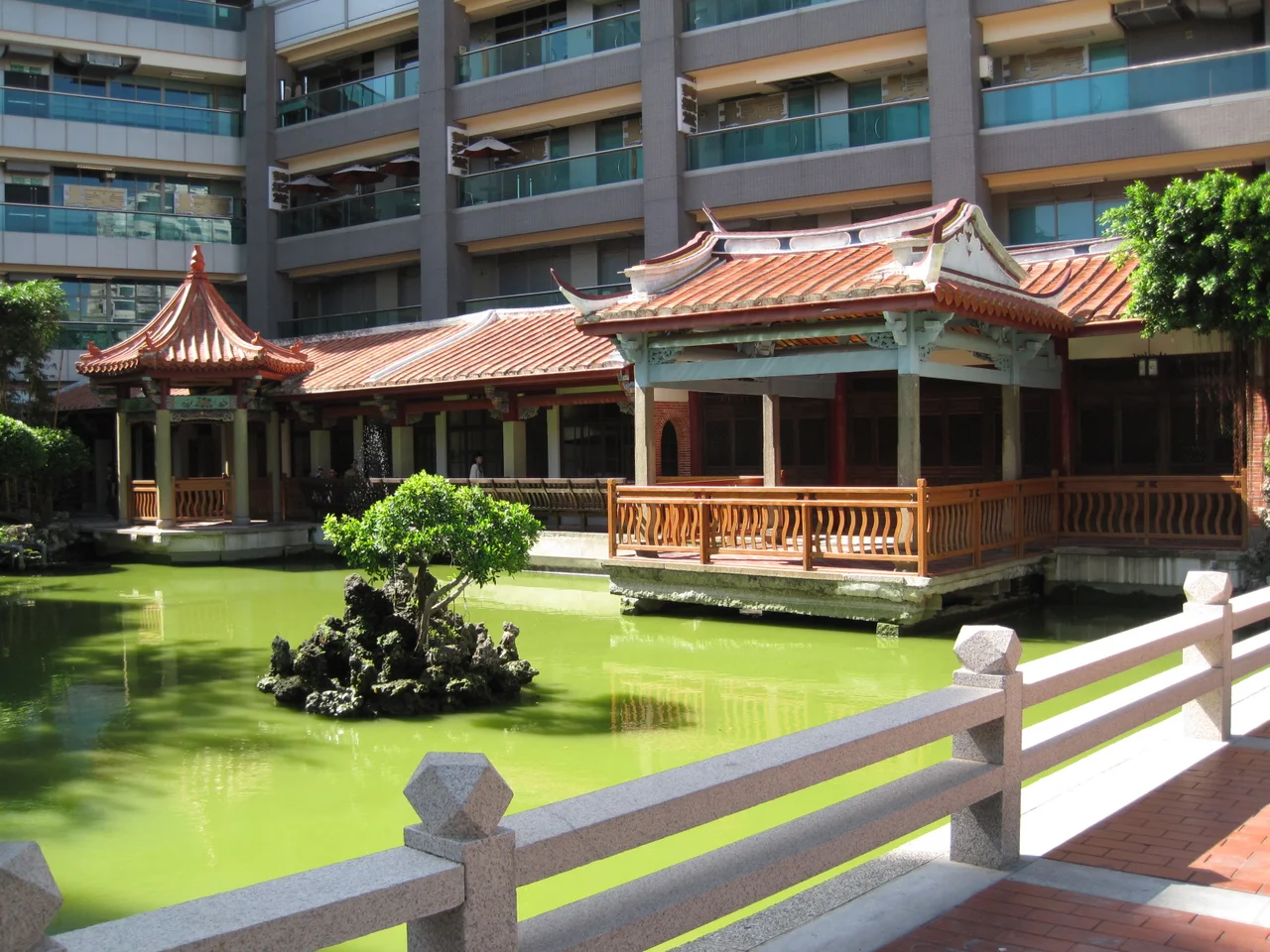

Tainan Wu Garden
There is a Taiwanese saying about the Wu family estate: "Even if you have the wealth of lau-a lai, you don't own the estate of lau-a lai; even if you own the estate of lau-a lai, you don't have the wealth of lau-a lai." The proverb captures something about the sheer scale of what salt magnate Wu Shangxin built around 1828 when he purchased and transformed a garden in Tainan's Pang-kio-thau district. What makes the story stranger is the garden's earlier owner: He Bin, an interpreter during the Dutch colonial period who played a direct role in the fall of Fort Zeelandia by providing Koxinga with intelligence about Dutch defenses. From a colonial collaborator's private grounds to a salt tycoon's showpiece to one of Taiwan's Four Great Gardens, Wu Garden has been reinvented by every era that touched it.
The Salt King's Paradise
Wu Shangxin made his fortune in Taiwan's salt trade, an industry that concentrated enormous wealth in relatively few hands during the Qing dynasty era. Around 1828, he acquired the garden previously owned by He Bin and transformed it into the Purple Spring Garden, a name that carried connotations of imperial elegance. The garden became known as one of the Four Great Gardens of Taiwan, alongside the Lin Family Mansion and Garden in Wufeng, the Beiguo Garden in Hsinchu, and the Lin Family Mansion and Garden in Banqiao. That ranking placed it among the island's most significant private estates, a reflection of both Wu's wealth and his taste. The family's prosperity generated the proverb that their riches and their property were each independently beyond comparison.
Confiscation and Encroachment
Fortunes turn. During the Japanese colonial period, the Wu family's wealth declined, and the garden was confiscated by Tainan Prefecture. What followed was a gradual dismemberment of the estate. In 1911, the Former Tainan Assembly Hall was built along the garden's southern edge. The Four Seasons Inn went up on the southeastern side. In 1920, the Tainan Library occupied the northwestern corner. In 1922, the Tainan Municipal Swimming Pool was constructed on the northern edge. By 1974, the inn, library, and bathhouse had all been sold to Far East Department Store, which now operates its Park Branch on the site. A garden that had once been a unified private landscape became fragmented among public institutions and commercial enterprises, each taking a bite from the perimeter.
The Garden That Survived Itself
In 1994, a proposal for commercial development on the remaining garden grounds threatened to erase what was left. The plans were dropped, and Wu Garden has been preserved to this day. What survives is a green space in the heart of Tainan's West Central District, a rockery garden with artificial hills modeled after famous Chinese landscape features, ponds, and mature trees that shade paths where salt merchants once strolled. The Former Tainan Assembly Hall, which claimed the garden's southern boundary over a century ago, now functions as a complementary cultural venue. The garden's persistence is not heroic so much as stubborn. It exists because at every moment when it might have vanished, someone decided not to build on it. In a city as dense and commercially active as Tainan, that restraint is its own kind of monument.
From the Air
Tainan Wu Garden is located at 22.9942N, 120.206E in Tainan's West Central District. From the air, the garden appears as a pocket of greenery amid the dense urban fabric of central Tainan, adjacent to the Former Tainan Assembly Hall. The rockery features and pond are visible at lower altitudes. Tainan Airport (RCNN) is approximately 5nm south. The garden is near other historic sites including the Confucian Temple and the State Temple of the Martial God.
Nearby Stories
- Chung Li-ho Museum 0.7 km away
- Jingzaijiao Tile-paved Salt Fields 8 km away
- Wanchin Basilica of the Immaculate Conception 9.3 km away
- Namasia District 16 km away
- Battle of Penghu 21 km away
- Shoushan (Kaohsiung) 21 km away
- Penghu Air Raids 62 km away
- Daya Bay 512 km away