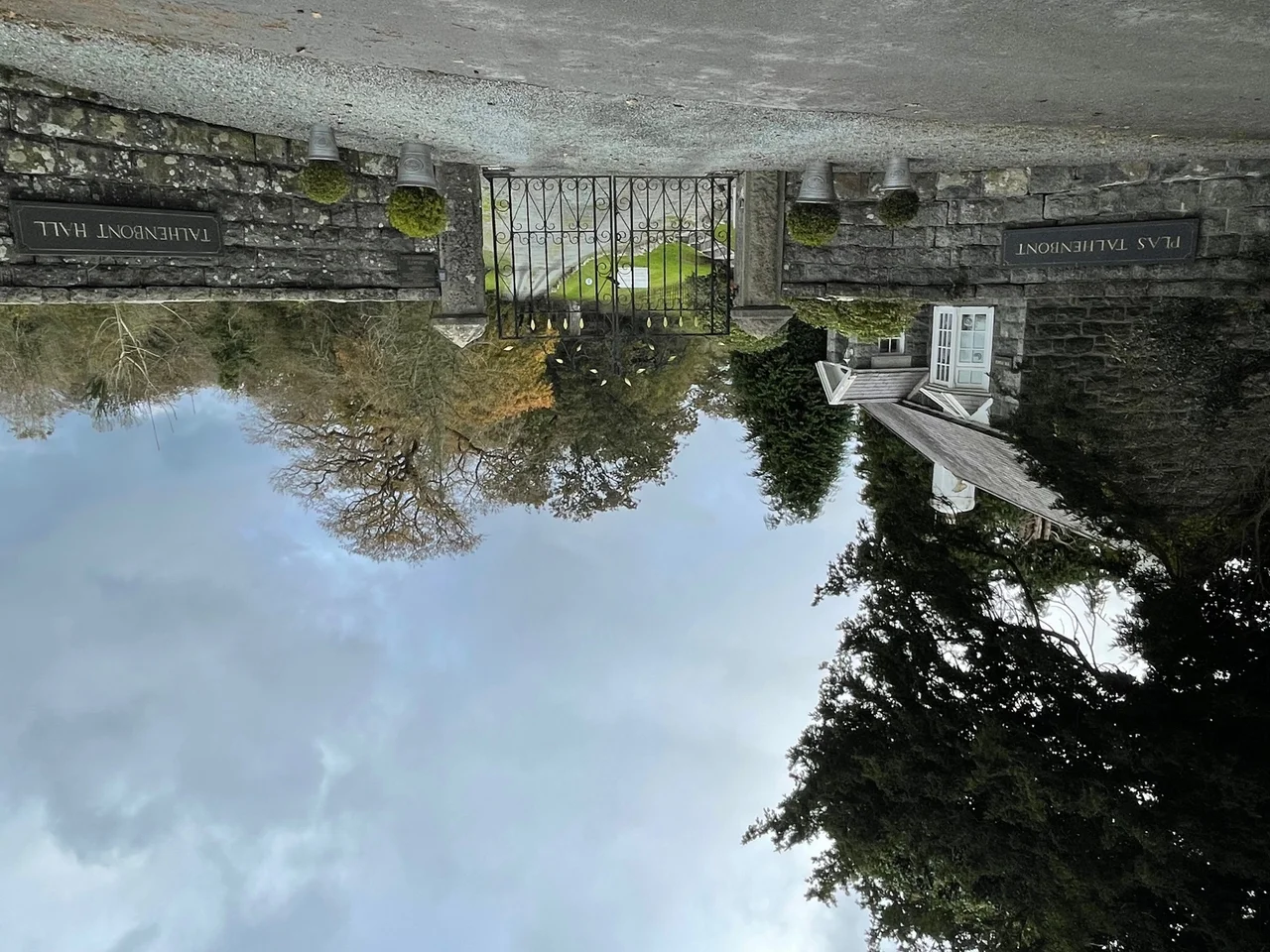

Talhenbont Hall
The stone tablet over the south-west doorway carries the initials WV and the date 1607. WV is William Vaughan of Corsygedol, the man who built the house, and 1607 is the year he completed it -- forty-one years before the king he would later support went to the block in Whitehall. The hall was originally called Plas Hen, the old place, a name that perhaps acknowledged that the Vaughans had been here a long time before they built in stone. The first record of the family in Eifionydd dates from around 1416. They claimed descent from Collwyn ap Tagno, the eleventh-century lord whose lineage formed the fifth of the legendary Fifteen Tribes of Wales. By the time William Vaughan put up the present house, the Vaughan estate was part of the largest landholding in North Wales.
The Civil War in the Hall
Within forty years of being built, Plas Hen found itself caught between the two sides of the English Civil War. Parliament's New Model Army seized the mansion at one point in the campaign. The Royalists under Sir John Owen of Clenennau -- the Welsh general who held North Wales for Charles I -- later took it back and used it as a headquarters. The war ended badly for Owen; he was condemned to death in 1649, then reprieved at the last moment by the Council of State, who decided that executing him alongside the king would do nothing for the new Republic's reputation in Wales. His daughter later married into the Vaughan family of Talhenbont, knitting the Royalist commander into the genealogy of the house he had defended. The Vaughan family kept the estate through the Restoration, the Glorious Revolution, the Jacobite risings and the Hanoverian succession, holding the land continuously for over two hundred years.
From Vaughan to Mostyn to Ellis-Nanney
The last Vaughan generation began with William Vaughan, born 1707, who attended Cambridge and served as MP for Merioneth from 1734 through six parliaments until 1768. He married Catherine Nanney, heiress of the Nannau estate, in 1733. They had one daughter, Anne, who died young and childless. William outlived her by eight years and died without male heirs. The estate passed to his brother Evan Lloyd Vaughan, also an MP, and on Evan's death without children to William's niece Margaret. Margaret had married Sir Thomas Mostyn, sixth Baronet Mostyn, and the union pulled Plas Hen into the Mostyn portfolio alongside Corsygedol, Bodidris and the Wynn family seat at Bodysgallen. The Mostyns held it for less than fifty years. In 1845 the Ellis-Nanney family bought the Hall and surrounding land for 50,000 pounds, renamed it Talhenbont Hall, and added it to their estate of over 16,000 acres. The Ellis-Nanneys, however, had over-extended themselves during the Napoleonic Wars, and in 1884 the estate was broken up to pay debts. The remaining holdings were sold to their tenants in 1959.
Stone, Slate and a Tudor Arch
The house that William Vaughan built in 1607 was originally T-shaped. Subsequent owners altered it to a W cross-wing plan, adding a gabled porch on the north-east leading to the parlour and a service wing in the nineteenth century. The exterior is two storeys plus an attic, the walls of rubble stonework with cut ashlar quoins, the roof of slate with slate copings on the gables. The chimney stacks are tall, the eaves stone-bracketed, the windows fitted with stone ovolo-mullions. The original Tudor-arched doorway on the south-west still bears the carved stone tablet with William Vaughan's initials and the 1607 date. Beneath the date are the quartered arms: Collwyn ap Tagno for the fifth of the Fifteen Tribes, Osbwrn Wyddel for the thirteenth-century Irish founder of the Corsygedol line, four lions passant for the Kingdom of Gwynedd, and Ednyfed Fychan -- the great twelfth-century seneschal of Gwynedd. Beside William Vaughan's initials are the letters AV, presumably for his wife Ann Vaughan of Plas Hen. The arms below carry the family motto in Welsh.
Weddings and Wallpaper
Talhenbont Hall is now run as a wedding venue, with the outbuildings converted into self-catering holiday cottages. The old farm workers who lived in those cottages until the 1980s would barely recognise the place; the pigsty is gone, the stable with its round-headed doorway is now accommodation, the coach house that once stabled horses and housed the grooms in a single chimney-warmed room above is rented out by the week. In 2011 the Hall featured in an episode of the BBC One series Hidden Houses of Wales, presented by Laurence Llewelyn-Bowen, the flamboyant interior designer who used to make over British living rooms on television in the 1990s. The pairing was incongruous and appealing. A house built in 1607 by a Welsh-Irish dynasty, fought over in the Civil War, sold for 50,000 pounds in 1845, and finally examined on prime-time television by a man best known for crushed-velvet curtains. The estate sits between Llanystumdwy and Chwilog, the same neighbourhood that produced David Lloyd George, the planted lane of Lon Goed, and Penarth Fawr. Eifionydd punches above its weight in country houses.
From the Air
Located at 52.93N, 4.29W in rural Eifionydd between Llanystumdwy (south-east) and Chwilog (west), in the lowlands behind the south coast of the Llyn Peninsula. Caernarfon Airport (EGCK) lies 13nm north. Best viewed at 1,500-2,500ft AGL. The hall sits within wooded parkland off a minor road, with the planted avenue of Lon Goed beginning a couple of miles to the south at Afon Wen.
Nearby Stories
- GeoMôn 1.9 km away
- Battle of the Conwy 3.2 km away
- Irish Sea Bridge 5.2 km away
- Ysbyty Ifan 10 km away
- Machynlleth 16 km away
- Barmouth Lifeboat Station 23 km away
- Irish Sea 27 km away
- HMS Tyler 32 km away