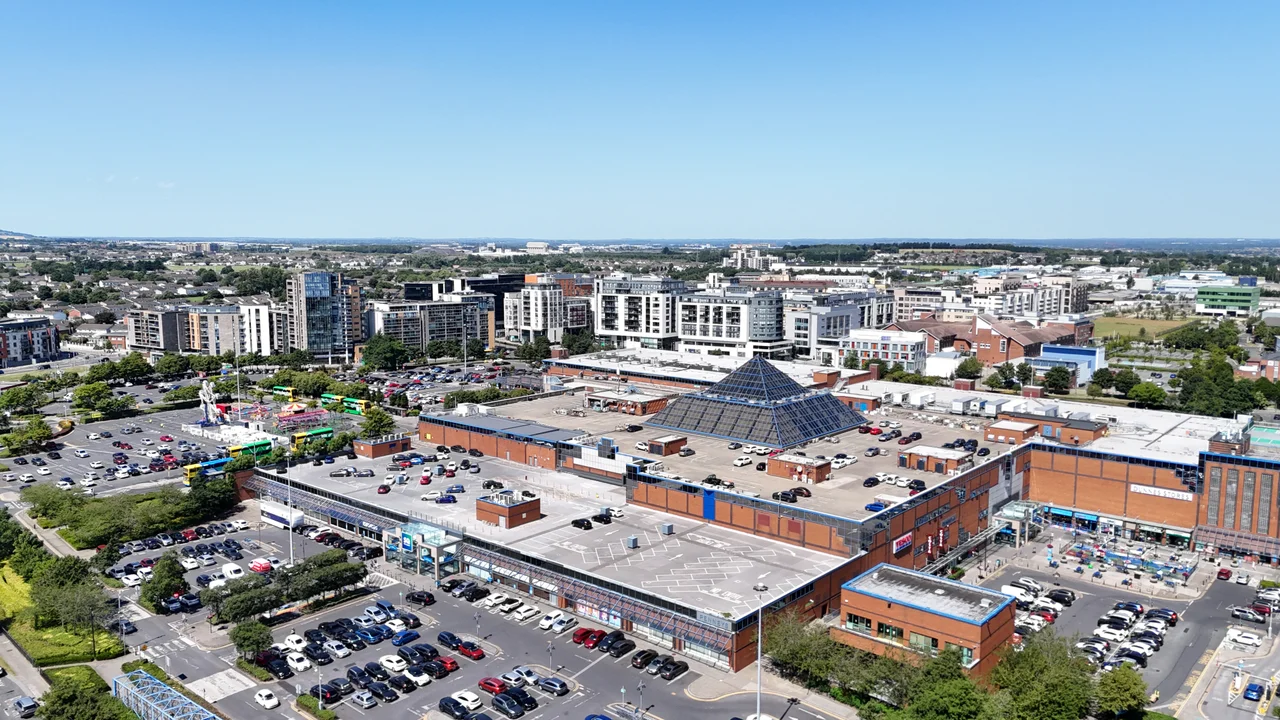

Tallaght
Tamh-leacht. Plague pit. The name comes, the old stories say, from the burial place of Parthalon's people - the first invaders of Ireland in the Book of Invasions, all nine thousand of whom died in a single week. Modern archaeology has found only normal Bronze Age burials here, but the name stuck. Today Tallaght is the largest settlement in Ireland without city status: 81,022 people across thirteen electoral divisions, the county town of South Dublin, sprawling thirteen kilometres south-west of Dublin city centre at the foot of the Wicklow Mountains. In 1961, before the planners arrived, only 4,565 people lived here. The transformation in sixty years is one of the most dramatic in modern Irish history.
The Two Eyes of Ireland
Long before suburbia, Tallaght was a monastery. Saint Maelruain founded it in 769 and made it a centre of the Celi De movement - a reform of Irish monasticism toward stricter prayer, study and asceticism. Tallaght became so influential that, paired with the monastery at Finglas, it was known as one of "the two eyes of Ireland." Saint Aengus, an Ulsterman seeking anonymity from his own followers, came here in secret and enrolled as a lay brother; Maelruain eventually recognised him and the two may have written the Martyrology of Tallaght together. In 806 the monks of Tallaght were powerful enough to prevent the Tailteann Games. In 811 the Vikings devastated the place, though not permanently. The strangest fact about Maelruain's monastery is that almost nothing visible survives. Centuries of warfare, castle-building, demolition and replanting erased it. What remains are the records and a Persian walnut tree on the grounds of the modern Dominican priory, said to mark the original site.
The Battle of Tallaght
On the night of 5 March 1867, during the Fenian Rising, several thousand armed men gathered on Tallaght Hill to march on Dublin. Word reached the small Royal Irish Constabulary barracks in the village. Fourteen constables and a head constable under Sub-Inspector Burke took up firing positions outside the barracks. They commanded the roads from Greenhills and Templeogue. The first Fenian column came in from Greenhills and was driven back by police fire. The second came from Templeogue and was scattered the same way. The rising collapsed within days. In 1936, a skeleton was found in a hollow tree stump near Terenure, with a sword-bayonet and water bottle beside it - likely a Fenian who had hidden there after the engagement and either died of his wounds or froze to death in the woods. The skirmish, almost forgotten in larger histories of Irish nationalism, remains the moment Tallaght entered the modern political story.
The New Town That Wasn't
The 1967 Myles Wright masterplan proposed four self-contained new towns around Dublin: Tallaght, Clondalkin, Lucan and Blanchardstown. The houses came quickly. The schools, shops, jobs and community facilities did not. Through the 1970s and 1980s, Tallaght became almost synonymous with what poorly planned European suburbs feel like from inside: isolation, distance, a sense that the place is composed only of "the houses and the mountains," as one resident put it. Families moved in from inner-city Dublin tenements expecting better; many found themselves stranded. The Tallaght Rehabilitation Project was set up in 1997 to address the drug and alcohol problems that followed. The reckoning was painful and partial. But Tallaght also produced its own institutions: the Civic Theatre, the Rua Red arts centre, the Institute of Technology that opened in 1992 and later folded into the Technological University Dublin.
A Suburb Becomes a City
The turning point was Alan Dukes's 1987 Tallaght Strategy speech to the local Chamber of Commerce - a moment that gave the place a political identity beyond Dublin's planners. The Square shopping centre opened in 1990. South Dublin County Council moved its headquarters here in 1994. Tallaght Hospital opened in 1998. The Civic Theatre opened in 1999. The Luas Red Line connected Tallaght to central Dublin in 2004, finally giving the town the rail link it had lacked since the Dublin and Blessington Steam Tramway closed. Tallaght Stadium was completed in 2009, and on 15 September 2011 Shamrock Rovers hosted Rubin Kazan there in the first UEFA Europa League group stage match ever to feature an Irish team. The Dominican Priory still stands on the grounds of the old Archbishop's palace, with St. Maelruain's Tree - that eighteenth-century Persian walnut - rooting the modern town to its eighth-century founder. Tallaght keeps growing. The question of whether to declare it a city has been raised more than once.
From the Air
Located at 53.29°N, 6.36°W in the south-west of greater Dublin, 13 km from the city centre near the foothills of the Wicklow Mountains. Best viewed at 2,500-4,500 ft AGL; the town sprawls just outside the M50 motorway ring road, with the Wicklow Mountains rising to the south. Dublin Airport (EIDW) lies 18 km to the north; Casement Aerodrome (Baldonnel, EIME) is 4 km to the west.
Nearby Stories
- Athcarne Castle 4.2 km away
- Wicklow Mountains National Park 10 km away
- Castlepollard 12 km away
- Portlaoise 19 km away
- Edward Pakenham 20 km away
- German submarine U-1051 39 km away
- HMS Manners (K568) 52 km away
- HMS Tyler 61 km away