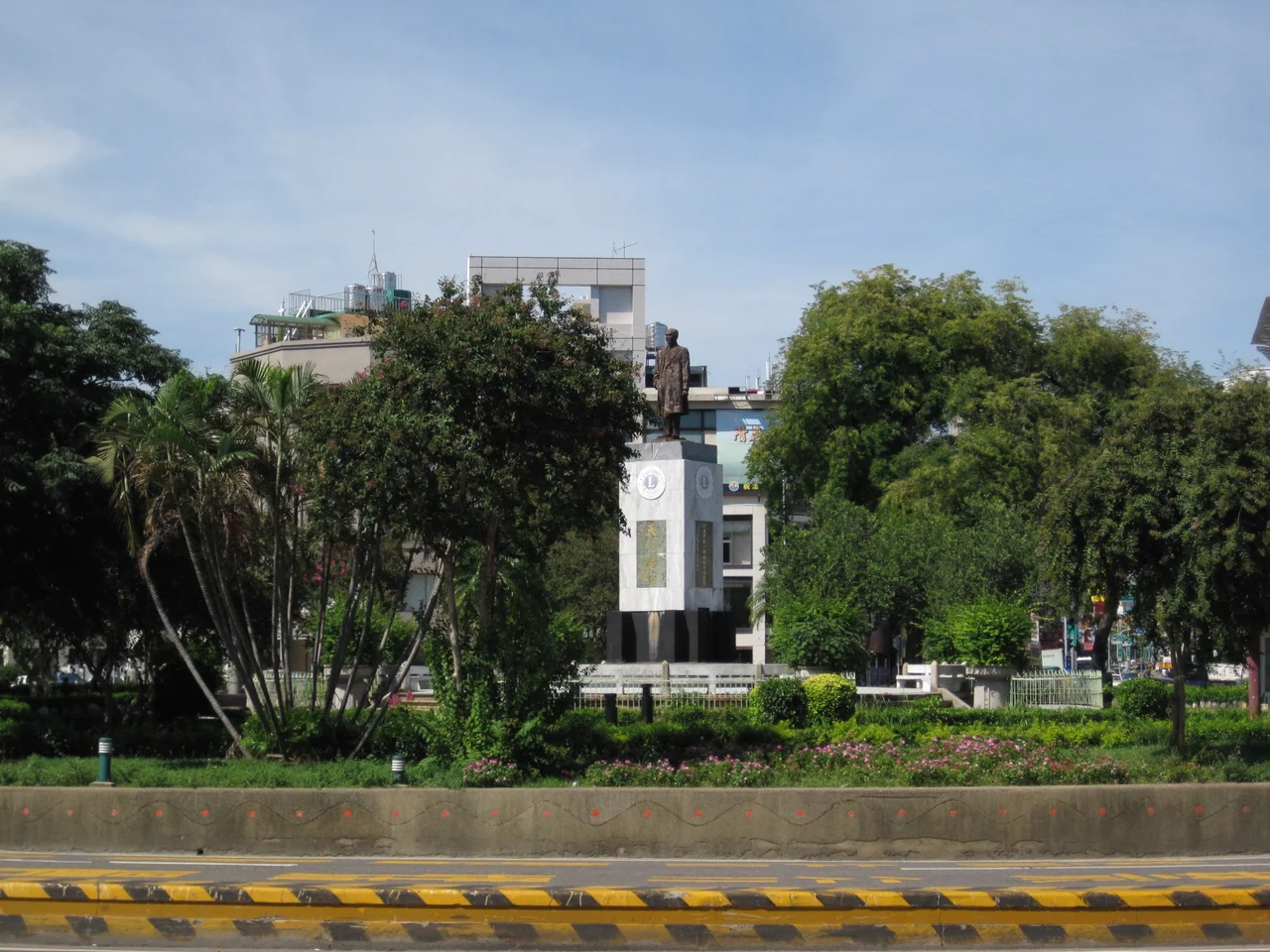

Tang Te-chang Memorial Park
Before soldiers shot him at this park on March 13, 1947, Tang Te-chang burned a list of names. It was his last act as leader of the Tainan branch of the 228 Handling Committee — the civilian body trying to negotiate calm during the February 28 Incident — and it was a deliberate one. The list held the names of his fellow committee members. By destroying it, Tang ensured that the Nationalist military forces closing in on Tainan could not use it to find and arrest the people who had worked alongside him. He was protecting others, right to the end.
A Lawyer in a City Under Pressure
Tang Te-chang was a respected figure in Tainan long before the crisis of 1947. He had studied law in Tokyo and returned to practice in southern Taiwan, eventually becoming a city assemblyman as well. He was the kind of person communities turn to when they need someone credible, measured, and fluent in both the law and the language of public affairs.
The February 28 Incident began in Taipei on February 28, 1947, when a confrontation between Nationalist authorities and civilians ignited island-wide unrest. As violence spread and Nationalist mainland troops were dispatched to restore control, local committees formed across Taiwan to mediate between the population and the government. In Tainan, Tang led the local chapter of the 228 Handling Committee — a role that placed him directly between armed forces and the community he had spent his career serving. He worked to de-escalate tensions, urged protesters to disarm, and tried to prevent the crisis from deepening. His reported last words were: 'Long live Taiwan.'
March 13, 1947
Tang was arrested on March 11, 1947. Two days later, on March 13, he was brought to the park and shot. The proceedings against him were not a trial in any recognized legal sense — there was no fair hearing, no presentation of evidence, no legal defense. He was killed as the Nationalist military suppressed the uprising across Taiwan.
The February 28 Incident and its aftermath resulted in the deaths and disappearance of thousands of Taiwanese civilians, and was followed by decades of martial law and official silence on what had occurred. For many years, the victims could not be publicly mourned or named. The formal acknowledgment of these events by the Taiwan government came much later, beginning in the 1990s, and the process of memorialization continues.
From Taisho Park to Memorial Ground
The park itself has a layered history that predates 1947. During the Japanese colonial era it was known first as Kodama Park, after a statue of Kodama Gentarō — the fourth Governor-General of Taiwan — erected by local residents in 1907. Later it was renamed Taisho Park. After Taiwan's handover to the Republic of China in 1945, it became Min Sheng Green Park. The park sat at a traffic circle, a civic open space in the heart of a dense urban district.
In 1998, fifty-one years after the execution, Tainan Mayor George Chang renamed the park in Tang's honor and erected a bronze bust of him at the site. A further restoration of the park began in September 2017, costing NT$8 million and intended to harmonize the space with the Japanese-style buildings of the surrounding neighborhood. In 2015, the original head of the Kodama statue — long thought lost — was discovered by artists at an old Imperial Japanese Army barracks. The park quietly accumulates history.
The Bust at the Center
Today the park is small, circular, and unhurried. It sits in West Central District, a short walk southwest of Tainan Station, ringed by traffic and enclosed by an urban neighborhood that has changed dramatically around it. At its center stands the bust of Tang Te-chang, a man in his forties at the time of his death, looking composed.
On March 10, 2013, various civil society organizations and the PCT Church and Society Committee gathered at the park to commemorate Tang's life and legacy — one of many such observances that have taken place here since the memorial was established. Coming to this park is not a dramatic experience. The scale is modest, the surroundings ordinary. What makes it significant is the specific thing that happened here, in this city, to this one person who spent his last days trying to keep others alive. That is worth remembering, and worth visiting.
From the Air
Tang Te-chang Memorial Park is located at approximately 22.993°N, 120.205°E in West Central District, Tainan — a compact traffic-circle park near the city center, close to Tainan Railway Station. From the air it is identifiable as a small circular green space in the urban grid, roughly 300 meters north of the Tainan Judicial Museum. The nearest major airport is RCKH (Kaohsiung International), approximately 25 km to the southwest; RCNN (Tainan Airport) is the closer regional option, around 5 km to the north.
Nearby Stories
- Chung Li-ho Museum 0.7 km away
- Jingzaijiao Tile-paved Salt Fields 8 km away
- Wanchin Basilica of the Immaculate Conception 9.3 km away
- Namasia District 16 km away
- Battle of Penghu 21 km away
- Shoushan (Kaohsiung) 21 km away
- Penghu Air Raids 62 km away
- Daya Bay 512 km away