.jpg)
The Black Lake and the White Crocodile
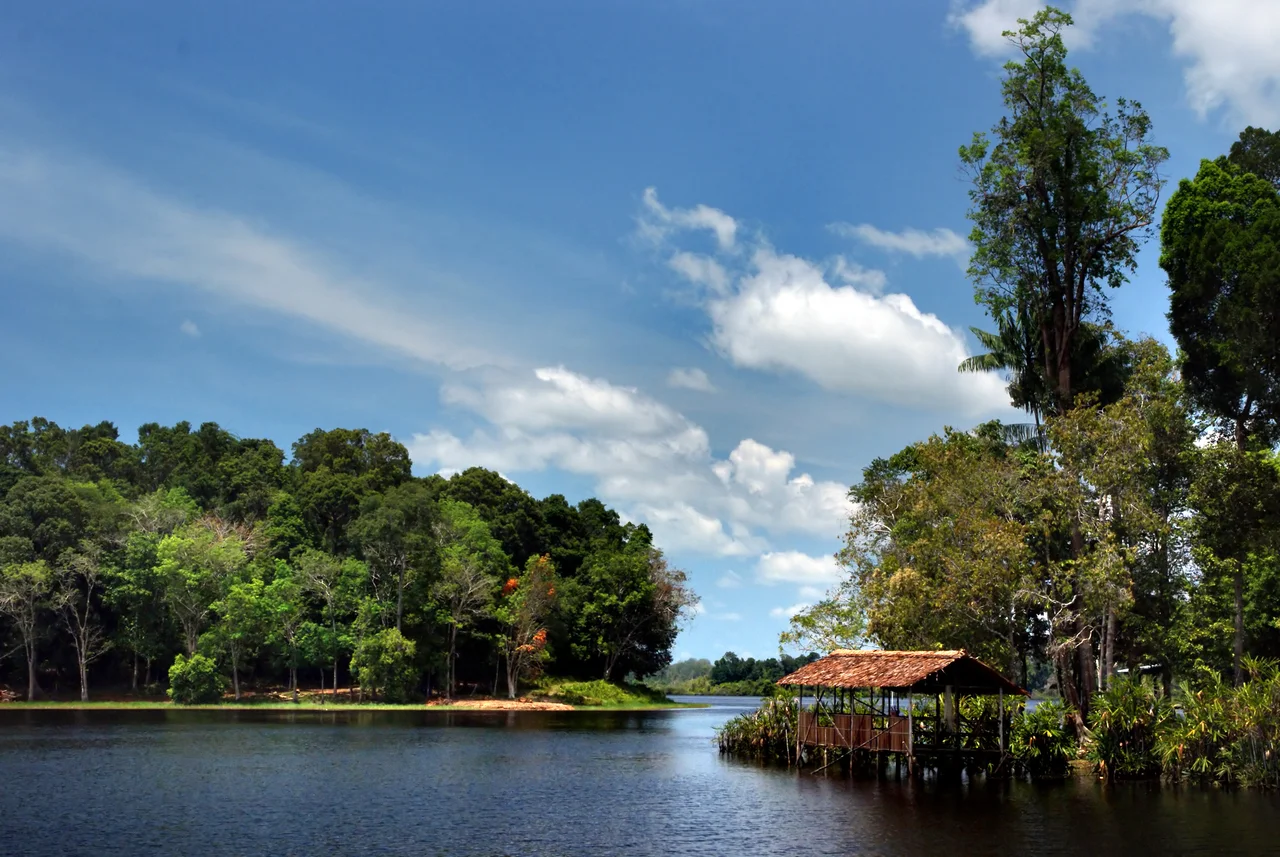
Somewhere beneath the dark water of Tasek Merimbun, according to the Dusun people who have lived on its shores for centuries, a white crocodile guards the lake. Its rare appearances are not celebrated -- they are feared, taken as omens of coming tragedy. Whether the creature exists in flesh or only in the collective memory of the community, its legend captures something true about this place: Brunei's largest natural lake is ancient, opaque, and not fully knowable. The water itself is nearly black, stained by tannins leaching from the peat forests that feed it, and the S-shaped lake curves through 7,800 hectares of protected wilderness like a dark signature scrawled across the Tutong District interior.
Imbun's Discovery
The Dusun Brunei, an indigenous people with deep roots on the island of Borneo, are believed to have inhabited the Merimbun area for centuries. Local tradition attributes the lake's discovery to a man named Imbun, the son of a village head from Merangking Hilir in the Belait District. The story goes that Imbun stumbled upon the lake while hunting and recognized immediately what he had found: a landscape of abundance, with fish in the water and game in the surrounding forest. He brought his family, then his neighbors followed. The lake and its surroundings took his name -- Tasek Merimbun, the lake of Imbun. A second etymology adds an intriguing layer: Chinese traders once frequented the area, and one merchant named Eng Boon became so associated with the settlement that some believe "Merimbun" derives from his name. Both stories point to the same truth -- this lake has drawn people to it for a very long time.
Water the Color of Tea
Two rivers, the Sungai Meluncur and the Sungai Bang Oncom, flow through peat forests before emptying into the lake, and it is the journey through those forests that gives Tasek Merimbun its most distinctive characteristic. Fallen leaves decompose in the acidic peat soils, releasing tannins that stain the water a deep reddish-brown, nearly black in the lake's deeper reaches. This is not pollution -- it is the signature of an intact peat ecosystem, one of Southeast Asia's most carbon-rich and ecologically important habitats. The dark water supports its own adapted community of life, from fish species tolerant of the low pH to freshwater wetland plants that form floating mats along the shallows. Walking the boardwalks that thread through the park, the lake surface reflects the sky with a strange, mirror-dark clarity, like looking into polished obsidian.
First Among Heritage Parks
In 1967, the first director of Brunei's Museums Department recognized Tasek Merimbun's potential as a wildlife sanctuary. A biodiversity survey conducted between 1983 and 1984 confirmed his instinct -- and produced a remarkable find: the white-collared fruit bat, a rare species whose presence underscored the area's conservation value. On 29 November 1984, Tasek Merimbun Heritage Park was designated the first ASEAN Heritage Park, a distinction that recognized it as a site of regional significance for biodiversity. The park was formally inaugurated on 27 May 2000. BirdLife International later designated it an Important Bird Area, citing its forest and freshwater wetland habitats as critical for the endangered Storm's stork, a bird so scarce that each nesting site matters.
A Living Sanctuary
The 7,800-hectare park shelters an ecosystem that shifts from lowland mixed dipterocarp forest to peat swamp to freshwater wetland, each zone hosting its own specialist species. Hornbills move through the canopy. Clouded leopards, sun bears, and slow lorises inhabit the forest interior, rarely seen but tracked by their signs. The great argus pheasant performs its extravagant courtship display on cleared patches of the forest floor. Bornean gibbons call across the treetops at dawn. White-bellied sea eagles, improbably far from any coast, patrol above the lake. The biodiversity is not merely catalogued -- it is the reason the park exists, and the reason it was singled out as worthy of protection before Brunei even had a national park system.
The Guardian Below
The Dusun descendants who still live near the lake carry the old stories with them. The white crocodile, the baya putih, is the custodian of Tasek Merimbun in their tradition -- not a pet, not a mascot, but a spiritual presence whose rare surfacings demand respect and caution. The legend persists not because it is quaint but because it encodes a relationship with the landscape that predates conservation science by centuries: the lake is powerful, the lake provides, and the lake is not entirely ours to control. Standing on the boardwalk as afternoon clouds build over the peat forest, watching the black water absorb the light rather than reflect it, you can understand why the Dusun might feel that something ancient watches back.
From the Air
Located at 4.593N, 114.681E in the interior of Tutong District, approximately 70 km from Bandar Seri Begawan and 27 km from Tutong Town. The S-shaped lake is the largest natural water body in Brunei and is clearly visible from altitude, its dark water contrasting sharply with the surrounding green forest. Nearest airport is Brunei International Airport (WBSB), approximately 60 km northeast. At 2,000-4,000 ft, the distinctive curve of the lake and the surrounding 7,800-hectare heritage park are easily identifiable against the Tutong interior landscape.
Nearby Stories
- The Billion-Dollar Playground That Michael Jackson Opened 5.8 km away
- From Residency to Memory 11 km away
- The Grand Old Lady of Canada Hill 29 km away
- The Ants of Borneo 31 km away
- Sarawak Chamber 37 km away
- Sabah State Railway 67 km away
- The Mountain You Must Not Name 88 km away
- Luconia Shoals 218 km away