
From Residency to Memory
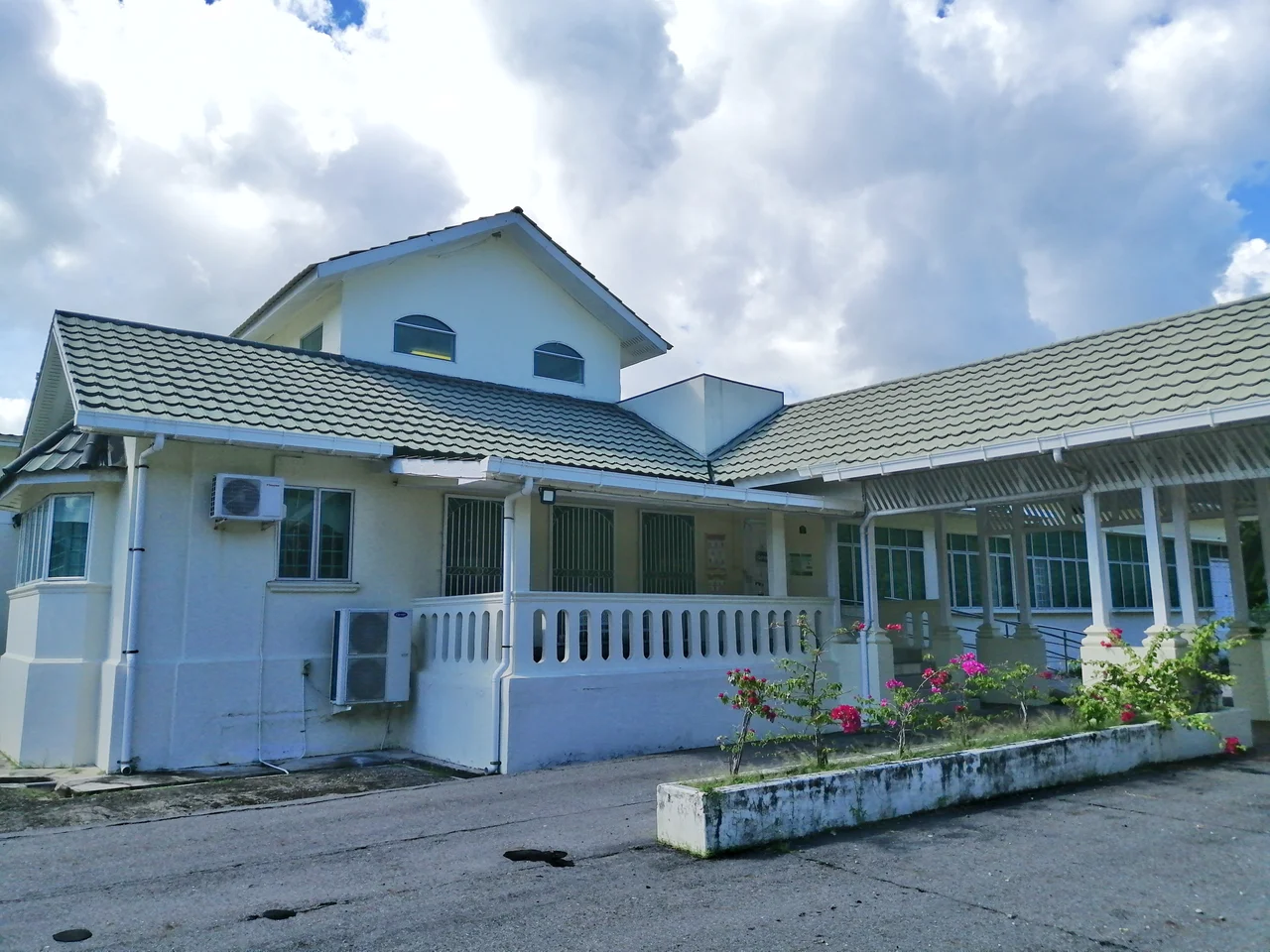
The first local man to live in the building was Pengiran Abu Bakar, appointed Deputy British Resident at a time when Brunei was still a protectorate and the real power in the district sat behind a desk in this very house. The six-acre compound at Jalan Maulana in Kuala Belait was built in 1938, its architecture a deliberate negotiation between two worlds -- traditional Malay rooflines of belah bumbung and potong limas set atop a structure whose floor plan and proportions spoke unmistakably of the British Colonial Office. For more than half a century, the building served whoever governed Belait District. Then, in 2016, it stopped housing administrators and started housing their history.
Two Rooflines, One Building
The architecture of the Belait District Museum tells its story before any gallery does. Spread across six acres of manicured grounds, the building blends Malay and colonial design in a way that was common across British Southeast Asia but rare in Brunei, where the protectorate's small size meant fewer administrative buildings of this scale. The belah bumbung roof -- a gabled form traditional to Malay houses -- sits alongside the potong limas style, a hip roof adapted from Javanese and wider Austronesian traditions. Below these distinctly local rooflines, the rooms follow the symmetrical, high-ceilinged layout favored by British colonial architects designing for tropical heat: tall windows for cross-ventilation, covered verandas for shade, and a banqueting hall large enough to receive a sultan. When Sultan Hassanal Bolkiah visited the district on his birthday, it was this hall that hosted the occasion.
The District Officers' House
From 1938 until 1990, the building served as the official residence of whoever administered Belait District. First it housed the Deputy British Resident -- the colonial officer responsible for advising the local sultan on all matters of governance, a polite formulation for a role that often amounted to running the district outright. The residential system, imposed under the Supplementary Protectorate Agreement of 1906, gave these British officers effective executive control over Brunei's affairs. After independence in 1984, the building continued as the residence of Belait District Officers under the new sovereign government. By the time the last officer moved out in 1990, the house had witnessed the discovery of oil in nearby Seria, the Japanese occupation and its aftermath, the country's transition to self-governance, and full independence. Every major chapter of modern Belait history had passed through its doors.
Five Galleries, One Story
The building was renovated in 2011 and opened as a museum on 23 July 2016, overseen by the Museums Department under Brunei's Ministry of Culture, Youth and Sports. In 2006, it had already been designated a historical monument under the Antiquities and Treasure Trove Act of 1967, protecting it from demolition or alteration. Today it houses five galleries, four permanent and one rotating. The Cultural Heritage gallery, or Galeri Warisan Budaya, displays the material culture of Belait's indigenous communities. The History of Administration gallery traces the district's governance from the sultanate through British residency to independence. The Oil and Gas Industry gallery tells the story that defines modern Belait -- the discovery at Seria in 1929, the wells that still produce, and the petroleum economy that transformed Brunei from an impoverished protectorate into one of the world's wealthiest states per capita. The Natural Heritage gallery catalogs the forests and wildlife that somehow survived alongside the extraction that made everything else possible.
Oil Country's Quiet Archive
Kuala Belait exists because of oil. The town sits at the western end of Brunei's narrow coastal strip, close to the Seria oil fields that have pumped crude since 1929. Most visitors to Belait District come for the petroleum industry -- the Shell compounds, the offshore platforms visible from the coast, the infrastructure that sustains a nation's prosperity. The museum offers something different: a chance to understand what Belait was before the oil and what it preserved alongside the drilling. The temporary exhibitions gallery rotates shows that connect local themes to broader narratives, while the permanent collections ground the district's identity in something older than the wells. It is a modest institution in a modest town, housed in a building that was never designed to be a museum but has aged into the role with something like grace. The administrators who once lived here made decisions that shaped the district. Now the district shapes how their era is remembered.
From the Air
Located at 4.589N, 114.191E in Kuala Belait, at the western end of Brunei's coastal strip near the Malaysian border. The museum compound at Jalan Maulana sits within the town center, identifiable from low altitude by its distinctive traditional Malay rooflines amid more modern structures. Kuala Belait is adjacent to the Seria oil fields visible along the coast. Nearest airport: Anduki Airfield in Seria, approximately 15 km east. Brunei International Airport (WBSB) is about 100 km to the northeast. Recommended viewing altitude: 2,000-3,000 feet for the town layout; higher for context showing proximity to Seria oil infrastructure.
Nearby Stories
- The Grand Old Lady of Canada Hill 9.7 km away
- The Black Lake and the White Crocodile 11 km away
- The Billion-Dollar Playground That Michael Jackson Opened 25 km away
- Sarawak Chamber 47 km away
- BRIDEX: Brunei's Window on the World's Arsenals 84 km away
- Similajau National Park 114 km away
- Luconia Shoals 156 km away
- Crown Colony of Sarawak 225 km away