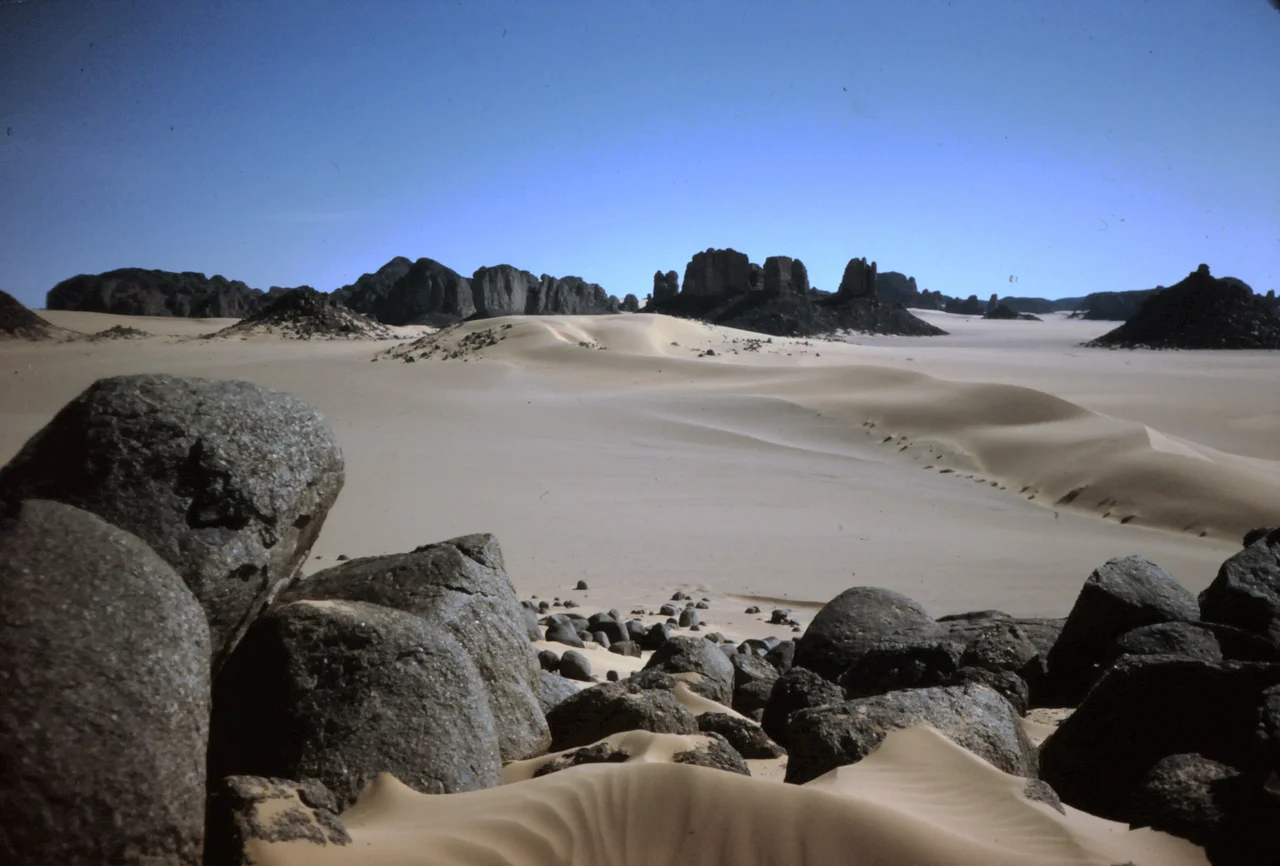

Tassili n'Ajjer
Its name means plateau of rivers, which is the first joke the Sahara plays on you here. The rivers are long gone. What remains at Tassili n'Ajjer is a labyrinth of sandstone - towers, columns, and arches eroded into what visitors have called a forest of stone - sprawling across more than 72,000 square kilometers of southeastern Algeria, near the borders of Libya and Niger. On the walls of that stone forest, ancient peoples left one of the densest concentrations of prehistoric art on the planet: some 15,000 engravings and paintings recording crocodiles, elephants, cattle herds, dancers, hunters, and gods. UNESCO listed it as a World Heritage Site in 1982. To walk through it is to read ten thousand years of human imagination written directly onto the rock.
A Forest Made of Stone
The plateau is built almost entirely of sandstone, its surfaces darkened by desert varnish - a thin skin of metallic oxides that stains the rock from dull red to near-black. The shapes are the work of unimaginable time. The story begins with the Tuareg Shield, an ancient block of African crust; over hundreds of millions of years the region was buried under sea, locked beneath an Ordovician ice sheet, then slowly lifted as the shield arched upward. Rivers, when the climate allowed, sawed channels up to 400 meters deep into the layered sandstone, and erosion did the rest, leaving behind the columns and natural arches that give Tassili its otherworldly skyline. One living creature still ties the present to that deep past: the aoudad, or Barbary sheep, the only animal depicted in the ancient art that survives in the region today.
Ten Thousand Years of Painters
Archaeologists sort Tassili's art into five broad traditions, each a window onto a different age. The Archaic period, from roughly 10,000 to 7500 BCE, is mostly engravings of the great wild animals of the early Holocene, often caught in hunting scenes. The Round Head Period that followed produced something stranger and more haunting - towering painted figures with round, featureless heads and weightless bodies that seem to float on the rock. Some are among the oldest and largest rock paintings in Africa, one human figure standing over five meters tall, others reaching some 13 feet. Then come the Bovidian or Pastoral herders with their cattle, the Horse period, and finally the Camel period from around 1000 BCE - the camel's arrival marking the rise of the trans-Saharan caravan trade that would carry salt, goods, and, in its darker chapters, enslaved people across the desert. The timeline is always being redrawn as dating methods improve, but the throughline is constant: people lived here, and they could not stop making images.
Goddesses, Giants, and Mushrooms
Certain figures at Tassili have become famous far beyond archaeology. At Sefar looms a painting Henri Lhote named the Great God of Sefar - a figure about three and a half meters tall, approached by smaller women with raised hands, its scale alone suggesting a being of enormous importance. From the same Round Head era comes the Running Horned Woman, captured mid-stride with horns on her head and dots across her body that may represent ritual scarification; she wears armbands, a skirt, and anklets, and scholars such as Arisika Razak have read her as an early image of an African sacred feminine. The art has also fueled wilder theories. In 1989 the researcher Giorgio Samorini argued that mushroom-like figures painted here record an ancient relationship between Saharan peoples and psychedelics, an idea later popularized by Terence McKenna. Other specialists are skeptical, but the debate captures something true: these images are strange, deliberate, and clearly charged with meaning we can only partly recover.
The Last Cypresses
Tassili is not only an archive of the dead. In its higher eastern reaches grows one of the rarest and most remarkable trees on Earth: the Saharan cypress, Cupressus dupreziana, an endemic species clinging on in scattered open woodland. These trees are survivors in the most literal sense - among the longest-lived organisms anywhere, ranked alongside the bristlecone pines of the American West, some of them having stood for thousands of years on a plateau that has slowly turned to desert around them. They are living relics of the green Tassili that the painters knew. The plateau's cultural pull endures too: the Tuareg band Tinariwen recorded an album here and named it Tassili in 2011, and the great horned figure of Sefar still surfaces in modern art and storytelling. The rivers may be gone, but the plateau of rivers refuses to be forgotten.
From the Air
Tassili n'Ajjer occupies roughly 25.67 degrees north, 9.0 degrees east, a vast plateau in southeastern Algeria near the borders of Libya and Niger, covering more than 72,000 square kilometers. From the air it is dramatic and unmistakable: a high, dark sandstone tableland eroded into forests of columns, towers, and natural arches, its edges falling away to dune seas and the Illizi Basin. The gateway airfield is Djanet Inedbirene Airport (ICAO DAAJ) on the plateau's southern flank; Illizi Takhamalt Airport (DAAP) lies to the north. This is remote Saharan airspace with superb visibility most of the year, but expect extreme heat, the hazard of blowing dust and haboobs, and sharp terrain relief along the plateau escarpments. A higher viewing altitude reveals the full scale of the stone forest, while a lower pass picks out individual arches and the deep wadis cut into the sandstone.
Nearby Stories
- Takarkori 108 km away
- Uan Muhuggiag 129 km away
- Acacus Mountains 156 km away
- In Amenas Hostage Crisis 213 km away
- Garamantes 354 km away
- Béryl Incident 378 km away
- Hoggar Mountains 402 km away
- Reggane 827 km away