
Acacus Mountains
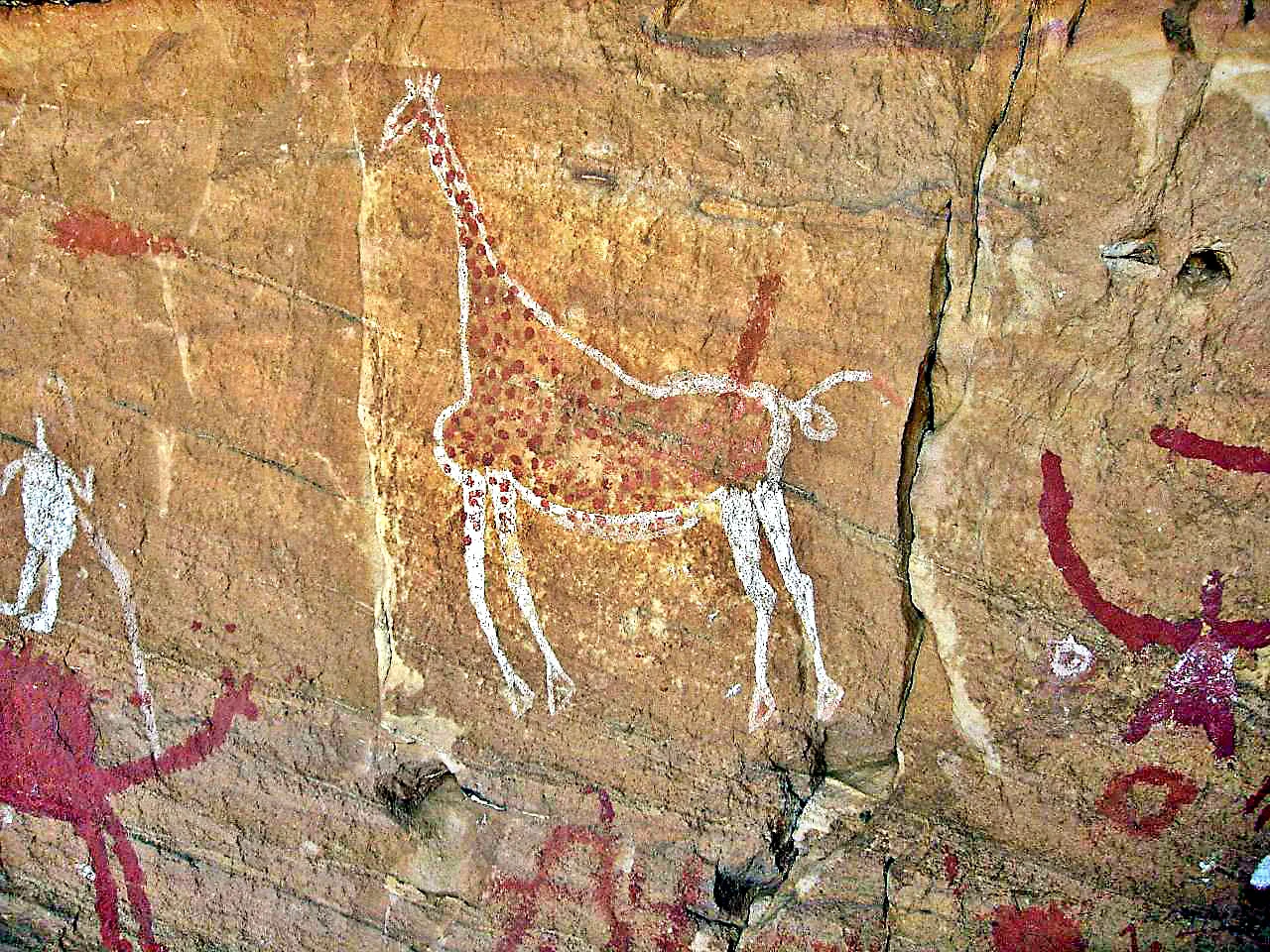
On a sandstone wall in the most arid stretch of the Libyan Sahara, a giraffe stands taller than a man, its long neck arching toward grasses that no longer exist. Elephants, ostriches, and herds of cattle crowd the same rocks. None of these animals could survive here now - there is barely a blade of grass for a hundred kilometers. Yet the people who painted them were not imagining. They were recording what they saw out their own doorways, in an age when this desert ran with water. The Tadrart Acacus, a chain of weathered peaks stretching north for about 100 kilometers from the Algerian border near the town of Ghat, holds one of the richest galleries of prehistoric art on Earth - a continuous human diary scratched and painted across roughly twelve thousand years.
A Green Sahara, Remembered in Stone
The paintings and carvings of the Acacus date from around 12,000 BCE to 100 CE, and they read like time-lapse footage of a vanishing world. The earliest images show the wild animals of a wet savanna. Later panels fill with cattle, herders, and scenes of daily life - people making music, dancing, going about ordinary days. This was the African Humid Period, when monsoon rains pushed deep into the Sahara and turned today's dunes into lakes and grassland. The art tracks the slow betrayal of that climate: as the rains retreated, the giraffes and elephants disappear from the walls, replaced by the hardy livestock of people learning to survive a drying land. UNESCO inscribed the Tadrart Acacus as a World Heritage Site in 1985, recognizing it as an irreplaceable record of how human beings adapted, again and again, to a world that would not hold still.
Twelve Thousand Years of Making a Living
Archaeologists divide the human story here into chapters. In the Early Acacus, roughly 9,810 to 8,880 years before present, small mobile bands camped beside lowland lakes. The Late Acacus that followed was drier; people gathered into larger, more settled groups in the valleys, grinding and storing wild grains with stones and pottery on a scale not seen before. Then, as the rains briefly returned, came the Pastoral Neolithic, when herders and their animals roamed a greener landscape once more. Crucially, the people of the Acacus never became farmers in the way the Nile Valley did. They fed themselves by herding and foraging - a flexible, mobile life suited to a fickle desert. The mountains also hold a quiet milestone in the human diet: residue on Acacus pottery preserves the earliest known evidence of processed milk, radiocarbon-dated to about 7,500 years ago. Somewhere on these slopes, someone first milked an animal and cooked with what they drew.
A Landscape Carved by Wind and Water
The Tadrart Acacus is more than its art. The range is a sculpture garden of natural stone - dunes that shift from gold to deep rust, narrow gorges, isolated towers, and the deep dry wadis that once carried rivers. Wind and ancient water have hollowed great arches through the rock; the spans of Afzejare and Tin Khlega are among the most striking. Even now, in one of the harshest places in the Sahara, life persists. Hardy plants such as the medicinal Calotropis procera cling to the wadis, and scattered springs and wells still surface in the mountains - the last threads of the water that once made this a place worth painting.
A Heritage Under Threat
Survival across twelve millennia does not guarantee survival now. During the long decades of Muammar Gaddafi's rule, from 1969 to 2011, Libya's Department of Antiquities was badly neglected, and the art grew vulnerable. From 2005, the hunt for oil brought seismic surveys whose shock waves rattled the very rocks that hold the paintings. Looting reached crisis levels, prompting UNESCO to warn that Libya's heritage was being looted by thieves and destroyed by developers. After the fall of Gaddafi, a UNESCO-backed project worth 2.26 million dollars - jointly supported by the Libyan and Italian governments - set out to train conservators and protect the sites. But conflict has taken its own toll. UNESCO reports documented that at least ten rock-art sites were deliberately and seriously damaged, with some panels reportedly attacked with sledgehammers and chemicals. Art that outlasted the disappearance of the rivers now depends on the fragile peace of the living.
From the Air
The Tadrart Acacus lies at roughly 24.83 degrees north, 10.33 degrees east, in the Ghat District of southwestern Libya, stretching about 100 km north from the Algerian frontier. From the air it reads as a band of dark, eroded sandstone peaks and rust-colored dunes rising from the surrounding desert plain, cut by deep wadis - watch for the natural arches and isolated towers. The nearest airfield is Ghat Airport (ICAO HLGT) just to the west; Djanet Inedbirene Airport (DAAJ) lies across the border in Algeria. This is remote, sparsely served airspace over open Sahara; expect excellent visibility but extreme heat, blowing dust during haboobs, and no significant terrain weather apart from occasional wave clouds over the ridges. Recommended viewing altitude is moderate, low enough to pick out the wadis and dune colors that define the range.
Nearby Stories
- Tassili n'Ajjer 103 km away
- Wadi Mathendous 146 km away
- Garamantes 278 km away
- Germa 311 km away
- In Amenas Hostage Crisis 347 km away
- Hoggar Mountains 462 km away
- Tamanrasset 534 km away
- Senussi Campaign 1430 km away