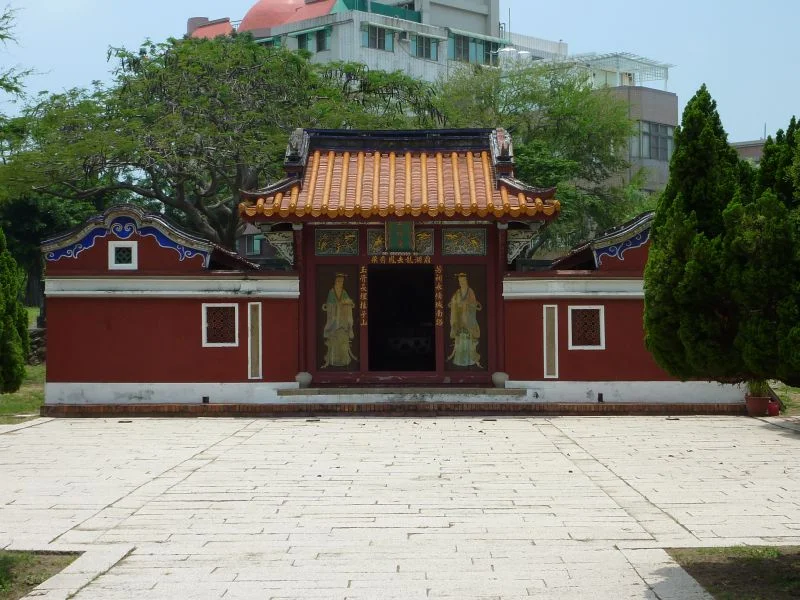

Temple of the Five Concubines
Five women are buried here, in the middle of a dense residential neighborhood in Tainan, because of a decision they made in 1683. Their names were Lady Yuan, Lady Wang, Xiugu, Sister Mei, and Sister He — the consorts of Zhu Shugui, the Ming Prince of Ningjing, who had held out on Taiwan as the last significant remnant of the Ming Dynasty after the Qing conquered mainland China. When Qing forces defeated the Kingdom of Tungning and Zhu Shugui took his own life, the five women chose to die rather than face what lay ahead under a conqueror's rule. A temple was built at their tomb. It is still there.
The End of the Last Ming Court
By 1683, Taiwan was one of the last places where the Ming Dynasty still existed in any meaningful sense. After the Qing conquest of mainland China, various Ming loyalists had retreated to the island, among them Zhu Shugui, the Prince of Ningjing, who maintained a court in exile in what is now Tainan. His household included Lady Yuan, Lady Wang, Xiugu, Sister Mei, and Sister He — five women who had accompanied him into this final refuge.
In 1683, Qing naval forces crossed the Taiwan Strait and defeated the Kingdom of Tungning, the Ming loyalist state that had controlled Taiwan since the 1660s. With defeat total and the dynasty he represented now truly finished, Zhu Shugui died by his own hand. His five consorts, facing the collapse of the world they had known and an uncertain future under Qing authority, made their own choice: to die rather than surrender to circumstances they had not consented to. Their full names were not recorded — what survives are the names they were known by at court.
Five Names, One Temple
The tomb was built, and then the temple was built in front of it. The Temple of the Five Concubines — also called the Temple of the Five Noble Ladies — became a place of veneration on Wufei Street in what is now West Central District, Tainan. It is a Taoist temple, and the five women are honored within it as figures deserving of reverence.
The Republic of China government has designated the temple a national historic monument under the country's Cultural Heritage Preservation Act, which is the highest level of heritage protection available under Taiwanese law. The designation recognizes not just the architectural significance of the structure but the historical weight of what it memorializes — the end of the Ming era in Taiwan, told through the story of five specific women whose names survived even when so much else was lost.
A Temple in a Living City
The neighborhood around the Temple of the Five Concubines has grown dense over the three and a half centuries since 1683. Tainan's West Central District is a compact urban grid of temples, old commercial buildings, Japanese colonial structures, and ordinary residential streets — a place where historical sites sit at ground level, accessible and embedded in daily life rather than fenced off or elevated.
The temple itself is not large. It occupies a modest plot on Wufei Street, its traditional architecture distinguishing it from the surrounding buildings without overwhelming them. Visitors come here as they come to other temples in Tainan — some to pray, some to observe, some drawn by the specific history the place carries. The temple remains an active religious site, not merely a preserved relic.
What Remembrance Looks Like
Three hundred and forty years is a long time to be remembered. What keeps these five women present is not dramatic commemoration — no large plaza, no sweeping monument — but the persistence of the temple itself, maintained and visited across centuries of political change: Ming to Qing, Qing to Japanese colonial rule, Japanese rule to the Republic of China. Each regime passed over this ground, and the temple remained.
The story of Lady Yuan, Lady Wang, Xiugu, Sister Mei, and Sister He is a story about the end of things — the end of a dynasty, the end of an era, the end of five particular lives. It is also a story about what a community decides to preserve when it could easily have let something disappear. This temple in Tainan is the answer to that question: these five women mattered to the people who lived here, and still do.
From the Air
The Temple of the Five Concubines is located at approximately 22.982°N, 120.205°E on Wufei Street in West Central District, Tainan. From the air, the area is a dense urban block roughly 1 km south of the Tainan Judicial Museum and 2 km from Tainan Railway Station. The nearest major airport is RCKH (Kaohsiung International), approximately 25 km to the southwest; RCNN (Tainan Airport) is the closer regional option, around 6 km to the north. Best observed at lower altitudes in clear conditions — the traditional temple roofline is identifiable among the surrounding urban fabric.
Nearby Stories
- Chung Li-ho Museum 0.7 km away
- Jingzaijiao Tile-paved Salt Fields 8 km away
- Wanchin Basilica of the Immaculate Conception 9.3 km away
- Namasia District 16 km away
- Battle of Penghu 21 km away
- Shoushan (Kaohsiung) 21 km away
- Penghu Air Raids 62 km away
- Daya Bay 512 km away