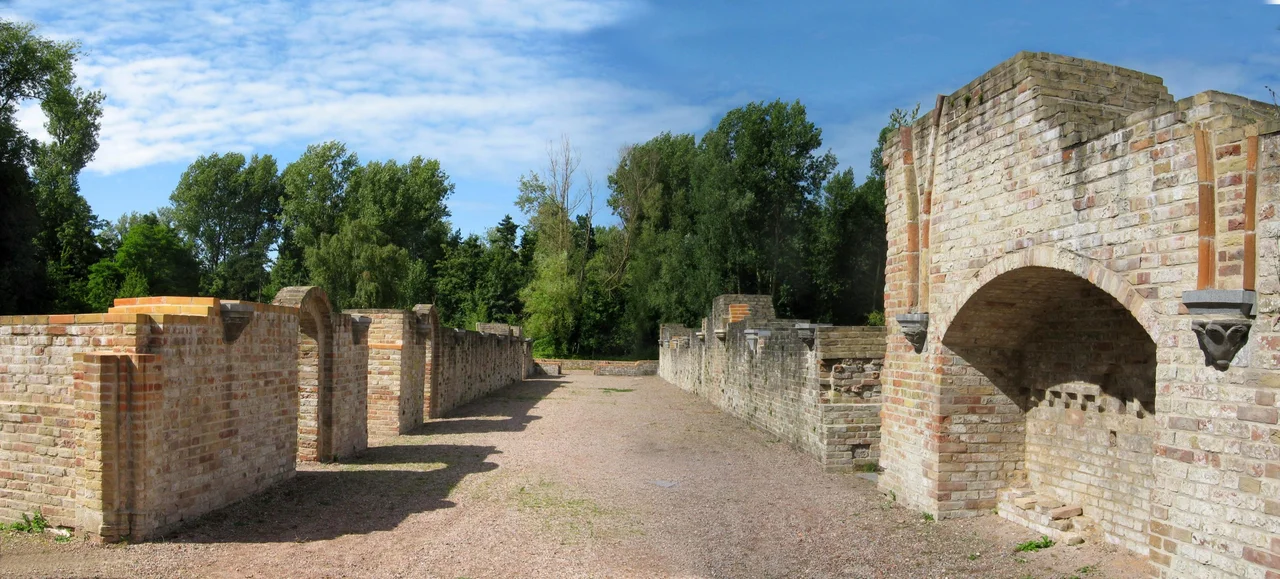

Ten Duinen Abbey
A hermit named Ligerius came to the dunes north of Koksijde in 1107 and built himself a cell among the marram grass and the wind. By the time he died, monks had gathered around him. Within a century the place was running a wool empire that reached England. Within four centuries it housed four hundred monks in a complex so large you could lose yourself in its cloisters for a day. And within five centuries the sand had eaten most of it.
The ruins you can walk today at the Abdijmuseum are about a tenth of what once stood here. The rest is still out there under the dunes, surfacing in spring storms, slowly being dug back into daylight by a century of excavations.
Sheep and Reclamation
Ligerius's community took the Rule of Saint Benedict in 1120 and affiliated to the Cistercian Order in 1139. The Cistercians were the medieval economy's most aggressive agricultural engineers - they turned marginal land into cash through systematic drainage, sheep husbandry, and meticulous estate management - and Ten Duinen, the Abbey of the Dunes, took to the work with extraordinary success. The dunes were not the obvious place to farm. They were also free, in the sense that no feudal lord wanted them. So the lay brothers built dykes and dug drainage ditches and reclaimed polders from the salt marshes inland, and on the higher ground they ran enormous flocks of sheep. The wool went to the cloth towns of Bruges and Ypres and from there to all of Europe. The abbey opened a daughter house in Eastchurch on the Isle of Sheppey in Kent to manage the English wool export trade directly. A second daughter abbey, Ter Doest near Bruges, became almost as rich as the mother house.
Four Hundred Monks
New monastic buildings were begun in 1214 and finished in 1237 to house a community that had grown to approximately four hundred monks and lay brothers - the same scale as Cluny in its prime. The new abbey church was consecrated on 13 October 1262 by the bishops of Thérouanne and Tournai. The complex covered a footprint comparable to a small town: church, cloister, chapter house, refectory, dormitories, infirmary, guesthouse, brewhouse, granary, workshops, abbatial residence, and the gardens and fish ponds that fed all of it. Archaeology has revealed underfloor heating in some rooms, glazed tile floors, and stone-vaulted cellars deep enough to keep wine through a Flemish summer. This was not the austere wooden cell of Ligerius's day. It was a city of prayer financed by sheep.
The Iconoclasts
What ruined Ten Duinen was the Reformation. In August 1566 the Beeldenstorm - the iconoclastic fury - swept across the Low Countries, and Protestant crowds smashed their way through Catholic churches breaking statues and stained glass and stripping altars. Ten Duinen was vandalised. Twelve years later, in 1578, Calvinist rebel forces sacked the monastery outright during the Dutch Revolt and scattered the community. The monks regrouped in 1583 and tried to maintain the site through decades of war and instability, but the dunes were no longer defensible. In 1627 the community formally relocated to Bruges, settling into the refugium that had been Ter Doest's town house. The buildings out at Koksijde were abandoned to the wind.
Buried by the Sea
The dunes do not stay still. They move in slow lateral waves driven by the North Sea wind, and over the late sixteenth and seventeenth centuries they migrated south-east across the empty abbey site, burying first the outer walls, then the cloister, then the church, until by 1700 there was almost nothing visible above the sand except some fragments of the highest masonry. By the time the French Revolutionary government formally suppressed the Bruges branch of the order on 9 April 1796 and confiscated its goods, the original Koksijde site had become a hill of grass and rabbit warrens. Local people knew there were stones under there. No one bothered to dig them out for another century.
Out of the Sand
Excavations began in 1897, picked up again seriously in 1955, and reached full archaeological intensity in 1987-88. What emerged was the most complete medieval Cistercian abbey complex anywhere in northern Europe still in its original position - because the dunes that buried it also preserved it, freezing the foundations and pavements and drainage channels exactly as the monks had left them. The Abdijmuseum on the site now displays the ruins beneath open sky, with interpretive walkways that let you trace the church's nave, the cloister garth, the chapter house, the abbot's lodging. A reconstructed model in the museum building shows the whole abbey as it stood in 1300. Walk the outlines on the sand and you understand the scale only when you realise that what survives above ground is the cellar level - everything in the upper stories is gone, blown out into the North Sea four hundred years ago. The monks moved on to Bruges and eventually disappeared into the Bruges seminary that still occupies their last building, on Potterierei. The dunes kept the bones of their first home.
From the Air
Abbey ruins at 51.11°N, 2.63°E, in the dunes immediately south of Koksijde and about 1.5 km inland from the North Sea coast. Visible from 1,500-3,000 feet as a cleared rectangular footprint among the surrounding dune system, with the modern Abdijmuseum building beside it. The Belgian coast unrolls north - De Panne to the west, Nieuwpoort to the east - and the long beaches are unmistakable. Nearest airfields: Ostend-Bruges (EBOS) 25 km north-east, Calais-Dunkerque (LFAC) 50 km south-west, Wevelgem (EBKT) 65 km south-east. Approach from the sea side at low altitude to see how the ruins sit in the dune corridor between coast and polders.
Nearby Stories
- Port of Zeebrugge 3 km away
- 1921 SNETA Farman Goliath ditching 4.5 km away
- 1382 Dover Straits Earthquake 7.7 km away
- HMS Wakeful (H88) 8.2 km away
- Battle of Mouscron 8.4 km away
- Battle of Cassel (1677) 10 km away
- 1933 Imperial Airways Ruysselede Crash 12 km away
- Boulonnais 26 km away