
Teruel Airport
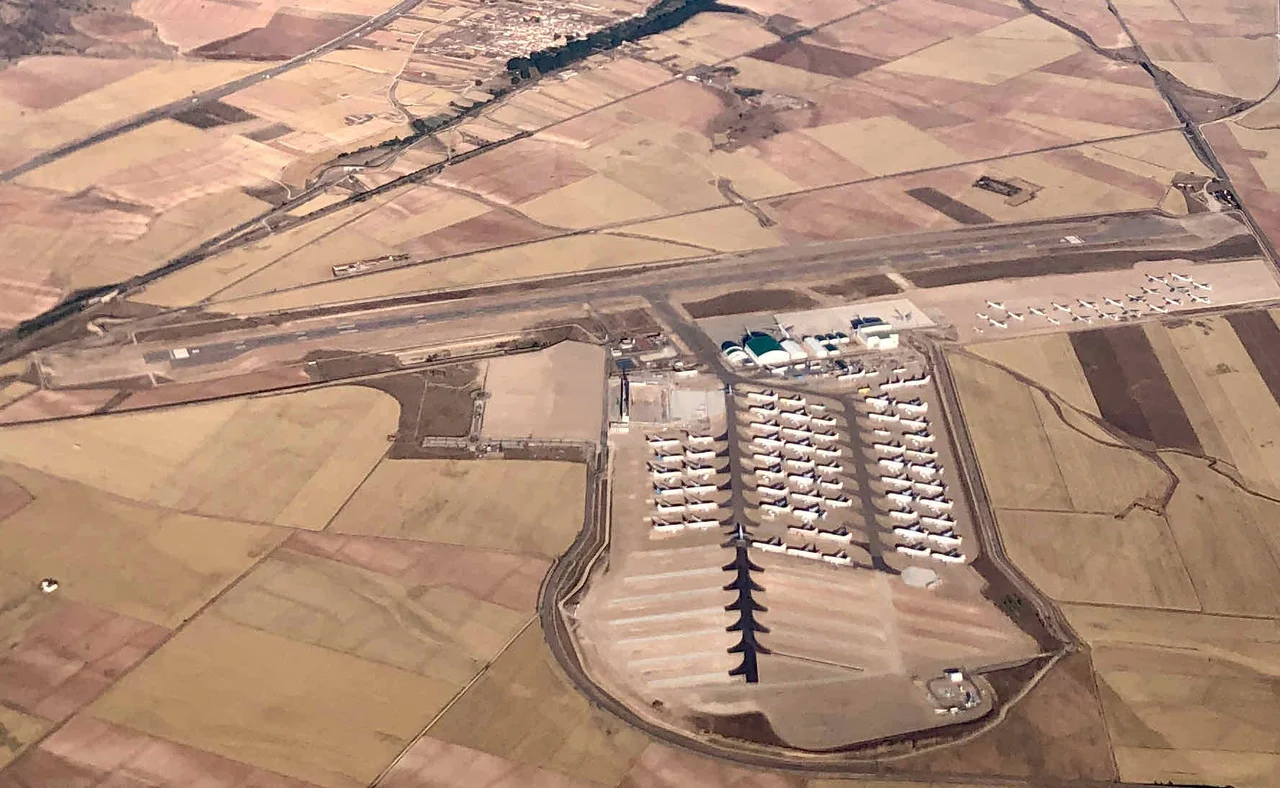
During the worst of the pandemic, roughly a hundred airliners sat parked on a high plateau in Aragon, engines sealed against the dust, windows taped over, waiting out a world that had stopped flying. This is Teruel Airport, and storing idle jets is what it does best. There are no departure boards here, no queues, no passengers at all. Instead there are rows of widebody aircraft stretched across the apron - some resting between contracts, others quietly being taken apart - beneath one of the driest, clearest skies in western Europe.
A Field Built for Dry Air
Aircraft corrode in damp, salty coastal air. Teruel offers the opposite: a high inland plateau and a climate so dry that the decay of aluminum, rubber, and wiring slows to a crawl. That arid stillness is the airport's whole reason for being, and it is why airlines ship planes here to ride out downturns rather than bleed money at busy hubs. The site can hold as many as 250 aircraft. Under its commercial name, PLATA - short for Plataforma Aeroportuaria-Teruel - it has become a favored European parking lot for jets between one life and the next.
From Airbase to Boneyard
The runway began its life as a military airbase. Spain's aviation regulator, AESA, certified the reworked site for public use in February 2013 and cleared it for air operations a few weeks later. Unusually for a Spanish airport, it does not belong to Aena, the national operator; it is owned instead by a consortium of the Government of Aragon and the Teruel City Council, and run for storage and maintenance by the firm Tarmac Aerosave. A control tower, a bare-bones terminal, and a rescue-and-firefighting station serve a field that will never board a single holidaymaker.
Where Jets Are Undressed
Three great hangars handle heavy maintenance and the careful business of dismantling - the oldest sized for the Boeing 747, the newest for the Airbus A340. A retired airliner is rarely just scrapped. Its engines, avionics, landing gear, and thousands of certified components are removed, catalogued, and sold on to keep other aircraft in the sky. A machine that once crossed oceans becomes a reservoir of spare hearts and limbs for its still-flying siblings. The Americans call such places boneyards, and the word settles easily over Teruel.
Rockets on the Runway's Edge
In August 2018 the airport took on an unlikely tenant. PLD Space, a Spanish launch company, signed a concession for a corner of the field - about 13,337 square meters - to test rocket propulsion. The agreement ran twenty-five years, with an optional decade more, and the firm planned to spend a million euros on a control room, offices, a rocket-engine hangar, and a new test bench for its Miura 1 rocket. It had already been firing engines here on short-term contracts for three years. The same dry emptiness that preserves airliners, it turns out, makes a fine place to light a rocket.
Two Futures on One Tarmac
There is a strange poetry to the place. On one side of the field, aircraft that have finished flying settle into a long, sunlit retirement or surrender their parts so that others can carry on. On the other, machines built to leave the atmosphere altogether are strapped down and made to roar. Endings and beginnings share a single stretch of Aragonese concrete, watched over by the same enormous, cloudless sky. Few airports hold both the past and the future of flight quite so plainly in view.
From the Air
Teruel Airport (ICAO LETL) lies at roughly 40.41°N, 1.22°W, on the plateau just west of Teruel city. Long rows of stored widebody jets make it one of the most recognizable fields from the air in all of Spain - unmistakable even from cruise altitude on a clear day. This is a working maintenance, storage, and test facility with no scheduled passenger service, so coordinate with the field for any operations. Valencia (LEVC) sits about 130 km southeast toward the coast and Alicante-Elche (LEAL) farther south. Expect excellent visibility most of the year over this dry, high-elevation basin.
Nearby Stories
- Penyagolosa 33 km away
- Rock Art of the Iberian Mediterranean Basin 36 km away
- Serra Calderona 43 km away
- Cuenca Cathedral 43 km away
- Morella 51 km away
- Castle of Alarcon 65 km away
- Battle of Belchite (1937) 87 km away
- Castle of Gormaz 144 km away