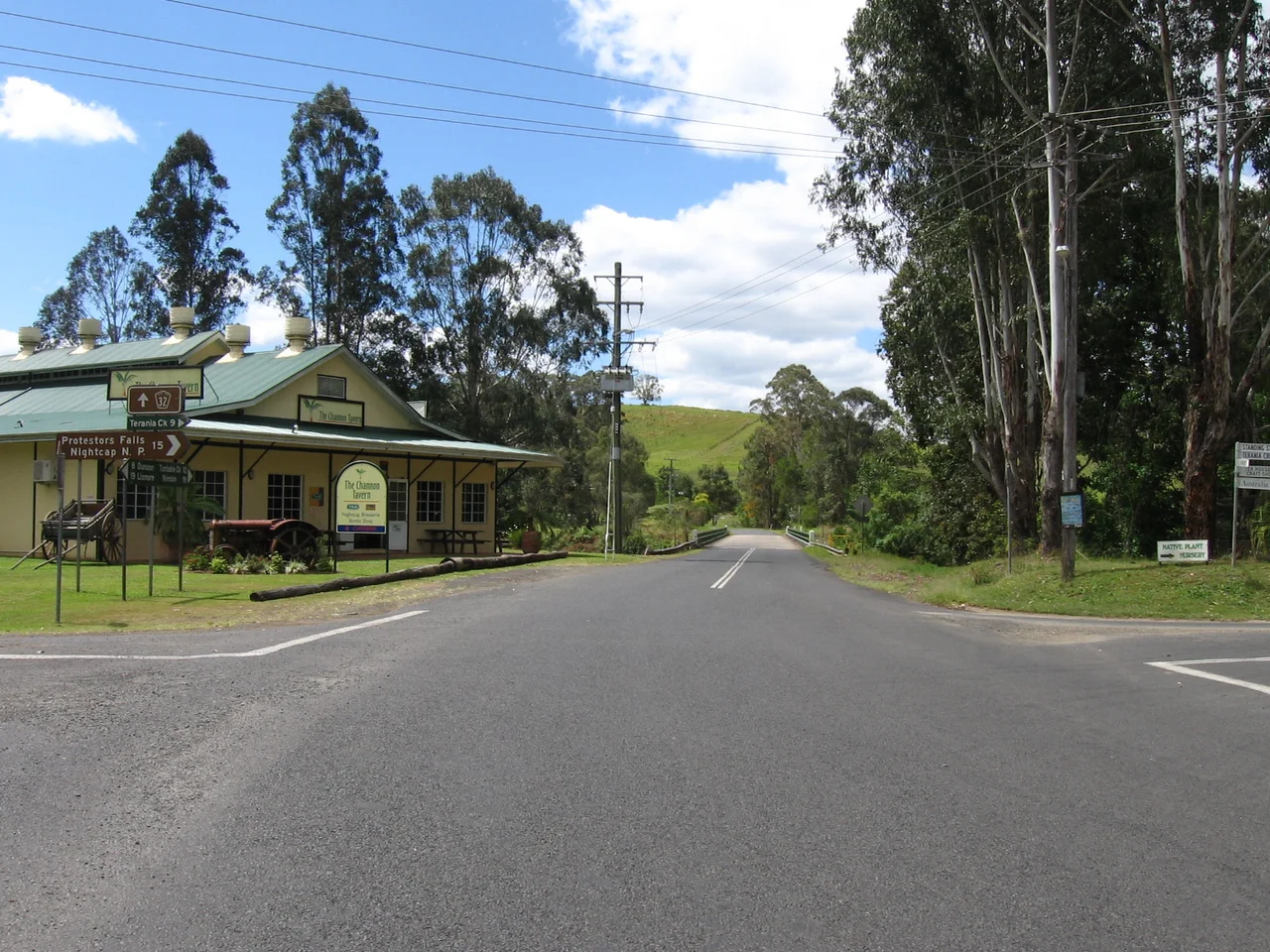

The Channon
Once a month, on the second Sunday, a village of a few hundred people swells with thousands. They come for the Channon Craft Market, a sprawl of stalls, buskers and food set out beneath the trees of Coronation Park - one of the oldest and largest markets of its kind in Australia, running continuously since 1976. But the market is more than a country fair. It was at gatherings like this one, among the alternative settlers who flocked to these green valleys in the 1970s, that an army was raised to stand in front of the bulldozers and save a rainforest. The Channon is small. Its influence on how Australia protects wild country is not.
Country Before the Cutters
The ridges and valleys around Terania and Tuntable Creeks are the country of the Widjabal, a portion of the wider Bundjalung nation and the traditional owners of this land. They knew the rainforest intimately. One traditional food was the seed of the burrawang, a cycad abundant in the area, known as djaning - toxic raw, but made safe through patient, extensive washing. It is thought the very name The Channon may derive from this Aboriginal word. A cave in the Terania Creek basin was a sacred men's site, and other sites lie scattered through the valley. Much of their deeper meaning was never written down: as one account records, the elders hold knowledge that their law forbids them to pass to the uninitiated, and so some of the valley's oldest stories remain, by design, untold.
Cedar, Cream and a Butter Factory
European history here began with the cedar getters who pushed up the Richmond River system from the 1840s, allowed to log but not to settle. The first permanent settlers arrived in the 1880s and after, clearing the forest and turning to dairying. For decades cream was the district's lifeblood, carted to Lismore until a local butter factory opened with great ceremony in 1913 - reportedly reached by one of the first motor cars ever to make the journey from the coast. The settlement had begun as Roach's Mill, then Terania, before officially becoming The Channon in 1908. The butter factory ran until 1946, when better roads made small local plants uneconomic. The building survived, though: sold off, used as a council depot, and finally reborn in 1991 as the village tavern it remains today.
The New Settlers
By the early 1970s, the dairy industry was in decline and land was cheap - and that drew a very different kind of arrival. In the wake of the 1973 Aquarius Festival in nearby Nimbin, seekers of alternative lifestyles poured into the area, establishing multiple-occupancy communities in the hills around The Channon. They came for self-sufficiency and a gentler way of living, and the landscape they found became the thing they would fight hardest to defend. Permaculture and organic farms, macadamia and coffee plantations and intentional communities still define the local economy. This blend of old dairy country and new countercultural energy gave The Channon a character all its own - and set the stage for the confrontation that would make its name.
The Battle of Terania Creek
In 1979, loggers came for the rainforest at Terania Creek. The new settlers refused to let them in. What followed was a month-long blockade - one of the first direct-action environmental protests of its kind in Australia - as locals appealed to the crowds at the Channon market and quickly mustered hundreds of people to put their bodies between the chainsaws and the trees. The confrontation gripped the nation. It pressured the New South Wales government to halt commercial logging in the wet rainforests and led ultimately to the creation of Nightcap National Park, declared in 1983. Historians have called Terania Creek the birth of modern Australian environmental activism. A handful of villagers, organising at a craft market, helped change a state's forests forever.
Gateway to the Rainforest
Today The Channon keeps the quiet rhythm of a hinterland village - a public school dating from 1922, war memorial gates honouring the local men who served in two world wars, a single general store, and Coronation Park at its heart. Like neighbouring Nimbin, it serves as a gateway to the rainforests of Nightcap National Park, the very wilderness its residents fought to protect. The famous market still fills the park on the second Sunday of every month, and an annual outdoor opera has been staged in the same green oval. To visit is to see a place that is both deeply ordinary and quietly historic: a small village that, when it mattered most, stood up and would not move.
From the Air
The Channon lies at roughly 28.67 degrees south, 153.28 degrees east, about 18 km northwest of Lismore in the Northern Rivers hinterland of New South Wales. From the air it appears as a small cluster of buildings in the steep, forested valleys of Terania and Tuntable Creeks, with the dark green canopy of Nightcap National Park rising to the north and northwest. The surrounding patchwork of farmland, macadamia and coffee plantations and rainforest gullies is the key visual reference. The nearest commercial airport is Ballina Byron Gateway Airport (YBNA), about an hour to the southeast; Lismore Airport (YLIS) sits about 25 km south, and Gold Coast Airport (YBCG) is roughly 90 minutes north. Best viewed in clear morning light; valley fog and low cloud are common over the ranges after rain.
Nearby Stories
- Uki, New South Wales 14 km away
- History of New Italy, New South Wales 23 km away
- Spicers Gap Road 67 km away
- Washpool National Park 70 km away
- Bald Rock National Park 87 km away
- HMS Porpoise (1799) 712 km away
- Wreck Reefs 742 km away
- SS Elingamite: Gold, Fog, and a Captain Wrongly Blamed 1801 km away